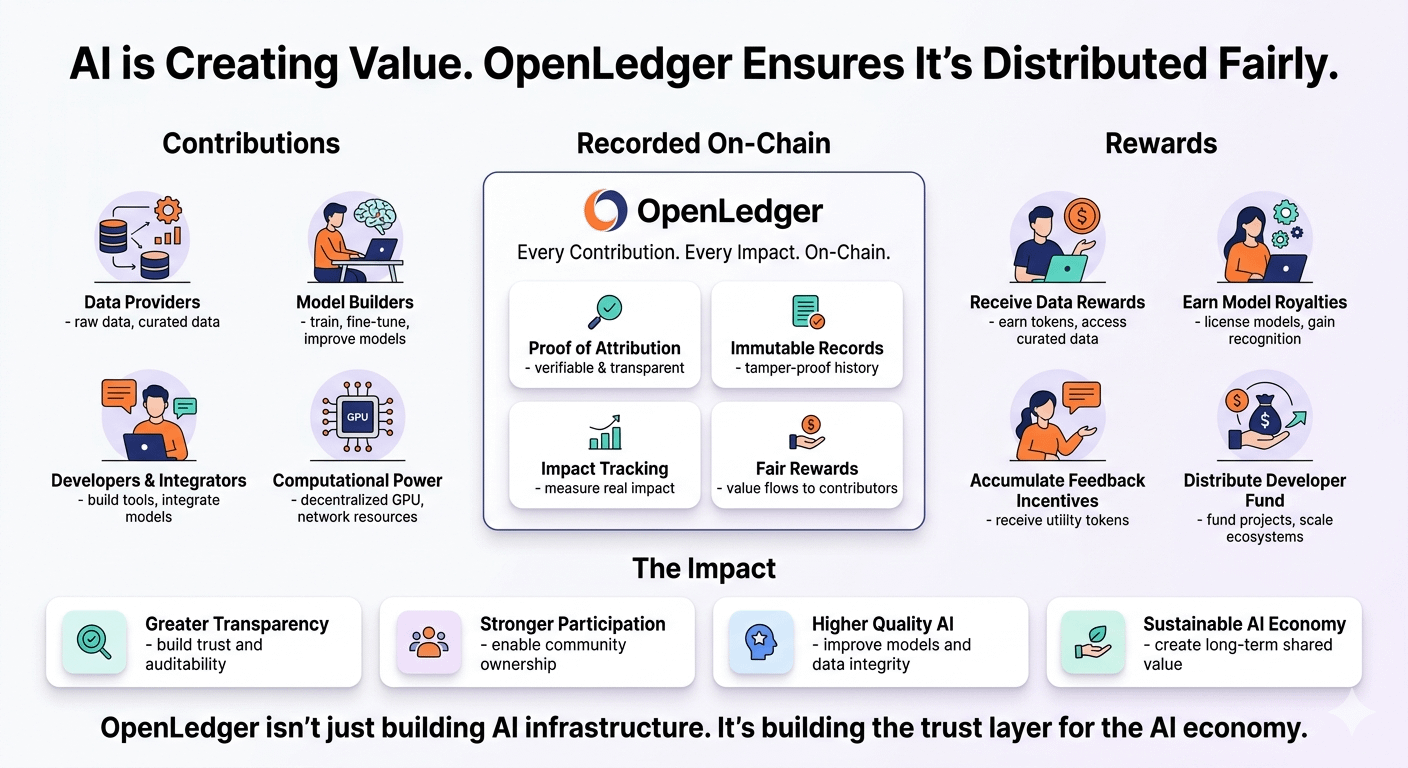
I'll be honest. When I first heard about OpenLedger, I assumed it was another attempt to attach a blockchain to artificial intelligence and call it innovation. The industry has produced enough grand narratives over the last few years that skepticism has become a default reaction. Every project claims to be building the future. Every protocol promises a more open, fair, and decentralized world. Most of them end up repeating familiar ideas with slightly different terminology.
But after spending time trying to understand what OpenLedger is actually attempting to build, I found myself becoming interested for a different reason. Not because it promises better AI. Not because it introduces another token economy. What caught my attention was the problem hiding underneath the technology.
The more AI advances, the more valuable data becomes. Yet the people generating that data rarely have any meaningful relationship with the value that emerges from it.
That disconnect feels increasingly strange.
Every day, millions of individuals contribute information, expertise, preferences, feedback, conversations, and countless other forms of digital labor. Collectively, these contributions become the raw material from which modern intelligence systems are built. Yet once that intelligence becomes useful, the economic rewards often flow toward a relatively small number of centralized entities. The contributors become invisible. Their role dissolves into the background.
For a long time, the industry has largely accepted this arrangement because there was no obvious alternative. Attribution at scale is difficult. Tracking influence across complex systems is difficult. Coordinating incentives among thousands or millions of participants is difficult.
OpenLedger seems to begin from a simple but surprisingly uncomfortable question: what if intelligence should remain connected to the people who helped create it?
That question sounds philosophical at first, but it quickly becomes economic.
Most discussions around AI focus on models. Bigger models. Faster models. Smarter models. OpenLedger appears more interested in what happens around those models. Who contributes data? Who validates quality? Who builds applications? Who creates agents? Who should benefit when those systems generate value?
The project is essentially trying to build infrastructure for attribution.
Not attribution as a social gesture.
Attribution as an economic mechanism.
That distinction matters.
For decades, the internet became exceptionally good at distributing information. AI introduces a different challenge. It is no longer just about distributing information. It is about transforming information into intelligence. Once that transformation occurs, ownership becomes difficult to define.
A model trained on thousands of sources contains traces of countless contributors. An AI agent may generate useful outputs using knowledge derived from millions of interactions. Traditional concepts of ownership start to feel inadequate because intelligence itself becomes increasingly collective.
This is where OpenLedger becomes more interesting than its surface description suggests.
Rather than treating data as a disposable input, it attempts to create a system where contributions remain visible and economically relevant over time. The architecture is designed around the idea that value should not simply appear at the end of the process. It should be traceable back through the network that helped create it.
Whether this can be achieved perfectly is another question entirely.
In fact, one of the reasons I find the project compelling is because it openly confronts a problem that may not have a perfect solution.
Human knowledge is messy.
Ideas overlap.
Contributions blend together.
Innovation rarely emerges from a single source.
Most breakthroughs are the result of accumulated effort spread across countless people, communities, and institutions.
Trying to measure that process is incredibly difficult.
Yet ignoring it creates its own problems.
The current AI landscape often operates as though attribution is impossible, which conveniently justifies concentrating rewards in a small number of places. OpenLedger seems to reject that assumption. Instead of declaring attribution unsolvable, it treats attribution as infrastructure.
That may ultimately be the most important aspect of the project.
Not the technology itself.
The perspective behind it.
There is also something fascinating about the economic implications.
Many blockchain networks begin with a token and then spend years searching for genuine economic activity. OpenLedger appears to be attempting the opposite approach. The token is positioned as a coordination mechanism within a broader ecosystem of data providers, validators, model builders, and AI agents.
In theory, value enters the system when useful intelligence is produced and consumed. Rewards can then flow backward through the network toward those responsible for making that intelligence possible.
Of course, theory and reality are rarely identical.
The challenge is that attribution systems become more complex as they become more accurate. Governance becomes more complicated. Disputes become inevitable. Questions emerge around validation, manipulation, and incentive alignment. Every mechanism designed to create fairness introduces new opportunities for strategic behavior.
This is where many idealistic systems encounter friction.
OpenLedger is not immune to that reality.
No decentralized coordination system has fully solved the problem of balancing openness, efficiency, and fairness. In many cases, decentralization simply moves complexity into places where it becomes harder to see.
The question is not whether those challenges exist.
The question is whether they are worth confronting.
Personally, I think they are.
Because beneath all the discussions about AI infrastructure lies a deeper shift that is beginning to reshape the digital world.
For years, ownership on the internet was relatively straightforward. Platforms owned platforms. Users generated content. The relationship was imperfect but understandable.
AI changes that dynamic.
Intelligence is becoming a product of networks rather than individuals. Value emerges from interactions rather than isolated actions. Knowledge becomes increasingly collective, yet economic rewards often remain concentrated.
That tension feels unsustainable in the long run.
Projects like OpenLedger matter because they are attempting to explore what comes next. Not necessarily because they have found the answer, but because they are asking a question that the industry can no longer avoid.
Who owns intelligence when intelligence is created collectively?
The answer is unlikely to be simple. It probably won't emerge from a single protocol or a single breakthrough. It may take years of experimentation before meaningful solutions appear.
But I find myself appreciating OpenLedger for attempting to engage with the problem rather than working around it.
The project sits in an uncomfortable space between idealism and practicality. It wants fairness without sacrificing functionality. It wants decentralization without losing coordination. It wants attribution without creating impossible complexity.
Those are difficult goals. Maybe impossibly difficult.
Yet some of the most important infrastructure in history began as attempts to solve problems that appeared too complicated to solve.
Whether OpenLedger succeeds or fails is ultimately less interesting to me than what its existence reveals about the direction of technology itself.
We are moving toward a world where intelligence is no longer scarce. The harder question may become how we recognize, reward, and coordinate the countless contributions that make that intelligence possible.
And perhaps that is the real story here.
Not blockchain.
Not AI.
But the growing realization that ownership, attribution, and value are becoming inseparable questions in the age of machine intelligence.