


Six months ago, if someone had asked me which part of @OpenLedger would become most interesting, I probably wouldn't have mentioned the EVM Bridge. I would have talked about Proof of Attribution, Datanets, or the broader vision of creating an economy around AI. A bridge felt like infrastructure. Important, perhaps, but not something capable of changing the direction of a network. Ironically, the more I follow #OpenLedger , the more the bridge is becoming the piece I pay attention to most.
Part of that comes from how the conversation around it has changed. The EVM Bridge is no longer being discussed as a simple asset transfer tool. Increasingly, people inside the ecosystem are framing it as infrastructure for AI native applications, autonomous agents, and cross-chain execution. At first I thought that interpretation was a little ambitious. But the more I considered $OPEN long term vision, the harder it became to separate the bridge from the bigger story the protocol is trying to tell.
What keeps pulling me back is a question I don't see discussed often enough. Everyone talks about how intelligent AI systems will become. Everyone talks about larger models, faster inference, and better automation. But what happens when intelligence starts participating in economies rather than simply serving users? Not as software. Not as an assistant. As an actor capable of making decisions, coordinating resources, and interacting with markets. That feels like a very different future, and it requires very different infrastructure.
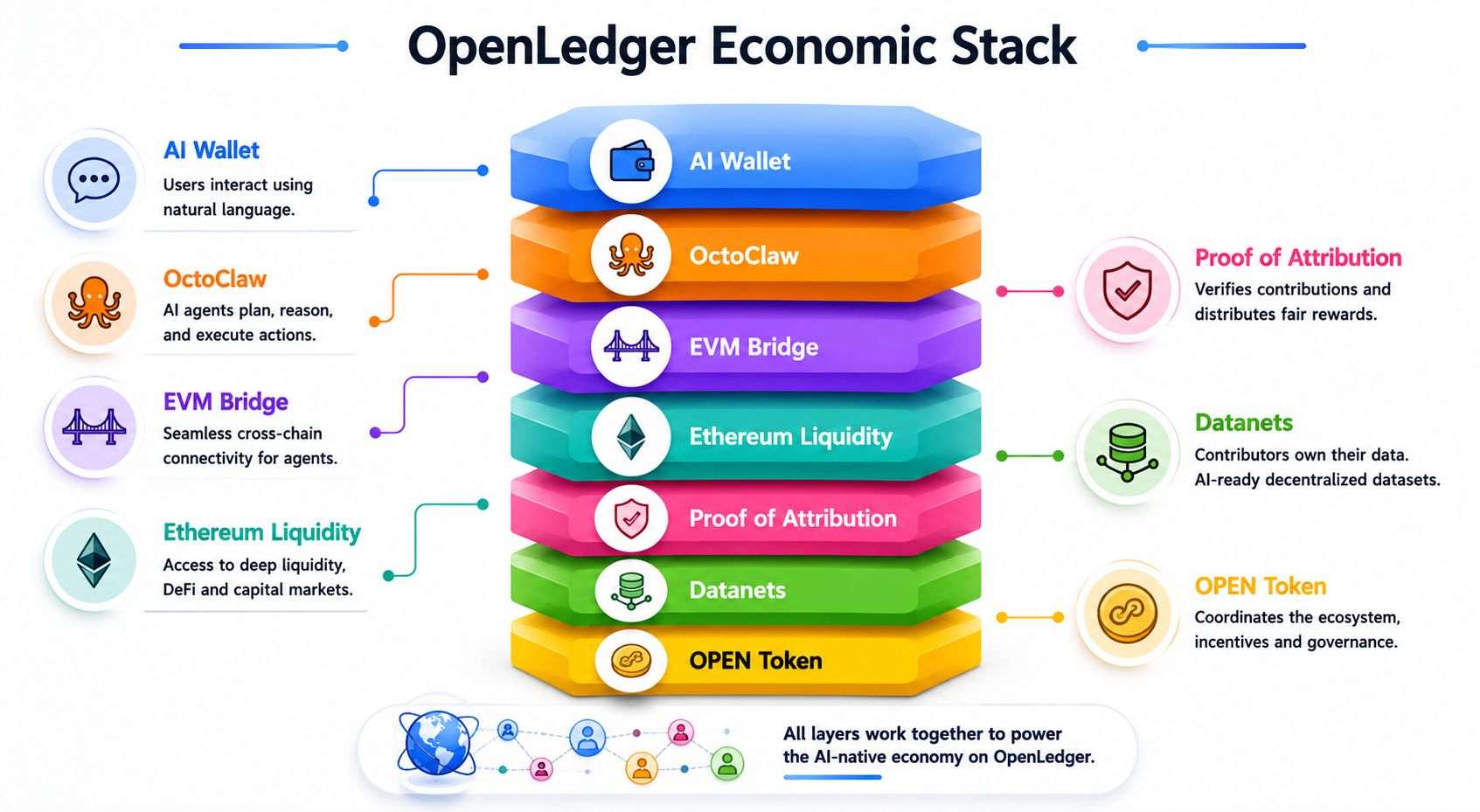
This is where OpenLedger's architecture starts to make sense to me. The protocol isn't simply building blockchain infrastructure. It is trying to create an economic system around intelligence itself. Proof of Attribution sits at the center of that vision by making contributions measurable and rewardable. Data contributors, model builders, developers, and users all become participants in the same value loop. The network has already surpassed 3 million registered users, more than 1.5 million contributors, and over 100 million attributed AI interactions. Those aren't just growth metrics. They are evidence that attribution is becoming a functioning economic layer.
The bridge becomes interesting because economies do not thrive in isolation. OpenLedger has been placing increasing emphasis on EVM compatibility, allowing developers to deploy Ethereum style smart contracts while accessing AI focused infrastructure. On paper, that sounds like a technical update. In practice, it lowers the barrier for existing Web3 ecosystems to integrate AI agents, attribution systems, and data driven applications without abandoning the environments they already understand. That feels less like interoperability and more like economic expansion.
I think the Ethereum connection is especially important. Recent ecosystem developments highlight support between Ethereum and OpenLedger infrastructure, allowing assets, liquidity, and applications to move across both environments. Most people naturally focus on the movement of tokens. I find myself focusing on the movement of opportunity. Liquidity isn't just capital sitting on a chain. Liquidity determines where activity can happen, where builders can experiment, and where entirely new behaviors can emerge. If OpenLedger wants to become an AI native economy, access to Ethereum's liquidity network feels almost essential.
The launch of OctoClaw pushed my thinking even further. Like many people, I initially viewed it as another step toward AI automation. The framework supports research, workflow coordination, and on chain execution. Useful features, certainly. But after sitting with the idea for a while, I started asking a different question. Where exactly are these agents supposed to operate? An intelligent agent restricted to a single environment remains constrained by that environment. An intelligent agent capable of interacting across ecosystems begins to look far more powerful. Suddenly, the bridge becomes much more than infrastructure.
That is probably why the recent bridge narrative resonates with me. It suggests that OpenLedger is thinking beyond isolated AI tools. If agents eventually coordinate trades, manage data workflows, execute transactions, or interact with decentralized applications, they will need access to multiple economic environments. Cross chain execution stops being a feature and starts becoming a requirement. The EVM Bridge increasingly looks like the connective tissue that allows those systems to interact rather than compete.
Another recent development reinforced that view. OpenLedger has been highlighting AI powered wallet experiences focused on natural language execution and verifiable AI actions. I remember reading those updates and initially treating them as a completely separate product direction. Looking back, I think I was wrong. If users eventually interact with blockchain networks through AI agents instead of traditional interfaces, those agents will need access to wallets, liquidity, applications, and execution environments across multiple ecosystems. The bridge becomes one of the invisible layers that makes that experience possible.
Market attention appears to be following some of these developments. OPEN has recently traded around the $0.19–$0.21 range, while daily trading volume has frequently exceeded $10 million to $15 million. Those figures do not prove that the thesis is correct. Markets are often early, late, or simply wrong. Still, they suggest that investors are beginning to evaluate OpenLedger through a wider lens than AI alone. Increasingly, the conversation seems to revolve around how intelligence, attribution, liquidity, and execution might eventually work together.
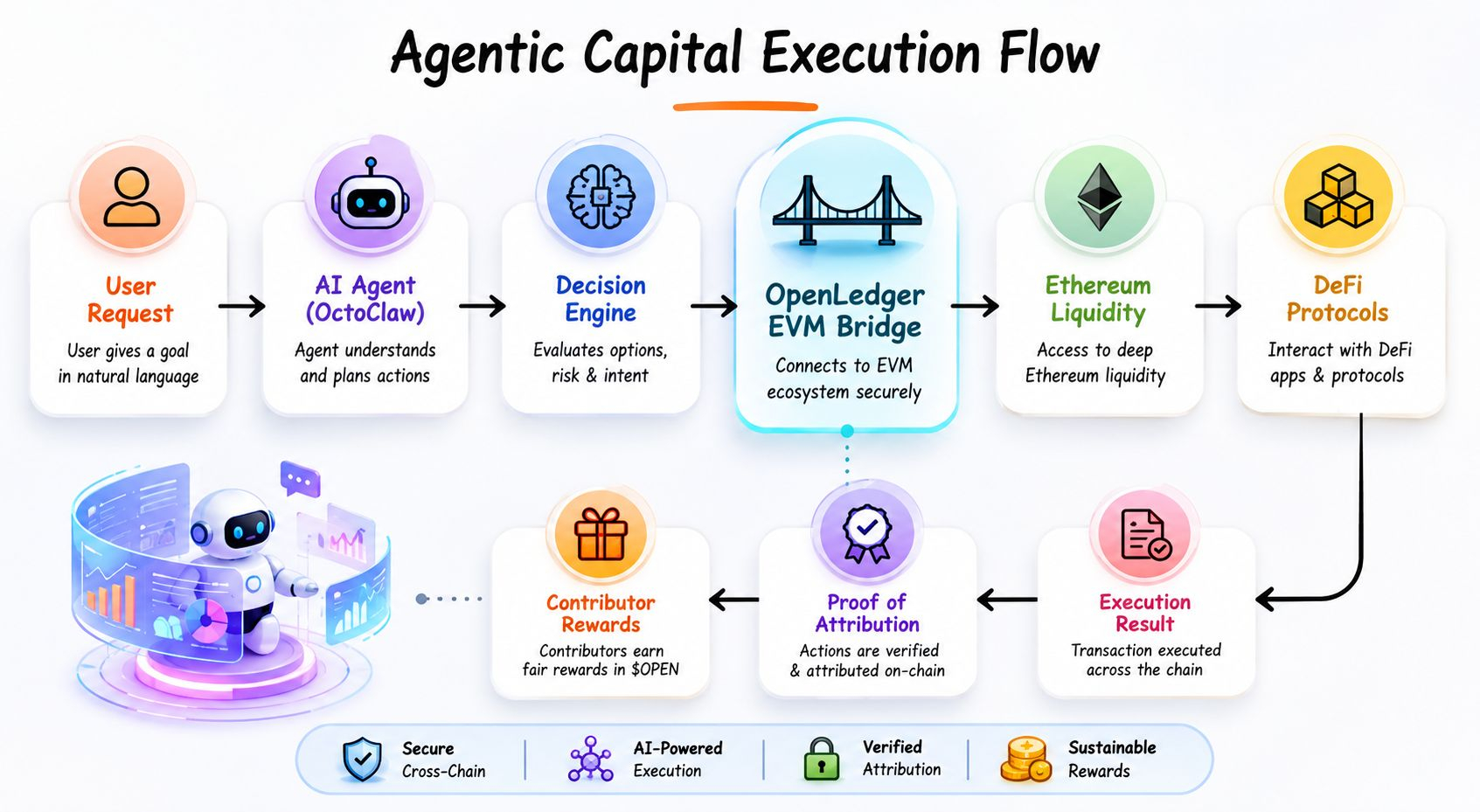
What fascinates me most is that OpenLedger appears to be focused on a problem many projects have not fully recognized yet. Most AI projects are trying to make intelligence more capable. Most blockchains are trying to make transactions more efficient. OpenLedger seems to be exploring what happens when intelligence itself becomes capable of transacting. That is a subtle distinction, but it changes everything. Attribution matters. Liquidity matters. Identity matters. Cross chain access matters. Suddenly, infrastructure decisions that once felt secondary become central to the entire system.
Maybe none of this unfolds the way supporters expect. Maybe AI agents remain tools rather than participants. Maybe interoperability remains a background feature users never think about. I genuinely think those possibilities deserve consideration. But I also can't shake the feeling that the market may be underestimating what OpenLedger is actually building. The more I follow the project, the less I view the EVM Bridge as a bridge. Increasingly, it looks like foundational infrastructure for a future where intelligence doesn't just generate value, it actively participates in the economies built around it.