
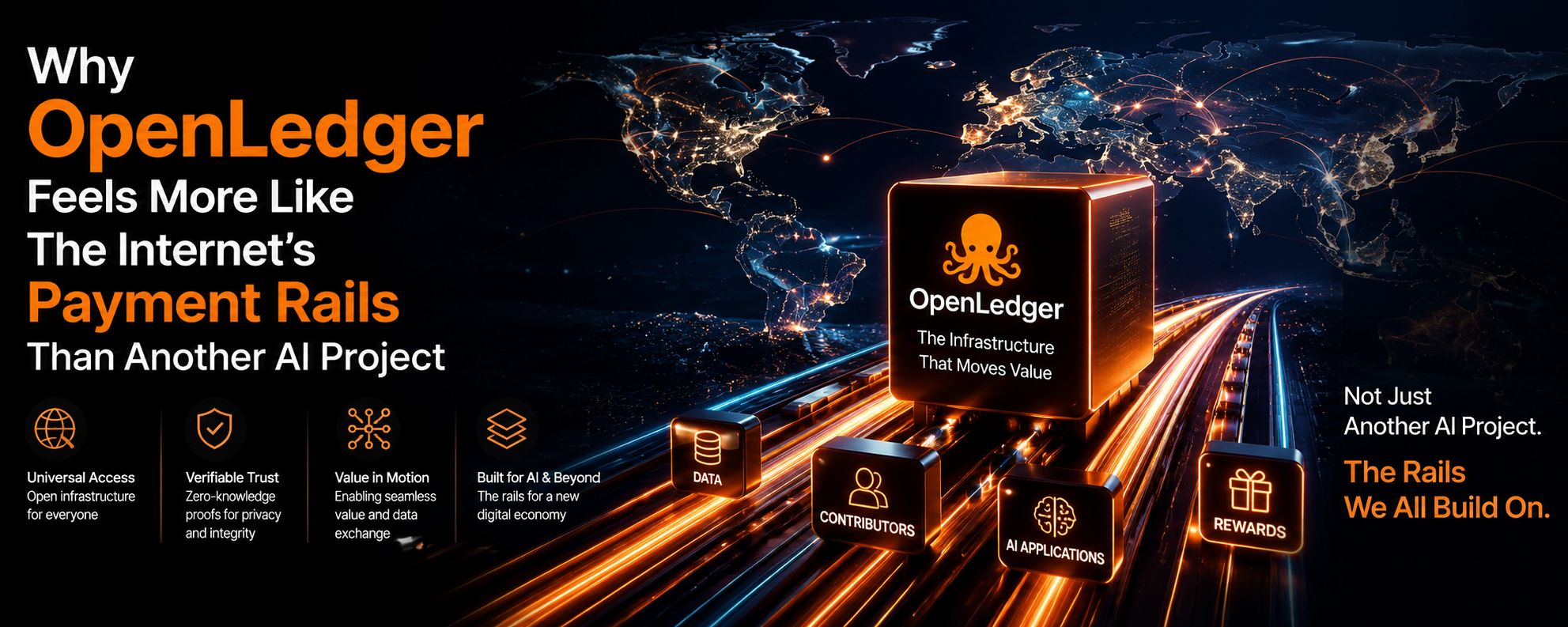
When people talk about major technological shifts they usually focus on what appears at the surface. During the rise of the internet most attention went toward websites search engines and social networks. Very few people spent time discussing the protocols and infrastructure quietly operating underneath them. Yet those invisible layers ultimately became the foundation that allowed everything else to grow.
That perspective is why OpenLedger catches my attention.
Most conversations around artificial intelligence revolve around models. Which model is smarter. Which model is faster. Which model generates the best output. The discussion is almost always centered on the final product that users can see.
What receives far less attention is the economic system surrounding AI itself.
As AI ecosystems become larger they depend on an increasingly diverse network of contributors. Data providers model developers application builders and users all play different roles in creating value. The challenge is not simply generating intelligence. The challenge is tracking where value originates and ensuring that value can move efficiently across the network without losing its connection to the people who helped create it.
That is where OpenLedger appears different from many projects entering the AI sector.
Rather than focusing entirely on building another application or another model it seems focused on the infrastructure layer that supports economic coordination. In many ways it reminds me less of an AI company and more of the payment rails that allowed digital commerce to scale across the internet.
The most important systems are often the ones that nobody notices at first.
Credit card networks rarely receive the same excitement as online stores. Internet protocols rarely attract the same attention as social media platforms. Yet without those underlying systems entire industries would struggle to function efficiently.
History repeatedly shows that infrastructure becomes more valuable as ecosystems become more complex.
When only a few participants exist coordination is simple. As networks grow coordination becomes the challenge. Questions of ownership attribution rewards and incentives become increasingly important. Without reliable mechanisms to manage those relationships growth eventually creates friction rather than efficiency.
This is why I view OpenLedger through a different lens than many AI projects.
I do not see it primarily as a prediction about which AI model will dominate the future. I see it as an attempt to address a deeper question. If artificial intelligence becomes a massive economic ecosystem how will value be measured distributed and connected to the contributors responsible for creating it?
That question may ultimately matter more than the next breakthrough model.
The AI industry is moving toward a world where intelligence is increasingly produced through collaboration between datasets developers applications and autonomous agents. In such an environment the systems responsible for attribution and value flow could become just as important as the intelligence itself.
Whether OpenLedger succeeds remains uncertain. Every emerging technology sector is filled with ambitious ideas that never reach large scale adoption. Skepticism is healthy especially in crypto where narratives often move faster than reality.
Still the reason I continue watching OpenLedger is simple.
It is addressing a problem that many people acknowledge but relatively few projects prioritize. The future of AI may not be determined solely by who creates the most intelligence. It may also depend on who builds the infrastructure that allows intelligence and economic value to move efficiently across an increasingly connected digital world.
That makes OpenLedger feel less like a bet on a trend and more like a bet on the systems that trends eventually require.