

I did not understand OpenLedger properly the first time I looked at it.
Maybe that is why it stayed in my head.
At first it felt like another AI and crypto idea trying to survive inside a market that has already heard too many promises. I was tired, scrolling through charts, watching people argue with the same confidence they always have before changing their minds two weeks later. Nothing felt new. The language felt familiar. Data, ownership, incentives, AI. Words that have been used so many times they almost lose their weight.
But then one thought kept bothering me.
What if data was never really just data?
What if it was work that nobody agreed to call work?
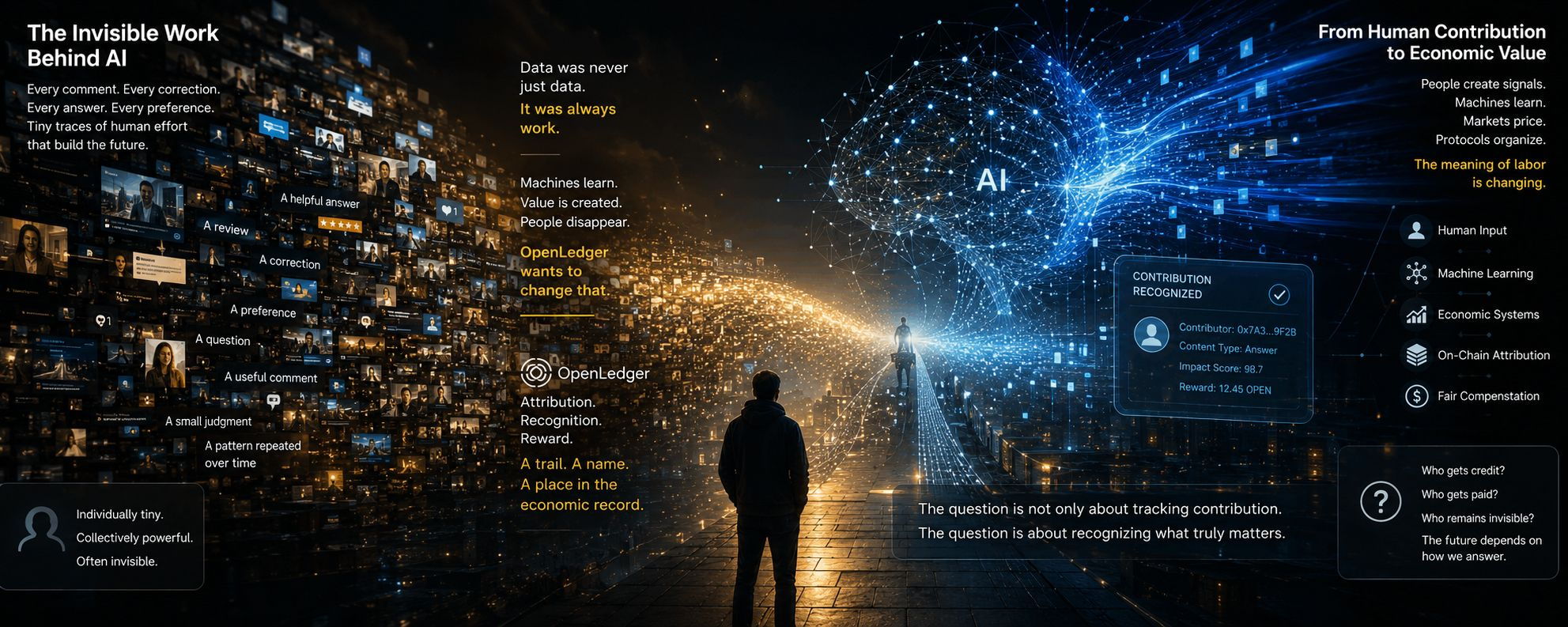
That is where OpenLedger started becoming interesting to me. Not because it made everything clear, but because it made the old internet feel a little more uncomfortable. For years, people have been leaving pieces of themselves online without thinking too much about it. A review. A correction. A comment. A preference. A question. A useful answer. A small judgment. A pattern repeated over time.
Individually, these things look tiny.
Almost meaningless.
But once machines learn from them, they become valuable.
And that is the strange part. The value appears later, somewhere else, inside a model, inside an output, inside a product, while the original contributor disappears from the story.
OpenLedger seems to be trying to stop that disappearance.
Not perfectly. I do not think any system can solve something this messy in a clean way. But the attempt itself matters. It is trying to give contribution a trail. A name. A place in the economic record. It is trying to ask whether the people and communities behind useful data should remain invisible once that data starts producing value.
That question feels bigger than one project.
Because AI has changed the mood of the internet. Before, people gave away attention and data because the exchange felt harmless enough. You used platforms, platforms used your behavior, and most people accepted that without thinking too deeply. But AI makes the exchange feel sharper. It turns old traces into new outputs. It makes human contribution feel less like background activity and more like unpaid infrastructure.
And once you see it that way, it is hard to unsee.
Still, I cannot pretend this is simple.
The moment contribution becomes rewardable, people change. They start optimizing. They start gaming the system. They produce for the metric instead of the meaning. That is always the danger. A system built to reward useful data can quickly attract useless data dressed up as effort.
That is why I feel both curious and cautious about OpenLedger.
The idea is strong because it touches something real. The execution is difficult because humans are difficult. Markets do not just reveal value. They also distort it. They turn belief into behavior, behavior into numbers, and numbers into games people learn to play.
So the hard question is not only whether OpenLedger can track contribution.
The harder question is whether it can recognize contribution that actually matters.
Because recording activity is easy compared to understanding value.
And maybe that is the deeper shift happening here. The internet is slowly moving toward a world where human input, machine learning, and economic systems are no longer separate. They are beginning to fold into each other. People create signals. Machines absorb them. Markets try to price them. Protocols try to organize them. And somewhere inside that loop, the meaning of labor starts to change.
That is what makes this whole thing feel strange.
Not exciting in a clean way.
Not frightening in a dramatic way.
Just strange.
Like watching something ordinary become financial before anyone has agreed what it really is.
Maybe OpenLedger succeeds. Maybe it struggles. Maybe the incentives work for a while and then get tested by the same problems every open system faces. I do not know. But I do think it is pointing toward a question that will keep coming back.
Who gets credit when machines create value from human traces?
Who gets paid when knowledge becomes output?
Who remains invisible when the system becomes profitable?
I do not have a neat answer, and I do not trust neat answers here anyway. The market loves certainty because certainty is easier to trade. But this feels like one of those things that needs uncertainty. It needs doubt. It needs time.
I only know that after reading about OpenLedger, data started to feel less like a resource and more like a record of human effort.
And that changes the way I look at everything.
The internet has always been full of invisible labor. Maybe AI is simply making that labor impossible to ignore.
Maybe OpenLedger is one attempt to account for it.
Maybe the real story is not whether the market notices today, but whether people eventually stop accepting invisibility as the cost of being online.
