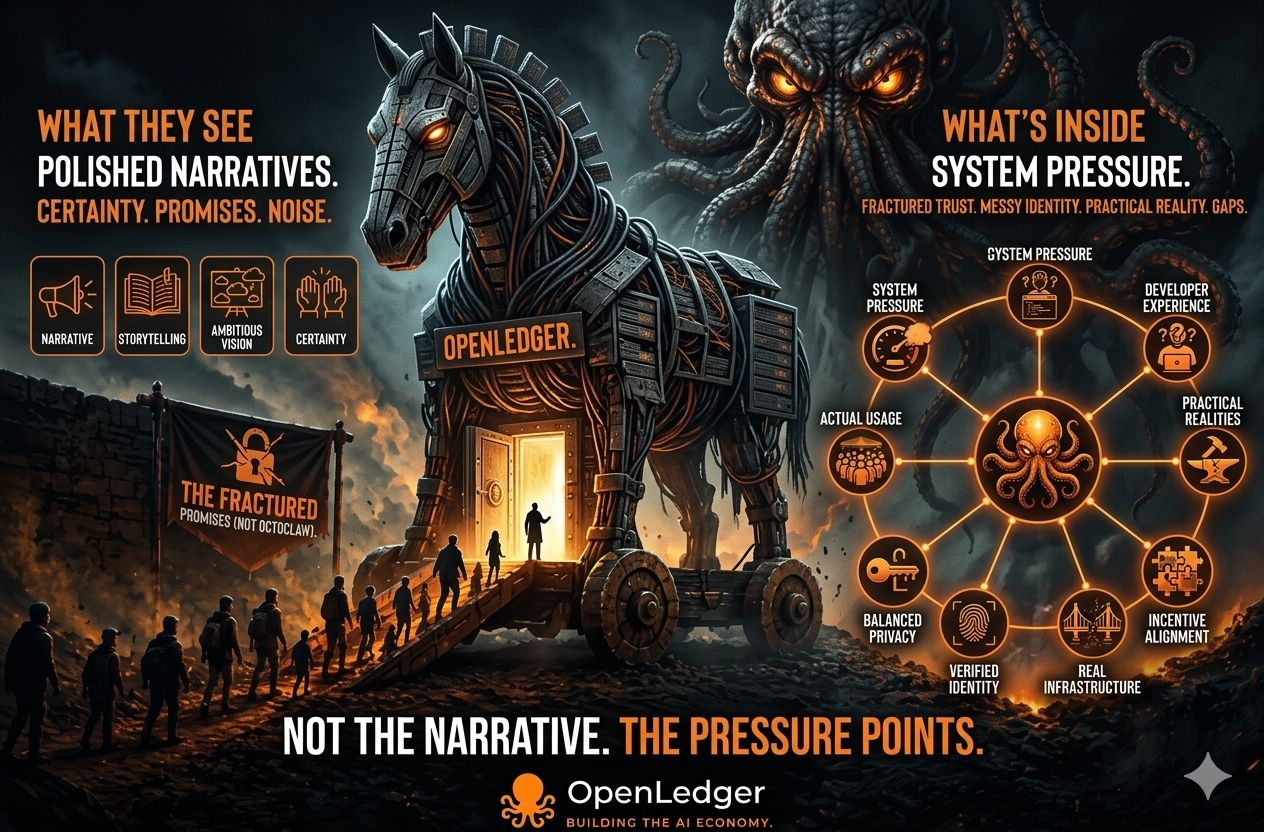
Lately, I’ve found myself paying less attention to what projects claim they will become and more attention to what they actually are. Maybe that comes from watching the same cycles repeat for years. Every new wave arrives with its own language, its own promises, and its own certainty that this time things will be different. Then, before long, the same narratives start getting repeated everywhere until they lose any real meaning. At some point, it becomes difficult to separate genuine progress from familiar storytelling. That’s one reason OpenLedger keeps making me think. Not because I have answers about it, but because it sits in the middle of questions I’ve been asking for a long time.
One of the biggest questions is trust. It sounds simple, yet it remains surprisingly unresolved. Every year there are new approaches, new frameworks, and new claims about fixing the problem, but trust still feels fragmented. Verification remains inconsistent. Identity remains messy. OpenLedger exists in an environment where those challenges continue to shape everything around it, and I can’t shake the feeling that these issues matter far more than whatever narrative happens to be popular at the moment.
At the same time, I’m increasingly uncomfortable with how much exposure has become normalized. Somewhere along the way, visibility started being treated as an unquestioned good. The expectation seems to be that more transparency automatically creates better systems. Yet I’ve never found that argument completely convincing. OpenLedger makes me think about this because the broader industry still struggles with the same dilemma. Too much exposure creates its own problems, but many privacy-focused approaches swing so far in the opposite direction that usability suffers and trust becomes harder to establish. The choice always seems forced, as if balance isn’t even being considered.
That tension connects to something else I keep noticing. Many projects appear designed around narratives rather than practical realities. The storytelling is polished. The vision is ambitious. The language is carefully crafted. But when I look beyond the presentation, I often struggle to find evidence that the gap between ambition and actual usage is closing. OpenLedger operates in a space where those gaps become impossible to ignore. It’s easy to describe a future. It’s much harder to build something people consistently rely on.
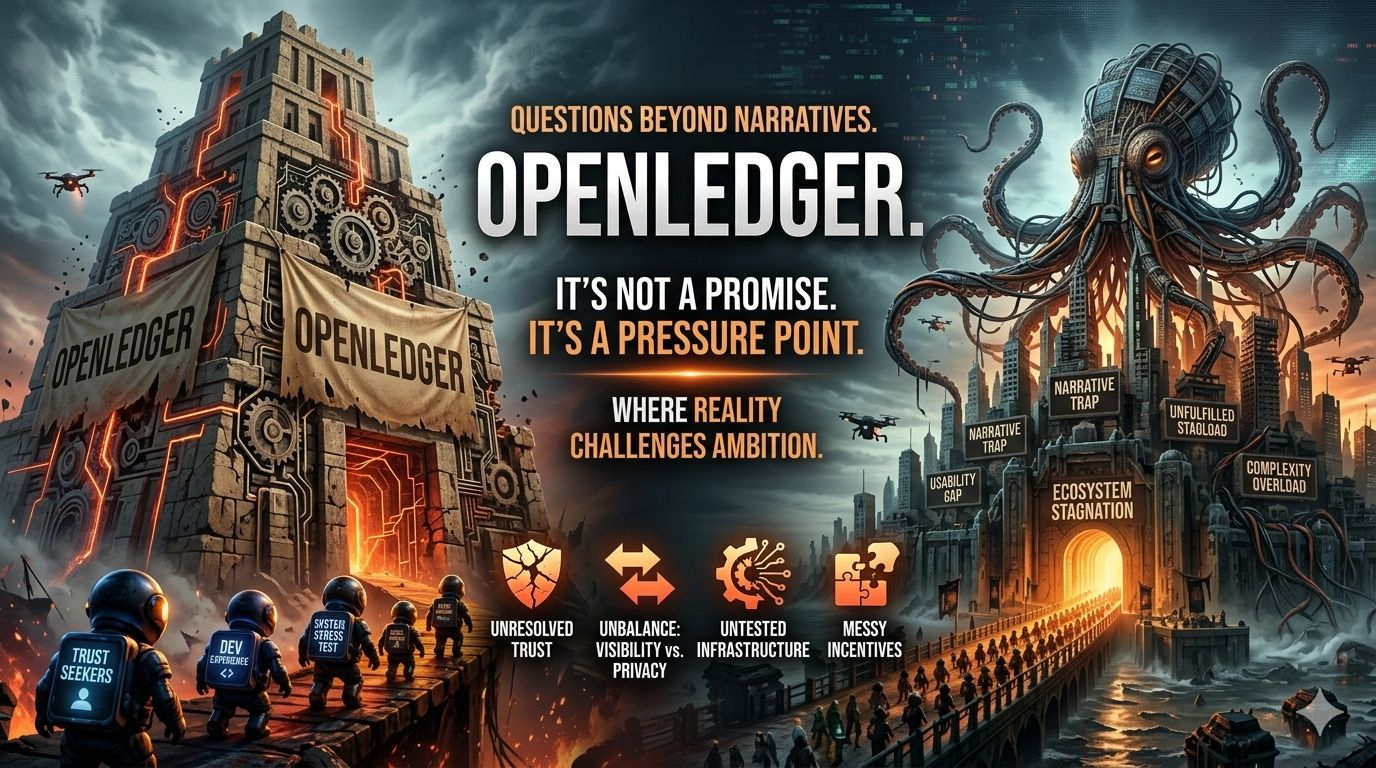
The same applies to infrastructure. Infrastructure always sounds important because, in theory, it supports everything else. But I’ve seen enough examples to know that sounding important and proving important are completely different things. OpenLedger reminds me of that distinction. Real infrastructure reveals itself when systems face pressure, when conditions become unpredictable, and when assumptions stop holding up. Until then, every claim remains largely untested.
Another issue that rarely gets enough attention is developer experience. It isn’t the kind of topic that generates excitement, yet it quietly determines whether ecosystems grow or stagnate. OpenLedger, like any project hoping to attract meaningful participation, eventually depends on people being able to engage without unnecessary complexity. I’ve watched too many promising ideas lose momentum because the people expected to build around them were treated as an afterthought.
Then there’s the question of incentives. Over time, I’ve become skeptical of structures that feel attached for the sake of expectation rather than necessity. OpenLedger exists in a market where incentive systems are constantly discussed, yet genuine alignment often feels rare. Too often, the conversation focuses on value before value has actually been created. The narrative arrives first, and reality is expected to catch up later.
Maybe that’s why I’ve stopped trusting polished narratives as much as I once did. OpenLedger interests me not because it offers certainty, but because it sits close to the kinds of questions that still don’t have clear answers. After years of watching noise receive more attention than substance, I’ve become less interested in promises and more interested in pressure points. I want to see where systems struggle, where assumptions break down, and where reality pushes back against ambition. Those moments tend to reveal more than any carefully constructed story ever will. They’re also the moments that keep me watching.