
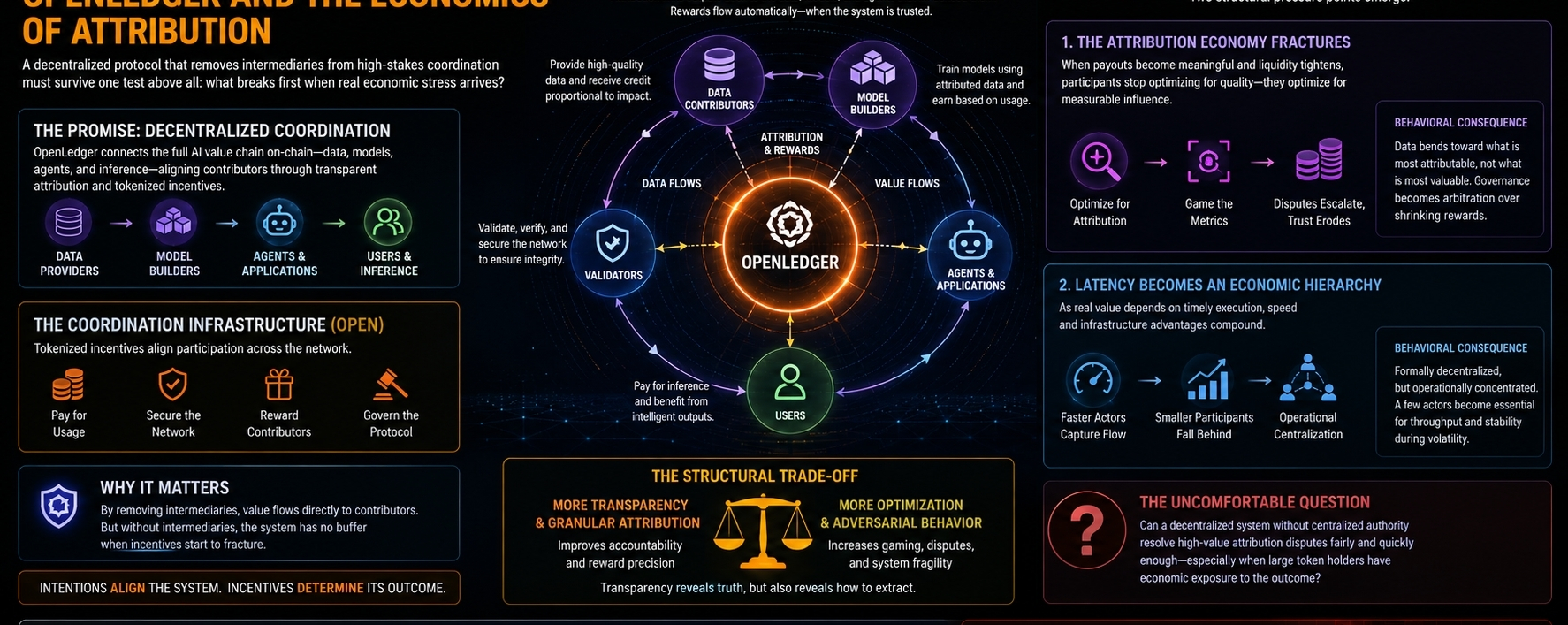
I keep returning to the same question whenever I study protocols built around decentralized coordination: what actually fails first when belief weakens and capital becomes selective? Not during expansion, when liquidity is abundant and every inefficiency can hide inside rising valuations, but during contraction, when participants begin measuring extraction more carefully than contribution. OpenLedger sits directly inside that tension because it tries to organize incentives around something unusually difficult to price honestly: attribution. The entire architecture assumes that value can be traced backward through datasets, models, inference, and agents with enough precision that contributors accept the system as economically fair. I do not think the critical issue is whether that attribution is technically possible. I think the issue is whether people continue accepting its legitimacy once the payouts become meaningful enough to fight over. The protocol is less exposed to technical failure than it is to contested interpretation under stress.
What I have learned from watching capital rotate through crypto narratives is that systems rarely collapse from obvious dishonesty. They usually destabilize when incentives become too rational. OpenLedger depends on continuous cooperation between actors whose interests eventually diverge: data contributors want compensation maximized, model builders want input costs compressed, validators want stable throughput, and inference users want predictable pricing. In calm conditions, these tensions look manageable because network growth masks them. The OPEN token functions as coordination infrastructure tying these layers together through fees, rewards, staking, and governance. But when liquidity tightens, the token stops feeling like infrastructure and starts behaving like a balance sheet. Participants begin recalculating whether future participation justifies present exposure. That is usually the moment when supposedly aligned ecosystems discover they were only synchronized by speculative expansion.
The first structural pressure point appears in the attribution economy itself. OpenLedger’s premise depends on the idea that influence inside AI systems can be measured with enough credibility to distribute rewards automatically. The technical ambition is impressive, but the behavioral consequence is more complicated than most people admit. Once attribution determines income, contributors stop optimizing for quality in the abstract and start optimizing for measurable influence. That distinction matters. Systems designed around attribution tend to attract participants who learn how the reward function behaves faster than the protocol evolves. I have seen this pattern repeatedly in liquidity mining, governance participation, and validator incentives. The moment a metric becomes economically important, the environment reorganizes around gaming it.
In OpenLedger’s case, the risk is not necessarily fraudulent data. The deeper issue is adversarial usefulness. Contributors may begin shaping datasets not to improve intelligence broadly, but to maximize detectable impact during inference. Those are different objectives. Over time, this can create a strange economic distortion where the network increasingly rewards data that is highly attributable rather than structurally valuable. The protocol may still appear active. Transactions continue. Rewards distribute. Models train. But internally, the informational quality of the ecosystem starts bending toward whatever the attribution layer can observe and monetize most easily.
I think this becomes especially dangerous once volatility enters the token layer. During bullish conditions, participants tolerate ambiguity because the appreciation of the coordination asset compensates for inefficiencies elsewhere. But under stress, attribution disputes become economic conflicts. Every contested reward allocation becomes a transfer of scarce liquidity. At that point, governance no longer functions as collaborative stewardship. It becomes arbitration over shrinking incentives. OpenLedger’s governance structure resembles broader Ethereum-aligned governance systems where token holders influence upgrades and protocol decisions. The uncomfortable question is whether governance without centralized authority can meaningfully resolve attribution disputes once large holders have direct economic exposure to the outcome.
This is where I think the protocol encounters its clearest structural trade-off. The more granular and transparent the attribution system becomes, the more economically adversarial the environment surrounding it becomes as well. Transparency increases accountability, but it also increases optimization pressure. Participants gain clearer visibility into how rewards flow, which encourages more efficient extraction strategies. A coordination system built to remove intermediaries eventually inherits one of the hidden functions intermediaries used to provide: absorbing conflict off-chain before it contaminated the economic layer.
The second pressure point is less visible but probably more destabilizing over time. OpenLedger assumes that decentralized coordination can maintain reliable latency across economically sensitive activity. That assumption becomes fragile once real value depends on timely execution. The protocol connects datasets, model deployment, inference payments, validators, and agents through an on-chain incentive environment. Conceptually, this creates auditability. Behaviorally, it introduces timing sensitivity into every layer of participation. Under normal usage, latency feels like a technical inconvenience. Under stressed conditions, latency becomes an economic hierarchy.
I have watched this happen across multiple blockchain environments. The actors with the fastest infrastructure, best routing, and deepest liquidity buffers gradually gain structural advantages over participants who are theoretically equal inside the protocol design. Decentralized systems often begin by removing institutional gatekeepers, only to recreate them through operational asymmetry. In OpenLedger’s case, sophisticated participants may eventually dominate inference markets, attribution claims, and staking efficiency simply because they can process information and react faster than smaller contributors. The protocol remains decentralized formally while becoming operationally concentrated behaviorally.
What interests me is how quietly this transformation happens. Most users do not notice concentration while prices are rising because network activity itself gets interpreted as proof of decentralization. But liquidity conditions expose hidden dependencies. Smaller contributors become less willing to lock capital into uncertain reward systems. Validators become more selective. Governance participation narrows. The ecosystem starts relying on a shrinking number of actors capable of maintaining throughput during volatility. Ironically, the system designed to eliminate trusted intermediaries begins depending on participants large enough to absorb uncertainty without immediate exits.
I do not think this necessarily means the architecture fails outright. Markets are capable of tolerating remarkable inefficiencies if enough participants continue believing future coordination will be more valuable than present friction. But belief itself behaves like liquidity. It deepens slowly and disappears quickly. Protocols tied to AI coordination face an additional problem because they are not only asking participants to trust financial incentives. They are asking them to trust measurement systems that remain probabilistic by nature. Attribution in machine learning is rarely absolute. Economic systems, however, demand absolutes once payouts matter.
That is the tension I cannot ignore when I look at OpenLedger. The protocol attempts to formalize contribution in an environment where contribution itself is context-dependent and continuously renegotiated. Under expansion, that ambiguity looks flexible. Under contraction, it starts looking political. And once coordination becomes political, decentralization stops removing power. It only changes where power accumulates.
