Most blockchain projects spend years trying to convince markets that they deserve institutional attention.
OpenLedger took a different path.
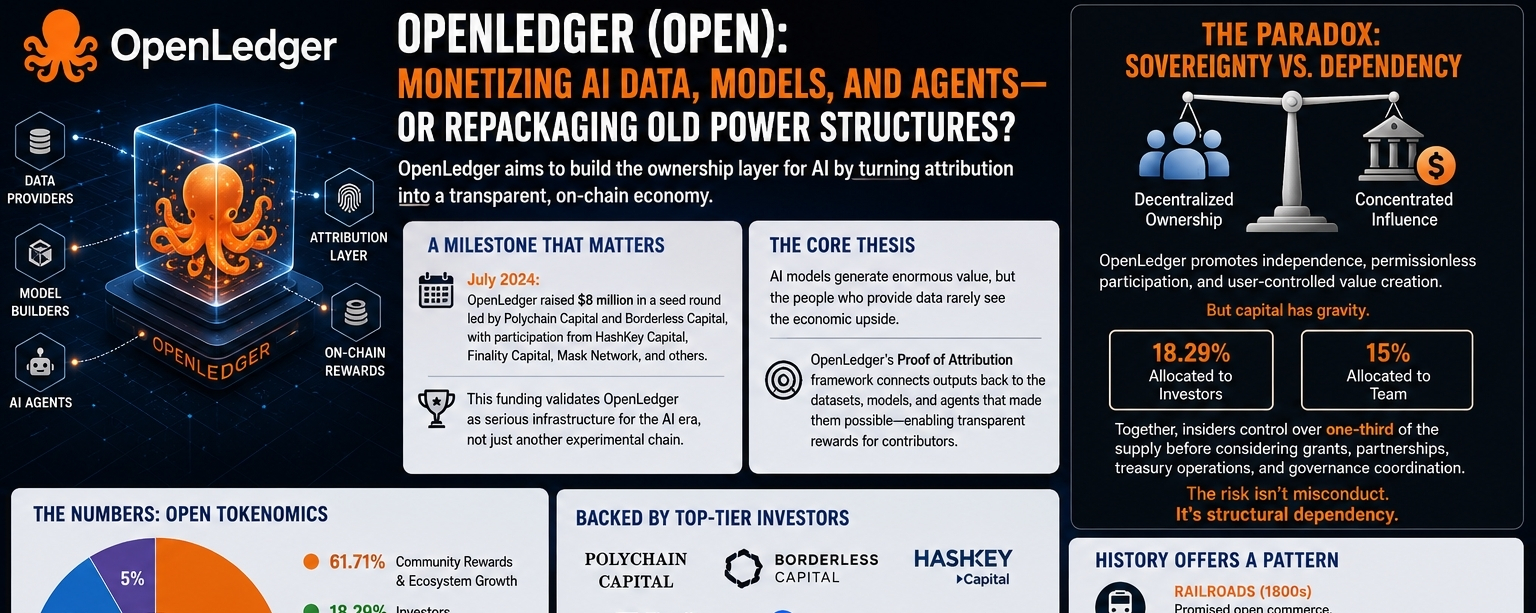
In July 2024, the project secured an $8 million seed round led by Polychain Capital and Borderless Capital, with participation from HashKey Capital, Finality Capital, Mask Network, and several established crypto investors. That fundraising event immediately distinguished OpenLedger from the growing list of AI-blockchain experiments competing for relevance.
The significance of this milestone is not merely the capital raised.
It is the identity of the capital providers.
Polychain Capital has historically backed some of the industry's most influential infrastructure networks. HashKey operates at the intersection of institutional finance and digital assets. Borderless Capital has consistently focused on large-scale blockchain ecosystems. Their involvement signals that OpenLedger is being evaluated as infrastructure rather than speculation.
That distinction matters because OpenLedger is attempting to solve one of the most economically important questions in artificial intelligence:
Who should own the value created by data?
The Economic Problem Most AI Companies Prefer Not to Discuss
Artificial intelligence has become one of the fastest-growing industries in modern history.
Yet a fundamental contradiction remains unresolved.
AI models generate billions of dollars in value. Data providers generate the raw material. The economic rewards, however, overwhelmingly flow toward model owners and platform operators.
The contributor rarely knows:
Whether their data was used.
How much value it created.
Whether they deserve compensation.
OpenLedger's answer is what it calls a Proof of Attribution framework.
The objective is simple in theory but extremely difficult in practice.
Every dataset, model, agent, and inference interaction should become measurable. Every contribution should become traceable. Every participant should potentially receive economic rewards proportional to the value they create.
If successful, OpenLedger would transform data from a passive input into an actively monetized asset class.
This is not a marketing problem.
It is a genuine economic problem that much of the AI industry still struggles to address.
Following the Money: Tokenomics and Capital Structure
The strongest narratives eventually collide with numbers.
OpenLedger's tokenomics reveal how economic influence may evolve inside the network.
OPEN maintains a fixed supply of 1 billion tokens.
Current allocations include:
61.71% for community rewards and ecosystem growth.
18.29% allocated to investors.
15% allocated to the team.
5% allocated to liquidity operations.
Initial circulating supply entered the market at approximately 21.55%, while investor and team allocations remain subject to vesting schedules, including one-year cliffs and multi-year release periods.
On the surface, this distribution appears relatively favorable compared to many venture-backed blockchain networks.
A majority of supply is reserved for ecosystem participants rather than insiders.
That deserves recognition.
However, token allocations alone do not determine influence.
Influence emerges from ownership concentration, governance participation, liquidity access, and coordination among major stakeholders.
This is where the more difficult analysis begins.
The Sovereignty Paradox
OpenLedger frequently presents itself as infrastructure for decentralized AI ownership.
The narrative is compelling.
Users own their data.
Builders own their models.
Agents own their economic activity.
Value flows directly to contributors.
Yet every infrastructure project faces a recurring paradox:
The system may aspire toward decentralization while depending on concentrated capital during its formative years.
Investors control approximately 18.29% of supply.
The team controls another 15%.
Collectively, these groups account for more than one-third of all tokens before accounting for strategic partnerships, grant programs, treasury influence, or governance coordination.
Again, this does not indicate wrongdoing.
It simply highlights a structural tension.
Can a network genuinely distribute power if a significant portion of economic influence originates from a relatively small group of early stakeholders?
The answer is not obvious.
History suggests this question deserves scrutiny.
History's Warning: Infrastructure Often Becomes the New Monopoly
The challenge facing OpenLedger is not unique.
Railroad companies in the nineteenth century promised open commerce.
They succeeded.
But the financiers controlling the rails often captured disproportionate economic value.
The early internet promised decentralized communication.
It succeeded.
Yet value increasingly concentrated within dominant platforms controlling access, identity, and distribution.
Cloud computing promised operational freedom.
Today, significant portions of the digital economy depend on a handful of providers.
Infrastructure frequently begins as an enabler and gradually becomes a dependency.
This historical pattern does not mean OpenLedger will follow the same path.
But it does mean investors and contributors should monitor the possibility.
Because dependency rarely appears at launch.
It emerges after adoption.
Separating Technical Quality from Economic Risk
One mistake frequently made by crypto analysts is confusing technical excellence with investment certainty.
The two are not the same.
By most available indicators, OpenLedger's technical direction appears serious.
The team is focused on attribution systems, data provenance, AI coordination, and economic incentive design areas that represent genuine bottlenecks in the AI economy.
The project's architecture reflects a sophisticated understanding of how AI value is generated rather than a superficial attempt to attach tokens to artificial intelligence narratives.
That deserves professional respect.
But even exceptional engineering cannot eliminate economic risk.
A technically elegant attribution system may still evolve into a platform where influence becomes concentrated.
Likewise, a network can remain decentralized at the protocol layer while becoming centralized at the governance or capital layer.
The risk is not technological failure.
The risk is economic gravity.
The Question That Will Define OpenLedger's Future
The success of OpenLedger ultimately will not be measured by transaction volume, token price, or investor participation.
It will be measured by whether contributors maintain genuine leverage.
Can data providers negotiate from a position of strength?
Can developers migrate elsewhere without losing their economic identity?
Can AI agents preserve their reputations across competing ecosystems?
Can attribution remain portable rather than platform-bound?
These questions determine whether OpenLedger becomes an ownership layer or merely another intermediary.
Because the most valuable infrastructure is not the system people enter.
It is the system they are free to leave.
And that leads to the question OpenLedger's leadership will eventually need to answer publicly:
If a major data contributor, model developer, enterprise, or autonomous AI agent decides to leave OpenLedger. or fork the network entirelybat what point can they take their attribution history, reputation, economic identity, and accumulated value with them without requiring permission from the ecosystem they helped create