
I've been writing about crypto long enough to remember when every second project called itself the next Bitcoin, the next Ethereum, or the thing that would somehow replace both. Back in 2021, I sat through conference panels where founders confidently predicted that entire financial systems would migrate onto their chains within five years. Most of those projects are either gone now or surviving on memories and old Twitter threads.
That's not cynicism. It's pattern recognition.
So whenever a new blockchain lands on my radar, my first reaction isn't excitement. It's suspicion.
What's the catch?
Who's this actually for?
And perhaps most importantly, would anyone outside the crypto bubble care if this thing succeeds?
Most projects struggle with that last question.
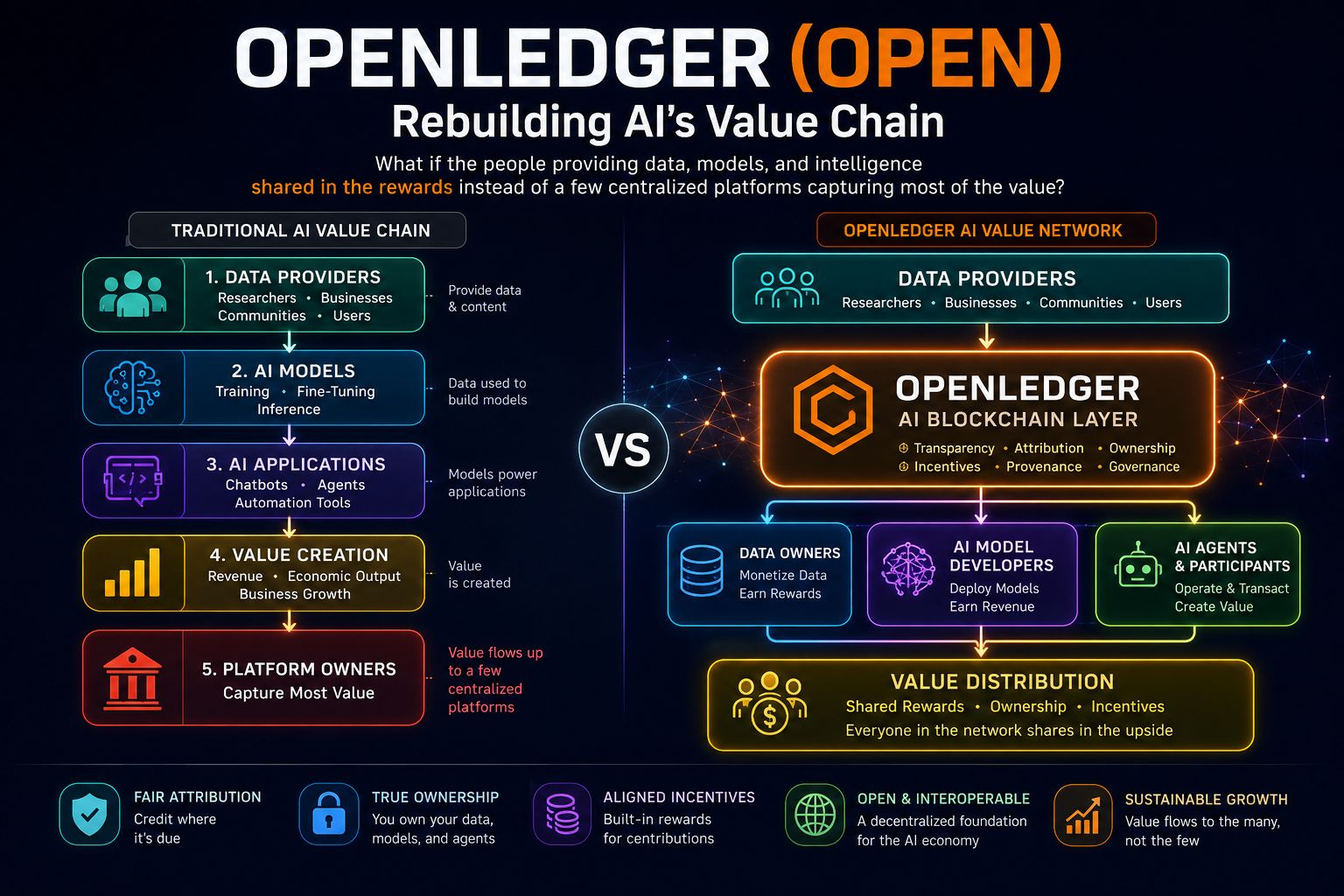
OpenLedger got my attention because it's not really selling speed, scalability, or whatever the industry's favorite buzzword happens to be this quarter. Instead, it's pointing at something much more practical—and honestly, much more uncomfortable.
The AI industry has a value distribution problem.
Everyone is obsessed with the companies building giant models. Investors throw around billion-dollar valuations. Headlines celebrate the latest chatbot milestone. Every week there's another announcement claiming artificial intelligence is about to transform everything from medicine to marketing.
Maybe it will.
But beneath all the excitement sits a simple question that doesn't get nearly enough attention: where does the value actually come from?
A few months ago, I spoke with a researcher whose team had spent years compiling highly specialized industry data. Not glamorous work. No flashy product launches. Just years of collecting, cleaning, organizing, and verifying information. The kind of work most people never see.
Then AI arrived.
Suddenly everyone wanted data.
Companies that had never shown interest before were knocking on doors.
The irony wasn't lost on him. The data became valuable overnight, yet the people who spent years building it weren't necessarily the ones capturing the rewards.
I've heard variations of that story more than once.
That's why OpenLedger's core idea resonates.
Not because it's blockchain.
Because it's about ownership.
AI doesn't emerge from thin air. It runs on data gathered by someone. It relies on models built by someone. It benefits from communities, researchers, developers, businesses, and users who contribute pieces of the puzzle. Yet when the money starts flowing, it often ends up concentrated among a relatively small group of platform owners.
That imbalance feels increasingly difficult to ignore.
And it's probably going to become a bigger issue, not a smaller one.
OpenLedger is built around a fairly straightforward proposition: if data helps create value, the people providing that data should have a way to participate in the upside. If developers create useful AI models, they shouldn't have to hand over most of the economics to a handful of dominant platforms. And if AI agents eventually become economic actors in their own right—a future that sounds strange today but increasingly plausible every year—they'll need infrastructure to operate within.
Strip away all the crypto terminology and that's the real pitch.
It's surprisingly easy to understand.
In fact, that's what I like about it.
The best technology ideas are usually simple enough to explain without a whiteboard.
Think about Uber. Most people couldn't explain the technical architecture behind it, but they instantly understood the value proposition. Same with Airbnb. Same with Netflix.
Nobody cared about the backend.
They cared that it solved a problem.
Blockchain has often forgotten that lesson.
For years the industry became obsessed with technical specifications. Faster transactions. Bigger throughput numbers. More complex architectures. Endless debates that sounded important inside crypto circles but meant absolutely nothing to normal people trying to get through their day.
I've lost count of how many projects spent years optimizing technology before proving anyone actually needed it.
OpenLedger, at least from where I sit, appears to be starting with the problem first.
That's refreshing.
Whether it succeeds is another matter entirely.
Because here's the uncomfortable reality: the history of blockchain is littered with excellent ideas that never became viable businesses.
Vision is easy.
Execution is where things get ugly.
Creating a system that fairly rewards data contributors sounds great in a pitch deck. Building one that works at scale is a completely different challenge. How do you determine which dataset deserves credit? How much credit? What happens when multiple sources contribute to the same outcome? What prevents gaming the system?
Those aren't small questions.
They're the kind of questions that keep engineers awake at night.
And unlike investors, engineers can't solve problems with optimism.
The same skepticism applies to OpenLedger's broader marketplace ambitions.
The project wants to create an environment where AI models themselves become economic assets. That's an attractive idea, especially for independent developers. I've spoken with enough AI founders over the past two years to know that building something useful is often easier than monetizing it. Distribution remains brutally difficult. Attention is scarce. Large platforms dominate mindshare.
In some ways, the situation reminds me of the early smartphone app economy. Thousands of developers built excellent applications. A small number built sustainable businesses. The gap between those two outcomes was enormous.
OpenLedger is betting it can narrow that gap.
Maybe it can.
Maybe it can't.
I'm genuinely not sure yet.
What I do know is that the problem is real.
And that's more than I can say for many blockchain projects I've covered over the years.
Then we arrive at the most controversial part of the vision: AI agents.
Whenever people hear the term "AI agents," I notice two reactions. Some immediately imagine science fiction. Others roll their eyes.
Both responses miss what's actually happening.
The reality is much less dramatic.
AI systems are already handling customer support conversations, managing schedules, conducting research, monitoring markets, and automating workflows. They're not replacing humanity anytime soon, but they're becoming increasingly capable of acting with limited supervision.
Step by step.
Quietly.
The next logical question becomes obvious once you think about it: what happens when these systems need to transact?
Not next month.
Not necessarily next year.
But eventually.
That's the future OpenLedger is positioning itself for, and while I wouldn't bet the farm on any prediction this far out, I can at least appreciate the logic behind it.
The project isn't trying to win yesterday's battle.
It's trying to prepare for tomorrow's.
That's risky.
Sometimes it ends brilliantly.
Sometimes it ends as another footnote in crypto history.
We'll find out soon enough.