One thing that has consistently bothered me about AI discussions is how often trust is treated as an afterthought. Everyone talks about smarter models, better outputs, and autonomous agents, but much less attention gets paid to how those systems are verified, coordinated, or held accountable once they start interacting with real users and real value.
That concern is one of the reasons OpenLedger eventually caught my attention.
When I first came across the project, I assumed it would be another attempt to combine AI and blockchain through broad narratives about decentralization. There are plenty of those already. But the deeper I looked, the more I noticed that OpenLedger seemed focused on something more specific: building infrastructure where AI activity itself can operate within a transparent and verifiable environment.
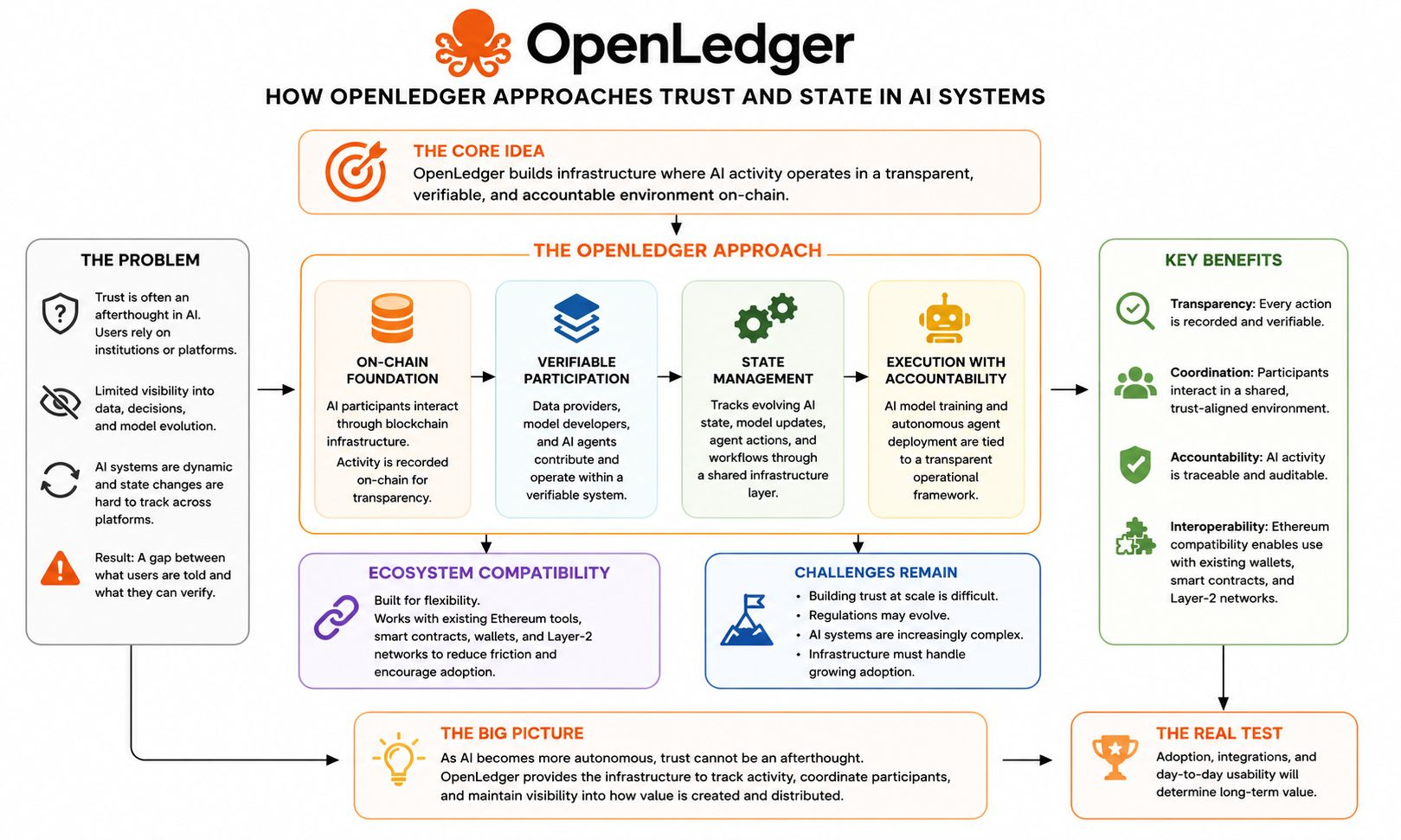
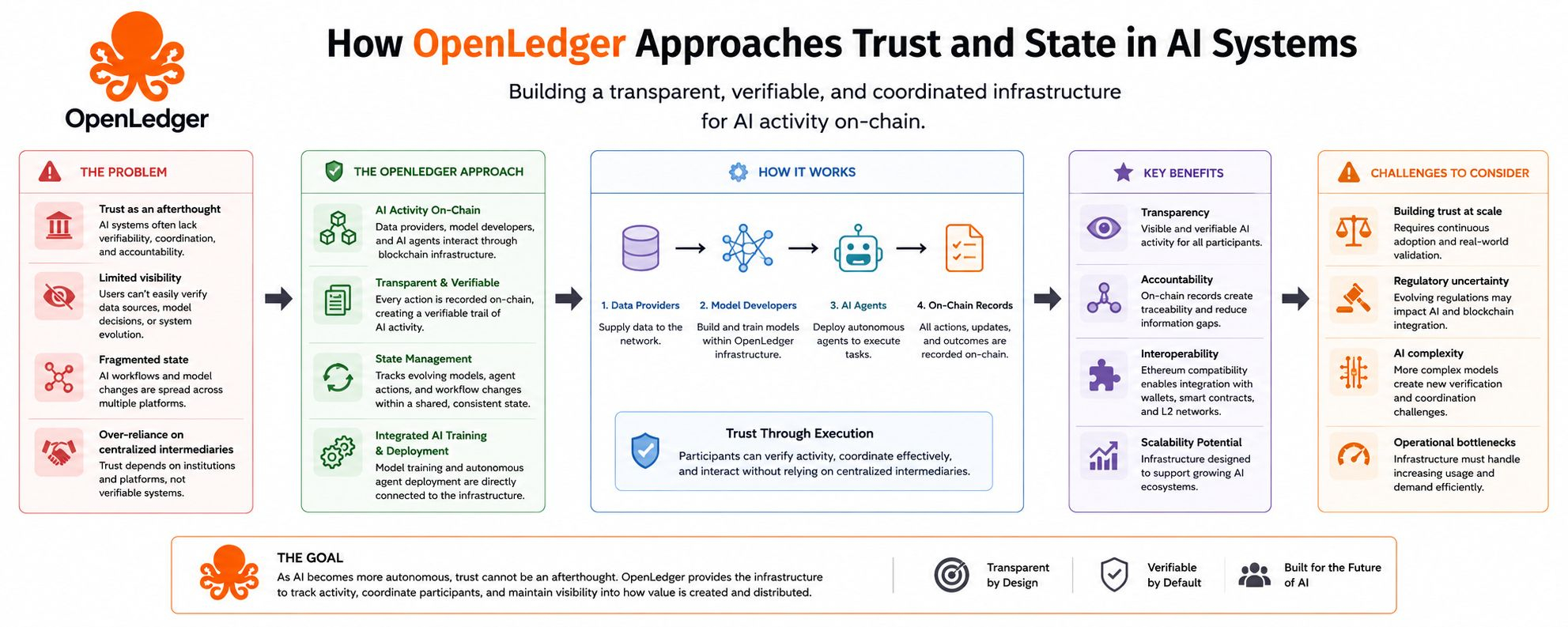
In traditional AI ecosystems, trust often depends on institutions, platforms, or service providers. Users typically have limited visibility into how decisions are made, where data originates, or how models evolve over time. Even when systems function correctly, there is frequently a gap between what users are told and what they can actually verify.
OpenLedger appears to approach this challenge differently by embedding AI participation directly into blockchain infrastructure. Data providers, model developers, and autonomous agents can interact through a system where activity is recorded on-chain. Rather than relying entirely on centralized oversight, the infrastructure itself becomes part of the trust mechanism.
The concept of state becomes particularly important here. AI systems are rarely static. Models learn, agents execute actions, and workflows continuously evolve. Keeping track of those changes can become difficult when information is spread across multiple platforms. OpenLedger seems designed to make those transitions more visible by connecting execution, coordination, and record-keeping through a shared infrastructure layer.
I found the approach to AI model training especially interesting. Instead of treating training as something completely separate from blockchain infrastructure, OpenLedger aims to integrate it more directly into the environment. Combined with autonomous AI agent deployment, the result is a system where actions are not only executed but also tied to a transparent operational framework.
Compatibility also matters. One reason many blockchain projects struggle is because they force users into isolated ecosystems. OpenLedger's Ethereum compatibility reduces that friction by allowing interaction with existing wallets, smart contracts, and Layer-2 networks. From a practical perspective, infrastructure becomes more useful when it works alongside existing tools rather than replacing everything.
What stood out most to me is that OpenLedger seems focused on trust through execution rather than trust through branding. Many projects ask users to believe in future outcomes. Infrastructure focused systems are different. Their value comes from whether participants can verify activity, coordinate effectively, and interact without depending entirely on centralized intermediaries.
That does not mean the challenges disappear. Building trust at scale is difficult. Regulations may change. AI systems continue becoming more complex. Even transparent infrastructure can face operational bottlenecks when usage grows significantly. None of those concerns should be ignored.
Still, I think OpenLedger raises an important point. If AI becomes increasingly autonomous, then trust cannot remain a secondary consideration. Systems need ways to track activity, coordinate participants, and maintain visibility into how value is created and distributed. From what I've observed, that appears to be one of the core problems OpenLedger is attempting to address.
I remain cautious, as I do with most infrastructure projects. The real test will come through adoption, integrations, and day to day usability. But after studying the project more closely, I found myself paying less attention to the AI narrative and more attention to the underlying architecture. In many cases, that's where long term value tends to emerge.