
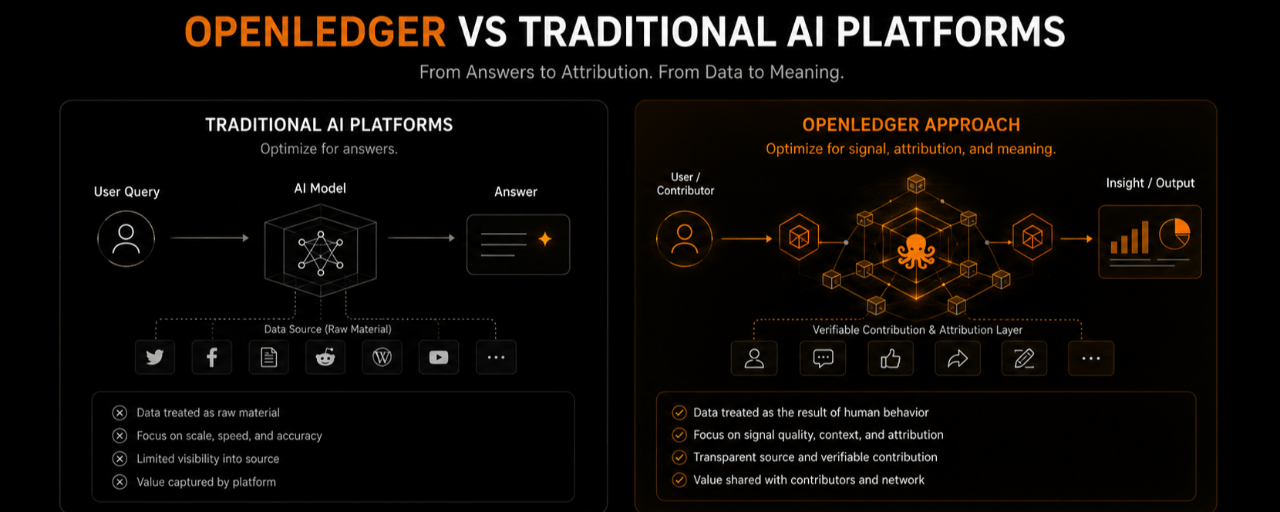
One thing I realized while watching the growth of AI is that the real competition may not be about which model is smarter, faster, or has more parameters.
That's simply the most visible layer.
The deeper question seems to be how AI reshapes the relationship between humans and knowledge.
For decades, the internet functioned as a massive repository of information. People searched for knowledge, tools helped them access it, and the final decisions remained in human hands.
Most AI platforms still follow that paradigm.
They focus on answering questions, improving accuracy, and synthesizing information from enormous datasets. In many ways, they're trying to become increasingly powerful knowledge engines.
But the longer I observe the AI economy, the more I feel that intelligence itself isn't the primary bottleneck.
The missing piece appears to be context.
Knowledge doesn't emerge in isolation. It comes from human behavior, lived experiences, and countless everyday interactions. A model may know nearly everything available online, but it doesn't inherently understand how people arrive at decisions.
This is where OpenLedger stands out to me.
Rather than treating AI solely as a computation problem, OpenLedger appears to focus on the origins of the signals that shape intelligence.
That distinction may sound subtle, but it touches a much larger issue.
Today's world doesn't suffer from a shortage of data. We live in an era of overwhelming data abundance.
What's truly scarce is meaningful data.
Every day generates billions of interactions and countless digital signals, yet only a fraction genuinely reflects human reasoning. Most signals capture reactions rather than thought.
And that's an important difference.
Thinking is slow and contextual. Reactions are fast and often impulsive.
If AI systems are trained primarily on collective reactions, an interesting question emerges: are they learning intelligence, or simply learning to replicate common patterns?
That may be one of the central paradoxes of modern AI.
More data doesn't automatically create more understanding. Sometimes increasing volume amplifies noise faster than knowledge.
Traditional AI platforms largely optimize access to information at scale.
OpenLedger appears to be exploring how to identify, trace, and value the signals that create that information in the first place.
Viewed through that lens, the difference isn't just technical—it's economic.
One approach focuses on answers.
The other focuses on the people and behaviors that generate the signals behind those answers.
One sees data as raw material.
The other sees data as the product of human activity and economic participation.
And when data begins to be treated as an asset created by individuals rather than a freely extracted resource, the incentive structure around AI starts to change as well.
History shows that major technological shifts rarely happen simply because tools become more powerful.
They happen when human behavior changes.
The internet transformed society not merely because information moved faster. Social media didn't reshape culture simply because people could connect. Likewise, AI may not transform the world just because models become smarter.
The more interesting question is how AI changes the creation, ownership, and distribution of value.
Whether OpenLedger ultimately succeeds remains to be seen. The industry is still early, and many competing models are being tested.
But one trend seems increasingly clear:
The future of AI may depend less on who owns the most powerful model and more on who understands the origins of the intelligence those models learn from.