I'll be honest, when I first heard about OpenLedger, I almost dismissed it.
Not because the idea sounded bad, but because I've spent enough time around both crypto and AI to become cautious whenever a project promises to reshape how digital systems work. The industry has become crowded with ambitious narratives. Every few months there seems to be another protocol claiming it will decentralize intelligence, democratize ownership, or rebuild the foundations of the internet. Most of them sound convincing until you start looking beneath the surface.
What made me pause with OpenLedger wasn't the blockchain. It wasn't the token. It wasn't even the AI angle.
It was the question hidden underneath everything.
As AI becomes more capable, who actually owns the value it creates?
The more I think about that question, the more uncomfortable it becomes.
Modern AI systems are often described as products of engineering, but that description feels incomplete. Behind every model sits an enormous web of contributors. There are people creating data, people labeling information, researchers building architectures, developers training models, communities generating feedback, and users interacting with systems in ways that continuously improve them. Intelligence, at least in its modern form, is rarely created by a single entity. It emerges from networks.
Yet when value is eventually generated, ownership often looks surprisingly concentrated.
This isn't necessarily a criticism of any particular company. It is simply how digital infrastructure evolved. The organizations capable of controlling compute, distribution, storage, and deployment naturally became the places where value accumulated. Meanwhile, many of the individuals whose contributions helped shape those systems remained largely invisible.
OpenLedger appears to start from that observation.
The project isn't merely asking how AI can become decentralized. It seems to be asking whether attribution itself can become part of infrastructure.
That distinction matters.
For years, data has been treated almost like a raw material. It gets collected, processed, consumed, and transformed into something more valuable. Once that transformation happens, the connection between the source and the outcome often disappears. The training data becomes invisible. The contributors become invisible. What remains is the finished product.
OpenLedger attempts to challenge that pattern.
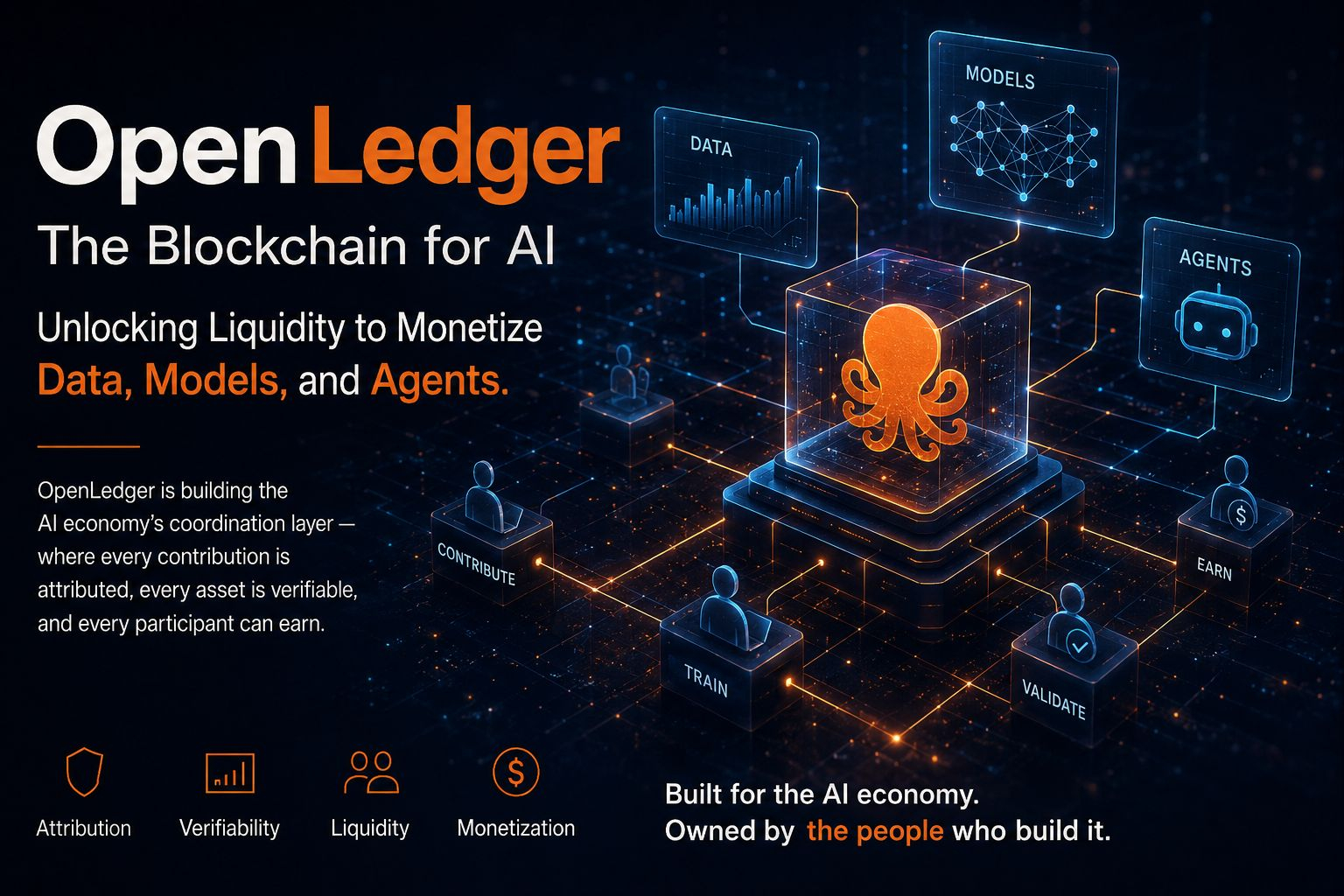
The idea, at least from my perspective, is not simply to build another AI network. It is to create a system where data, models, and intelligent agents can exist inside an economic framework that preserves attribution. In theory, contributors should not disappear once their contribution has been absorbed into a larger system.
That sounds straightforward until you realize how difficult it actually is.
Attribution is one of those concepts that feels obvious in conversation and incredibly complicated in practice.
Imagine thousands of datasets contributing to a model. Imagine thousands of users interacting with that model over time. Imagine researchers making small improvements that only become meaningful when combined with dozens of other improvements. Where exactly does value originate? How much credit belongs to any individual participant?
There are no easy answers.
This is where my initial skepticism returned.
Because the challenge OpenLedger is trying to solve is not primarily technical. It is economic and social.
Technology can record transactions. It can store information. It can automate processes.
Determining who deserves recognition is a completely different problem.
The moment attribution becomes connected to money, incentives begin to change. Participants optimize for rewards. Systems become targets for manipulation. Every measurement mechanism creates opportunities for gaming. Every reward structure creates behavior that nobody originally expected.
In some ways, this is what makes the project interesting.
OpenLedger is operating in a space where computer science collides with human nature.
The architecture itself reflects this tension. Rather than treating AI as a standalone product, the protocol appears to view intelligence as an ecosystem composed of interconnected contributors. Data providers, model builders, validators, developers, and users all occupy different positions within the network. The objective is to create a structure where value can flow through those relationships rather than stopping at a single point.
Whether that flow can be measured accurately remains uncertain.
But uncertainty does not make the problem less important.
If anything, it highlights how early we still are in understanding the economics of artificial intelligence.
For most of technological history, ownership was attached to tangible things. Land, machinery, factories, natural resources. Even intellectual property generally revolves around identifiable creations connected to identifiable creators.
AI complicates that framework.
Modern intelligence systems often emerge from collective inputs that are difficult to separate. Knowledge becomes distributed. Contributions become fragmented. Creation becomes collaborative on a scale that previous ownership models were never designed to handle.
That is why I find OpenLedger more interesting as a philosophical experiment than as a technology product.
It forces a conversation that the industry may eventually have to confront regardless of whether this specific protocol succeeds.
If intelligence increasingly becomes a network phenomenon, should ownership evolve as well?
I don't know the answer.
I suspect nobody does.
The practical challenges remain enormous. Governance alone introduces layers of complexity. Communities must decide what counts as value. Networks must decide what deserves compensation. Participants must trust systems that are constantly balancing competing interests. History suggests that these processes are rarely smooth.
Decentralization sounds elegant until real incentives enter the picture.
People disagree. Communities fragment. Governance becomes political. Economic systems create winners and losers. The idealistic version of coordination often collides with the reality of human behavior.
OpenLedger will almost certainly encounter these tensions.
Every ambitious protocol does.
Yet there is something refreshing about projects willing to engage with difficult questions instead of avoiding them.
Too much of the conversation around AI focuses on capability. How powerful will models become? How fast will they improve? What tasks will they automate?
Those questions matter, but they are only part of the story.
The equally important question is how value moves through the systems that produce intelligence in the first place.
Who contributes?
Who benefits?
Who gets recognized?
Who gets forgotten?
The answers to those questions may shape the future of AI just as much as technical breakthroughs do.
After spending time looking at OpenLedger, I find myself thinking less about blockchain and more about attribution. Less about tokens and more about ownership. Less about artificial intelligence itself and more about the invisible human network that makes intelligence possible.
Maybe that is the project's most interesting contribution.
Not a promise of perfect decentralization. Not a guarantee of fair distribution. Not a vision of a flawless future.
Just a reminder that as intelligence becomes one of the most valuable resources in the digital world, the systems we build around recognition, ownership, and coordination may matter just as much as the intelligence itself.
And whether OpenLedger ultimately succeeds or struggles, that feels like a question worth paying attention to.