
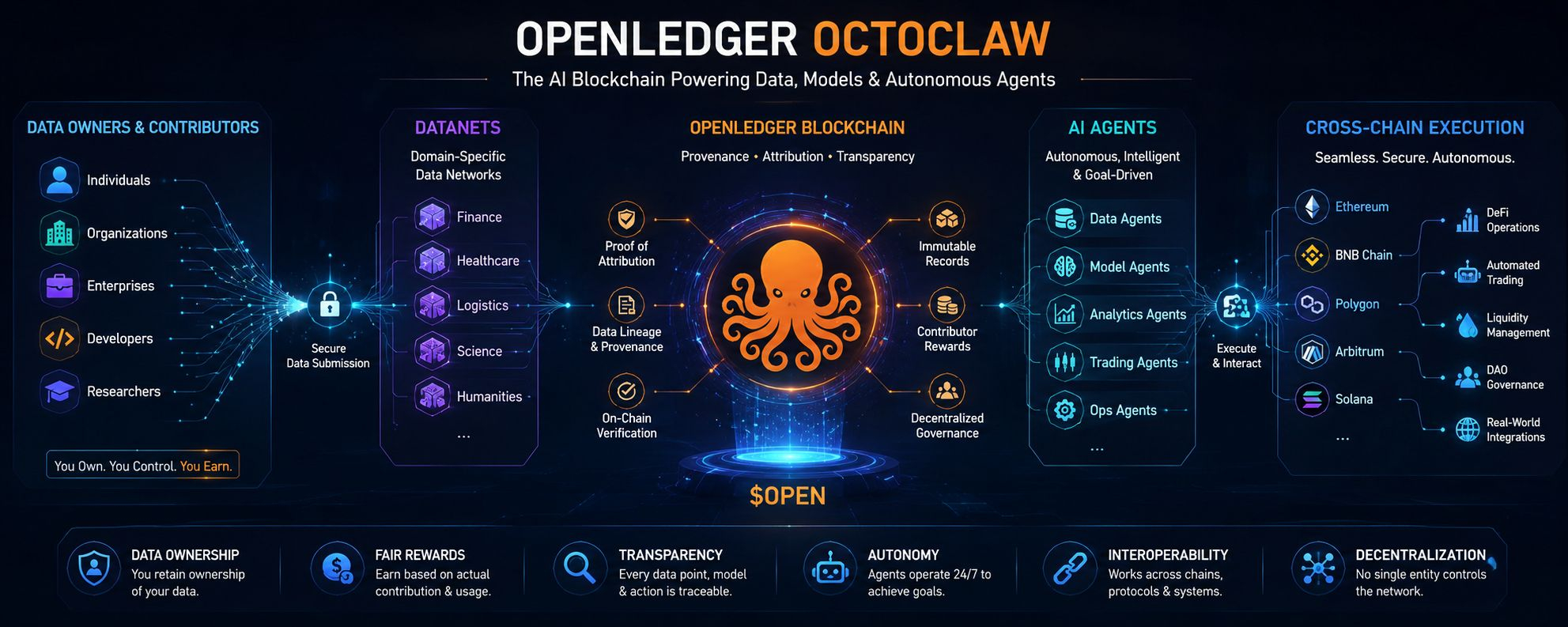

Most projects talking about AI and blockchain still feel trapped inside the same recycled narrative. Bigger models. Faster automation. Smarter agents. Better efficiency. The language changes slightly, but the core idea rarely does. That’s partly why OpenLedger’s OctoClaw launch caught my attention. Not because it arrived wrapped in some dramatic promise about changing everything overnight, but because it quietly points toward a deeper question the market has not fully priced in yet.
What happens when AI stops being a tool you consult… and starts becoming a system that actually acts?
That sounds simple until you think about the implications.
For years, AI has mostly lived inside the informational layer. You ask questions. It responds. You request analysis. It generates output. Even sophisticated systems still operate like highly capable assistants sitting beside the user rather than participating directly inside economic systems. But the line between assistance and execution is becoming thinner every quarter.
And honestly, that shifts the entire perspective.
OctoClaw feels connected to that shift. Because underneath the launch sits a bigger idea about what OpenLedger is trying to become. Not another blockchain chasing temporary AI momentum, but infrastructure built around a harder challenge: data ownership, attribution, autonomous agents, and the economics of intelligence itself.
That is where things start to get interesting.
The phrase “AI Blockchain” sounds almost too clean on paper. Maybe even slightly overused. The market has heard similar positioning before. But once you slow down and examine what the term actually implies, the conversation becomes more serious.
If OpenLedger’s thesis is correct, then blockchain is not just a settlement layer attached to AI systems. It becomes part of how intelligence is coordinated. Part of how data is tracked. Part of how contributors are recognized. Part of how autonomous systems establish trust without depending entirely on centralized operators.
That is a much bigger ambition than simply running AI products inside crypto environments.
And it also comes with far more execution risk.
Because AI infrastructure is already difficult enough without introducing economic attribution, decentralized coordination, onchain logic, cross-chain workflows, and autonomous behavior into the equation.
But difficult does not automatically mean unrealistic.
Sometimes difficult simply means the industry has reached the point where surface-level solutions are no longer enough.
Most people underestimate what’s happening at the infrastructure layer.
The visible part of AI captures headlines. New models. New benchmarks. Viral demos. But underneath all that activity sits a quieter battle over something much less glamorous: who owns data, who benefits from model creation, who controls execution systems, and how value moves through intelligent networks.
That battle matters more than many people realize.
Because the current AI landscape, despite its incredible progress, remains deeply centralized.
A handful of companies control massive training resources. A handful of platforms dominate distribution. Users contribute data, interactions, preferences, corrections, behaviors… yet the economic feedback loop back to contributors is still weak, fragmented, or completely invisible.
@OpenLedger seems to be approaching that imbalance from a different angle.
The idea appears straightforward on the surface: data should not disappear into a model and lose its identity forever. Contributors should not become invisible once training begins. If datasets create value downstream, there should be mechanisms capable of recognizing where influence came from and how rewards might be distributed.
Simple concept.
Extremely hard problem.
Because attribution inside AI systems is messy.
Realistically messy.
Models do not think like accounting spreadsheets. Influence is distributed, layered, nonlinear, and often probabilistic. A single output may emerge from countless overlapping training relationships. Measuring contribution inside that environment is not trivial. It is technically challenging, computationally expensive, and sometimes philosophically ambiguous.
This is where the real question begins.
Can decentralized systems make attribution practical enough to matter economically?
Not perfectly.
Not theoretically.
Actually.
That distinction matters.
Crypto has spent years proving that beautiful architectures do not automatically survive contact with reality. Markets reward implementation far more than intellectual elegance.
Which is why I think OpenLedger’s positioning is more interesting when viewed cautiously rather than enthusiastically.
Because the bigger story is not really about one launch.
It is about where intelligent systems may be heading over the next decade.
The rise of autonomous agents changes the discussion entirely.
An agent that summarizes information is useful.
An agent that executes trades, coordinates wallets, routes liquidity, monitors strategies, manages workflows, or acts across chains becomes something else altogether.
It becomes operational.
That transition carries consequences people often underestimate.
In trading environments especially, manual execution has historically been part of the edge. Timing mattered. Interface familiarity mattered. Speed mattered. Understanding market microstructure mattered.
But automation gradually changes what competitive advantage looks like.
If agents can monitor conditions continuously, optimize routes, coordinate transactions across ecosystems, and execute predefined logic without human delay, then the edge slowly moves away from manual activity.
Toward strategy design.
Toward behavioral architecture.
Toward defining the rules rather than personally performing every action.
That is not a small change.
That is a structural change.
The trader clicking buttons may slowly become the strategist supervising systems.
And honestly, some people are not emotionally prepared for that transition.
Because markets reward adaptation, but they rarely announce when the rules are quietly evolving underneath participants.
Of course, autonomy introduces an entirely different category of problems.
That part should not be ignored.
An AI system capable of executing actions can also execute mistakes.
Poor assumptions become expensive outcomes.
Faulty routing becomes financial loss.
Bad data becomes distorted behavior.
Smart contract failures become real exposure.
Automation amplifies both efficiency and error.
Sometimes simultaneously.
That tension matters.
The industry often romanticizes autonomous systems without spending enough time discussing operational risk.
But risk becomes unavoidable once intelligence gains permission to act.
This is precisely why trust assumptions become central to conversations around decentralized AI infrastructure.
Transparency stops being optional.
Explainability stops being academic.
Auditability stops being a luxury feature.
Users need to understand what systems are doing, what influenced their behavior, where decisions originated, and what safeguards exist when things inevitably go wrong.
Because they will go wrong.
That is not pessimism.
That is systems thinking.
Every sufficiently complex system experiences failure modes.
The important question is not whether failures happen.
The important question is whether failures remain understandable, bounded, and recoverable.
That principle applies equally to autonomous agents, decentralized trading workflows, and AI coordination infrastructure.
OpenLedger’s broader architecture appears aligned with that challenge.
Not through simplistic promises of flawless automation, but through an emphasis on attribution, provenance, interoperability, and coordination.
Whether execution ultimately matches ambition remains an open question.
And that uncertainty should remain part of the conversation.
Too many early-stage infrastructure narratives become distorted by forced certainty.
Reality is usually more complicated.
Building decentralized AI infrastructure is not just about launching technology.
It is about aligning incentives between contributors, builders, operators, enterprises, developers, agents, and end users — groups that often want very different things.
That balancing act is harder than token speculation.
Harder than marketing.
Harder than narrative momentum.
But potentially more durable.
Another dimension worth paying attention to is interoperability.
People often underestimate how strategically important ecosystem compatibility can be.
Because revolutionary ideas mean very little if integration costs remain too high.
Ethereum compatibility, cross-chain coordination, composability — these things may sound technical, but they heavily influence adoption realities.
Builders rarely want to abandon existing ecosystems completely.
They prefer systems capable of connecting into existing tooling, liquidity environments, wallets, developer workflows, and infrastructure standards.
Convenience matters.
Familiarity matters.
Reduced friction matters.
Infrastructure succeeds surprisingly often by making transition easier rather than forcing complete reinvention.
That lesson appears repeatedly across technology history.
And honestly, decentralized AI will likely be no different.
Then there is the enterprise question.
A topic that many crypto discussions prefer to avoid because it introduces uncomfortable practical constraints.
Enterprise adoption is rarely driven by ideology.
Companies do not adopt systems simply because decentralization sounds philosophically attractive.
They adopt systems that satisfy governance requirements, compliance expectations, security standards, operational clarity, and measurable utility.
That changes the evaluation framework significantly.
Suddenly, architecture must survive procurement processes instead of Twitter threads.
Documentation matters.
Reliability matters.
Audit trails matter.
Permission structures matter.
That environment tends to expose weak infrastructure quickly.
If OpenLedger wants to occupy meaningful ground inside decentralized AI, enterprise-grade realities eventually become unavoidable.
Not immediately.
But eventually.
That is where visionary architecture meets execution pressure.
And that meeting point is usually uncomfortable.
Still, there is a larger macro argument that should not be dismissed too quickly.
Centralized AI systems currently dominate for understandable reasons. They are powerful, capitalized, convenient, and rapidly improving.
But centralization also creates predictable tensions.
Data concentration.
Opaque training practices.
Limited contributor visibility.
Platform dependency.
As AI systems become more economically important, those tensions may intensify rather than disappear.
Which creates room for alternative coordination models.
Not necessarily replacements.
Alternatives.
That distinction matters.
Decentralized infrastructure does not need to defeat centralized AI entirely to become relevant.
It may only need to solve the problems centralized systems handle poorly.
Provenance.
Attribution.
Data ownership.
Economic transparency.
Composable participation.
If those pieces become increasingly valuable over time, infrastructure designed around them could become structurally important even without dominating the broader AI market.
That possibility feels more realistic than the exaggerated “winner-takes-all” narratives often pushed around emerging technology sectors.
Maybe OpenLedger ultimately becomes a meaningful coordination layer.
Maybe execution challenges slow adoption dramatically.
Maybe decentralized attribution proves harder than expected.
Maybe autonomous agent infrastructure evolves in directions nobody currently anticipates.
All of those outcomes remain plausible.
That is precisely why the conversation matters.
Because this story is not finished.
It is still unfolding in real time.
What interests me most about OpenLedger’s OctoClaw launch is not whether it instantly validates a bullish thesis.
It doesn’t.
That would be an oversimplification.
What interests me is the underlying direction it suggests.
A future where AI systems are not judged only by intelligence levels, but by how transparently they operate, how fairly they distribute value, how safely they execute actions, and how effectively they coordinate across decentralized environments.
That feels like a more important conversation than temporary market excitement.
And honestly, it may become one of the defining infrastructure questions of the next decade.
Not because anyone already has the final answer.
But because once intelligent systems begin acting, transacting, coordinating, and creating economic value independently, society eventually has to confront deeper questions about ownership, responsibility, incentives, and trust.
Those questions are coming whether markets are ready or not.
@OpenLedger appears to be building with that possibility in mind.
Whether the architecture ultimately proves durable… that remains unwritten.
And maybe that uncertainty is exactly what makes it worth watching.
