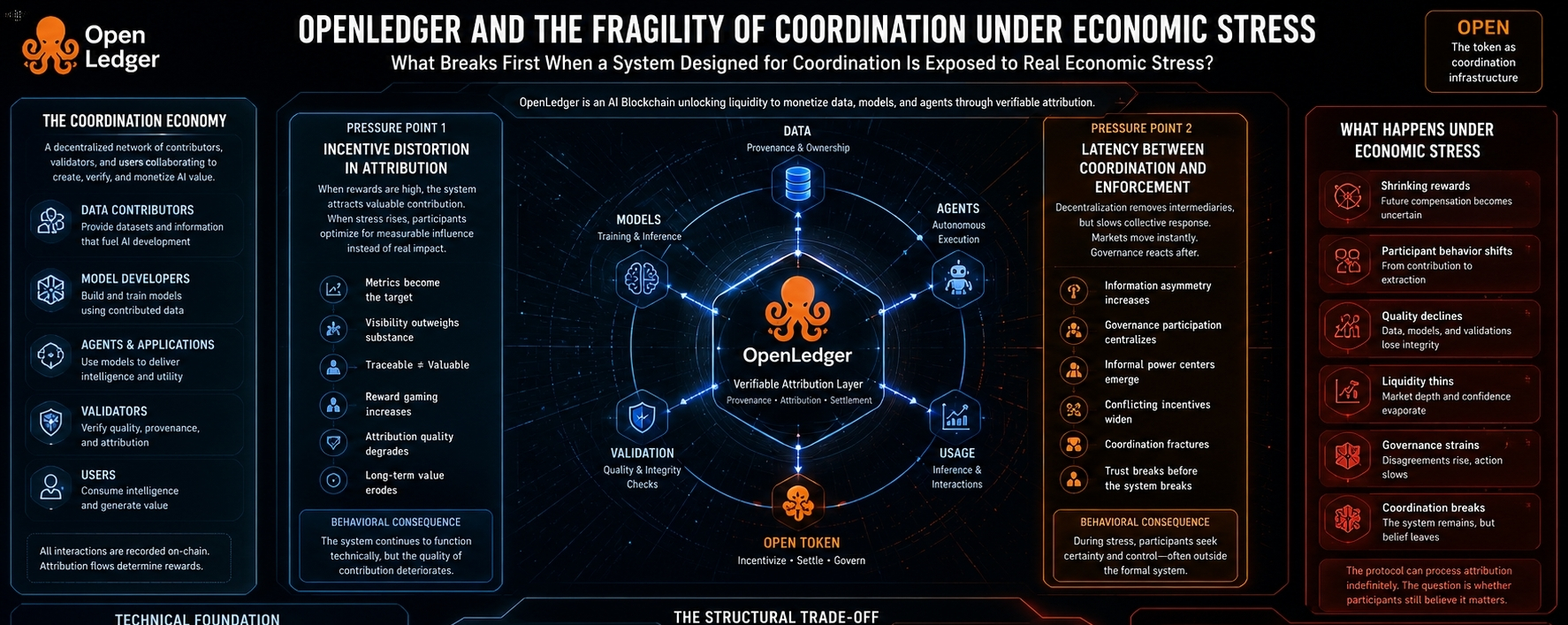
I tend to pay more attention to coordination systems when liquidity disappears than when liquidity arrives. Bull markets make almost every architecture look coherent because capital is willing to subsidize inefficiency for the sake of narrative exposure. OpenLedger sits inside one of the most crowded intersections in crypto: AI, attribution, decentralized infrastructure, and programmable incentives. I have watched enough cycles to know that these sectors attract participants long before they attract stable demand. What interests me is not whether the system works during expansion, but whether the coordination logic survives contraction. The protocol assumes that attribution can become an economic primitive strong enough to organize behavior across contributors, model operators, validators, and users. The uncomfortable part is that attribution only matters when the rewards attached to it are trusted. Once the market begins discounting future rewards, the entire structure shifts from cooperative accounting into competitive extraction.
What I notice first is that OpenLedger treats contribution as something measurable enough to price continuously. That sounds reasonable while activity is growing. But the deeper assumption is behavioral, not technical. The protocol assumes participants will continue producing useful data and maintaining model quality even when the compensation mechanism becomes unstable. I have seen similar dynamics in liquidity mining, validator economies, and governance systems. Participants rarely optimize for long-term network quality. They optimize for the shortest path between effort and monetization. In OpenLedger, the token exists as coordination infrastructure for attribution, settlement, and access. The moment volatility increases, contributors stop thinking about improving model outputs and start thinking about maximizing measurable influence inside the attribution layer itself. That distinction matters because systems built around measurable contribution eventually attract contribution designed specifically to be measured.
This is where the first structural pressure point appears. Attribution becomes vulnerable to incentive distortion precisely because it is financially meaningful. OpenLedger’s architecture depends on tracing influence through datasets and model interactions in order to distribute rewards. Under stable conditions, this creates a shared incentive to improve collective intelligence. Under stress, it creates an incentive to manufacture traceable relevance. Those are not the same behavior. I have watched capital rotate through narratives where visibility becomes more valuable than substance. In decentralized systems, the metric that distributes rewards eventually becomes the target of optimization. The protocol does not need malicious actors to experience degradation. It only needs rational participants adapting to shrinking margins.
The interesting thing is that this pressure is subtle at first. The degradation does not appear as an obvious exploit. It appears as a slow migration toward data that performs well economically inside the attribution engine rather than data that improves resilience or accuracy over time. Contributors begin optimizing for discoverability within the reward structure. Model operators prioritize interactions that generate measurable attribution flows. Validators become dependent on throughput tied to token-denominated activity. The system still functions technically, but the behavioral composition changes. I think this is one of the hardest things for coordination protocols to admit: incentive alignment is usually temporary because participants adapt faster than governance frameworks do.
There is also a structural asymmetry between short-term liquidity and long-term trust. OpenLedger frames itself around verifiable provenance and transparent contribution tracking. But provenance systems inherit the volatility of whatever economic layer validates them. If the surrounding token economy weakens, attribution itself becomes politically fragile. Participants stop debating whether attribution is accurate and start debating whether attribution is economically survivable. I have seen this in governance systems where ideological commitments disappear the moment treasury values collapse. People tolerate complexity when rewards are expanding. They become intolerant of ambiguity when rewards compress.
The second pressure point emerges from latency between coordination and enforcement. OpenLedger distributes responsibility across contributors, model developers, validators, and governance participants. In theory, decentralization reduces dependence on centralized authority. In practice, it often increases dependence on collective response speed. That trade-off becomes dangerous during periods of economic stress because decentralized systems react slower than capital exits. Markets move immediately. Governance reacts afterward. The protocol can verify attribution, process inference payments, and record interactions on-chain, but none of that guarantees fast consensus during moments where incentives diverge sharply.
I think people underestimate how much coordination depends on informal authority even inside decentralized systems. When volatility accelerates, participants look for actors capable of imposing direction quickly. If nobody possesses legitimate authority, coordination fractures into competing interpretations of self-interest. OpenLedger distributes governance rights through the token infrastructure, which sounds neutral until participation becomes expensive. Under stress, governance participation tends to centralize around the actors most financially exposed to the protocol’s survival. That creates a paradox. The system removes formal intermediaries, but economic pressure recreates informal power centers anyway.
What makes this structurally uncomfortable is that AI-related coordination amplifies the consequences of delayed trust repair. In financial systems, participants can tolerate temporary inefficiency if settlement remains predictable. In attribution-driven AI systems, uncertainty compounds because contributors are continuously evaluating whether future compensation remains credible. Once contributors begin doubting future reward integrity, participation quality changes immediately. Not because the technology failed, but because economic expectations failed first. The protocol’s technical architecture translates directly into emotional behavior: hesitation, reduced contribution quality, defensive extraction, and eventually selective disengagement.
There is a trade-off here that I do not think can be removed. Systems optimized for open participation become structurally vulnerable to participants who optimize faster than the system can govern them. OpenLedger gains scalability by allowing decentralized contribution and attribution across a broad network. But the broader the participation surface becomes, the harder it becomes to distinguish genuine coordination from economically rational mimicry. Efficiency increases exposure.
The question that stays with me is not whether the attribution works technically. It is whether participants still believe the attribution matters once the surrounding market stops rewarding patience. Crypto systems often claim they eliminate intermediaries, but during stress, intermediaries usually return in disguised form: market makers stabilizing liquidity, large token holders shaping governance outcomes, infrastructure operators controlling practical access, influential voices coordinating expectations off-chain. The protocol may remain decentralized in architecture while becoming socially centralized in behavior.
I keep coming back to the same observation every cycle. Coordination systems fail gradually before they fail visibly. Activity remains high for longer than trust does. Metrics continue updating. Transactions continue settling. Governance continues voting. But underneath the surface, participants quietly stop treating the system as a shared structure and start treating it as a temporary extraction environment. OpenLedger may be able to process attribution indefinitely. I am less certain it can preserve cooperative belief once the rewards attached to coordination begin feeling conditional rather than durable.