
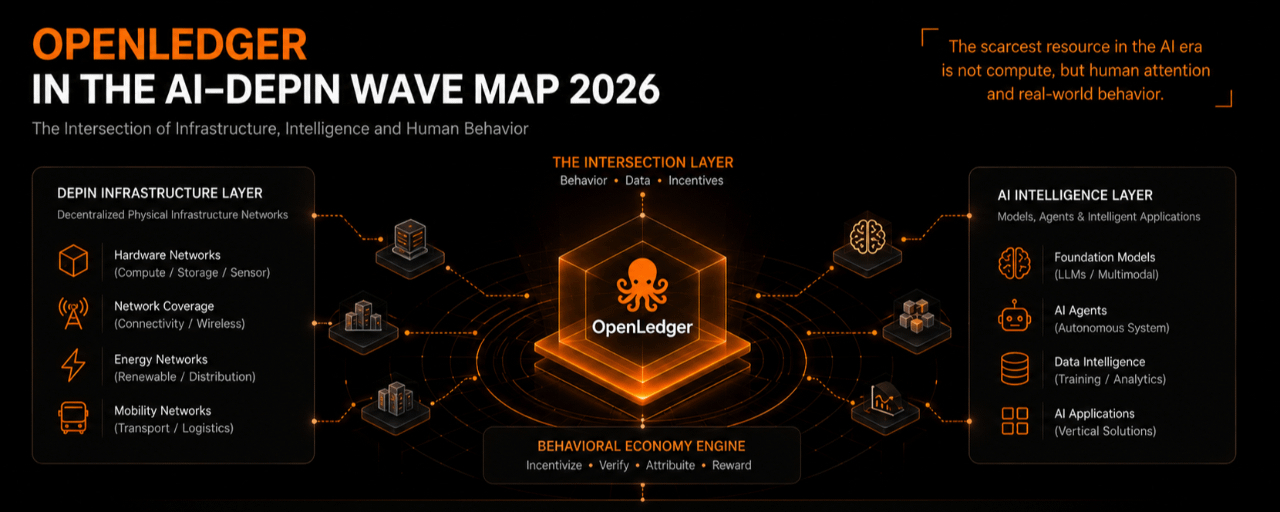
One thing I've noticed after watching multiple technology cycles is that the most important part of a new wave often isn't the technology itself—it's the behaviors that technology encourages.
Before DePIN became a major narrative, the conversation was largely about infrastructure. Who owns the resources? Who contributes the hardware? Who can build the largest distributed network? The focus was on optimizing physical and digital resources.
Today, as AI becomes the center of attention, the discussion appears to be shifting.
The key resource is no longer just infrastructure. It's data—and even more fundamentally, the human behavior that generates that data.
Viewed through that lens, OpenLedger doesn't seem to fit neatly into the traditional DePIN framework. Instead, it appears to occupy a unique position between decentralized infrastructure and the emerging behavioral economy.
AI is creating an interesting paradox.
Models are becoming more powerful. Reasoning capabilities continue to improve. Compute costs are gradually declining.
Yet high-quality data is becoming increasingly scarce.
Much of the internet's content is optimized for engagement, visibility, and algorithmic distribution rather than authenticity. AI systems, however, depend on signals that reflect genuine human activity and real-world behavior.
That gap continues to grow, and OpenLedger appears to be exploring ways to address it.
What's interesting isn't simply the addition of another blockchain layer or another AI token. The larger idea is transforming behavioral contributions into something measurable, attributable, and economically recognized.
At first glance, that may seem like a subtle shift, but it represents a fundamentally different way of thinking about data.
For most of the internet's history, data collection has been passive. People interact with platforms, platforms record behavior, and the resulting value primarily accumulates to the platform itself.
In that model, users often become the raw material without fully realizing it.
OpenLedger seems to be experimenting with a different approach.
Rather than focusing solely on collecting data, it seeks to create incentives for individuals to actively contribute to data creation and curation. This is where the conversation becomes more interesting than a typical DePIN narrative.
Because once behavior is incentivized, the challenge is no longer infrastructure optimization.
It's psychology optimization.
It's about designing incentives, motivations, and participation patterns.
And that's where some of the most important trade-offs emerge.
When data becomes an asset, does behavior remain organic?
When contributions are rewarded, do signals remain authentic, or do they gradually become optimized for incentives?
These questions extend far beyond OpenLedger.
They may ultimately define the broader AI economy itself.
Every incentive system changes the behavior of the people participating in it.
What makes OpenLedger worth watching is that it appears to sit at the intersection of two of today's most powerful trends.
On one side is DePIN, with its goal of decentralizing infrastructure.
On the other is AI, with its growing demand for trustworthy, high-quality data.
Yet the most overlooked layer may be neither infrastructure nor models.
It may be the behavioral layer in between—the place where humans decide how they engage with systems and how value is created.
The more I observe technology, the more it seems that the platforms that create lasting change are not always those with the most advanced algorithms, but those that best understand human decision-making.
Whether OpenLedger ultimately becomes a defining piece of the AI-DePIN ecosystem remains uncertain.
But the metric worth watching may not simply be node counts, network growth, or token performance.
It may be how effectively the system experiments with a much larger idea:
That in the AI era, the scarcest resources may not be compute power, but human attention, behavior, and authentic signals—and the competition to capture and coordinate those resources is only beginning.