
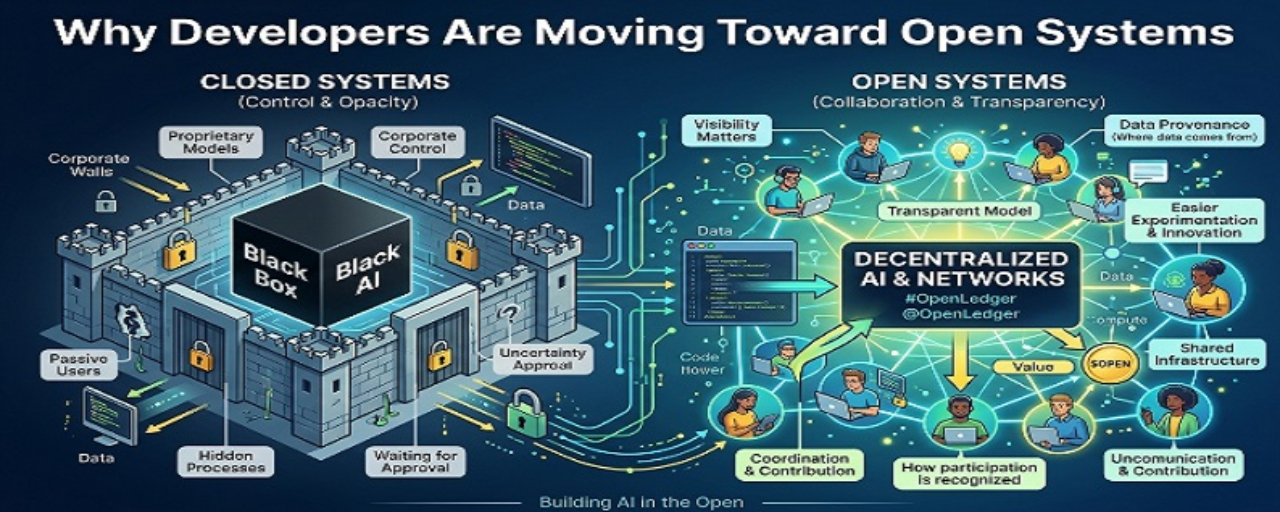
I've been watching the AI space for a while, and one thing keeps standing out.
The conversation isn't only about what AI can do anymore. More and more, it seems to be about where AI is being built and who gets to participate in that process.
A few years ago, it felt normal to assume that the biggest and most useful systems would exist behind closed doors. Companies would build, users would use, and that was pretty much the relationship.
Lately, that assumption feels weaker.
I noticed that many developers seem increasingly interested in open systems, and I don't think it's just about ideology. It feels more practical than that.
When people build on open networks, they can see how things work. They can contribute, experiment, and sometimes even improve parts of the system themselves. There's a different feeling when you're building with something instead of simply using it.
That thought came to mind while reading about @OpenLedger .
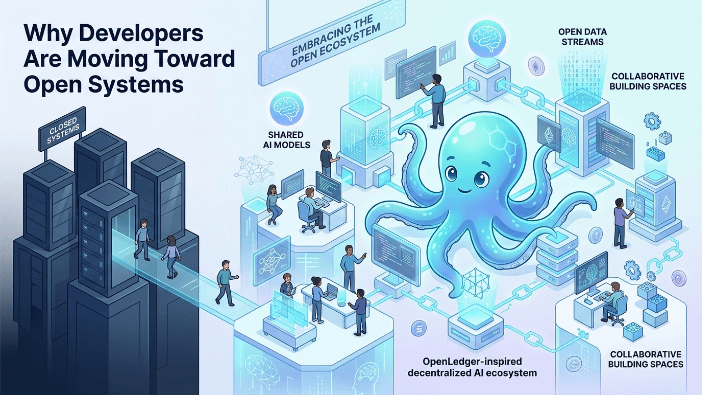
What's interesting is that projects like #OpenLedger are appearing at a time when AI is becoming more important in everyday digital life. As AI grows, questions around ownership, contribution, and access naturally become harder to ignore.
Developers tend to notice those questions early.
Sometimes I wonder if open systems are attracting attention because they reduce uncertainty. Not because they solve every problem, but because they make parts of the process visible.
Visibility matters.
If data contributes to a model, people want to know where it came from.
If a network creates value, contributors want to understand how participation is recognized.
If AI becomes part of daily infrastructure, developers often want transparency instead of black boxes.
Those are not new concerns, but they seem more relevant now than ever.
I've also noticed that open systems create room for experimentation. Ideas don't need to wait for approval from a single organization before being tested. Different people can contribute from different places, and sometimes unexpected solutions emerge from that process.
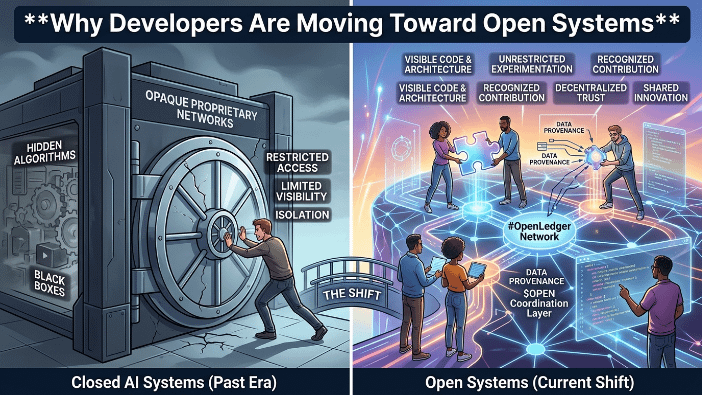
That feels closely connected to what @OpenLedger is exploring.
The project often appears in discussions about decentralized AI, but what catches my attention is the broader shift behind it. There seems to be growing interest in infrastructure where contributors, builders, and users can all play visible roles.
Not because openness is automatically better.
Just because participation becomes easier.
The more I think about it, the more it feels like developers are responding to the direction technology is moving. AI systems are becoming larger, more connected, and increasingly dependent on data from many different sources.
In that environment, open frameworks may simply fit the moment better.
I see similar conversations around $OPEN , where people aren't only discussing technology. They're discussing coordination, contribution, and how networks can function when many participants are involved.
That's a different kind of discussion than we saw a few years ago.
It feels less focused on control and more focused on collaboration.
Whether that trend continues remains to be seen.
Technology changes quickly, and today's assumptions rarely survive forever.
Still, when I look at projects connected to #openledger and the broader ideas behind #open systems, it feels like developers are searching for environments that are easier to understand, easier to contribute to, and easier to trust.
Maybe that's the real shift taking place.
Not a move away from innovation, but a move toward building it in the open.
And the more I watch these conversations unfold, the more it feels like that preference isn't temporary. It feels like a natural response to the way AI networks are evolving.
