
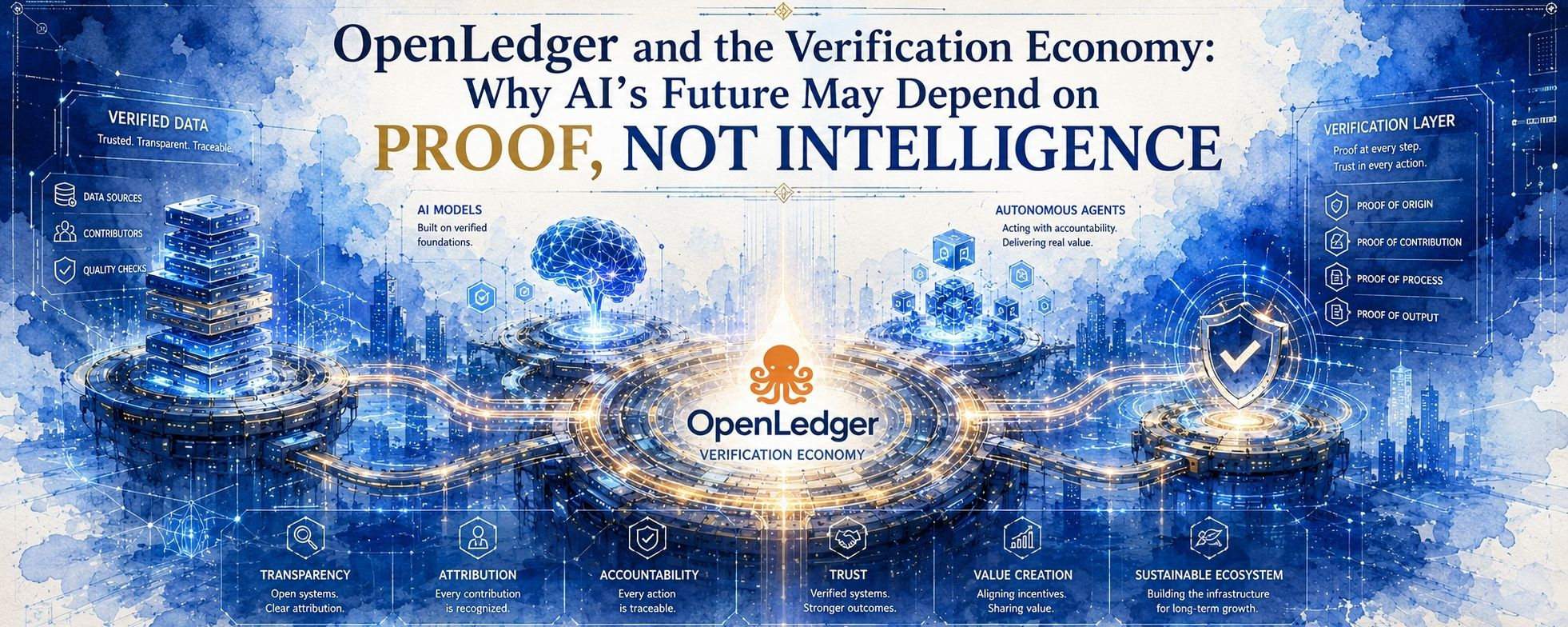

@OpenLedger The AI industry has become remarkably good at generating answers.
Not long ago, that alone would have sounded like a breakthrough. Models struggled with context, reasoning was inconsistent, and reliability remained a major obstacle. Today, the situation looks very different. AI systems can write reports, analyze complex information, generate software, summarize research, and increasingly perform tasks that once required entire teams of people.
The technology continues improving at a remarkable pace.
Yet the more capable AI becomes, the more I find myself thinking about a different problem.
A problem that has very little to do with intelligence itself.
The challenge is verification.
The future AI economy may not be constrained by what systems can generate. It may be constrained by how confidently people can trust what those systems generate.
That distinction feels increasingly important.
As organizations integrate AI into workflows, decisions, products, and services, the conversation naturally shifts away from simple capability and toward accountability. Businesses want to know where information originated. Developers want attribution. Contributors want recognition. Users want confidence that the outputs they receive are connected to reliable sources rather than opaque processes hidden behind increasingly complex systems.
This is one reason #OpenLedger has become more interesting to me over time.
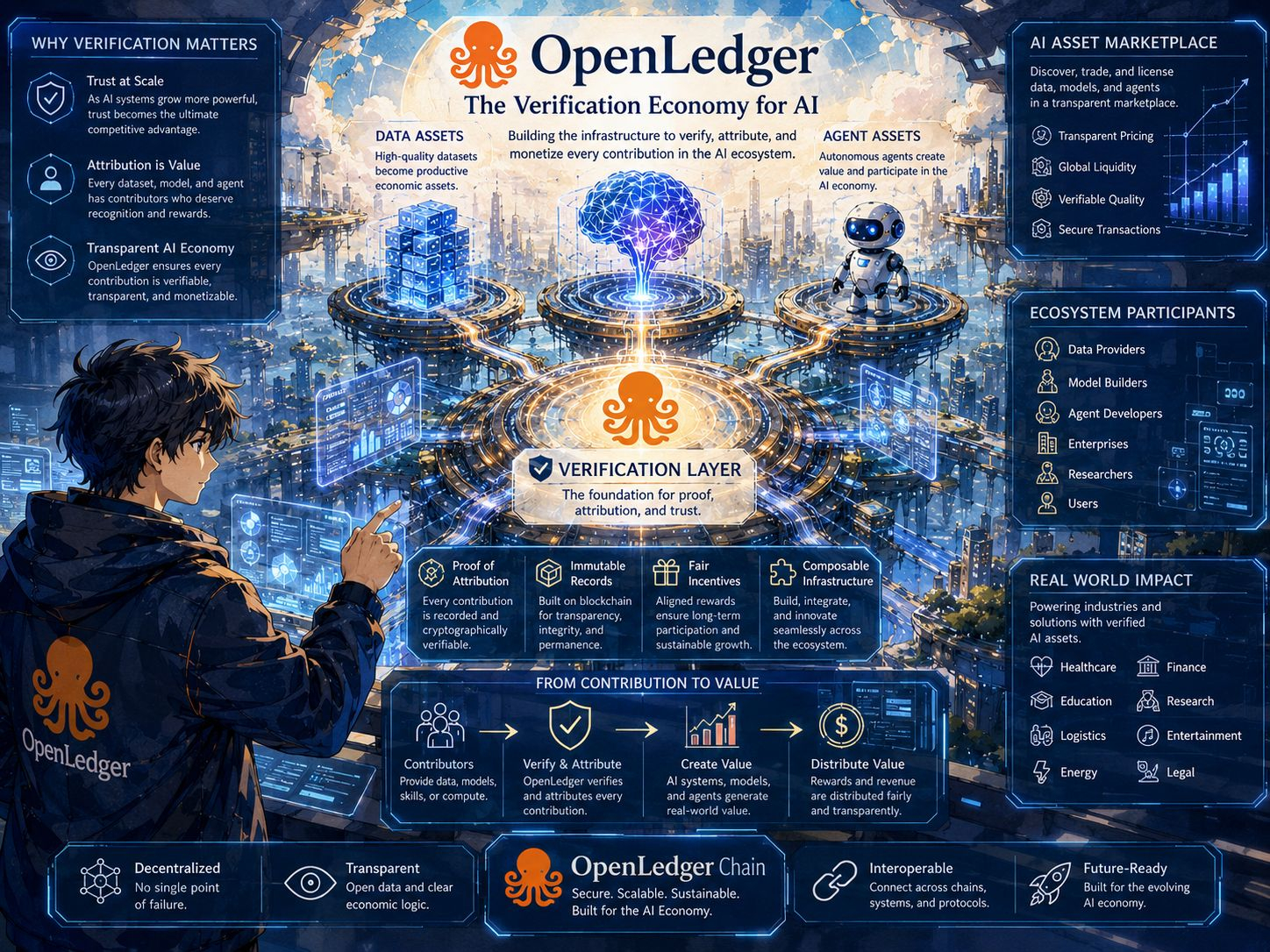
At first glance, #openledger is positioned as an AI blockchain focused on monetizing data, models, and agents. That description is accurate, but it only captures part of the picture. The deeper idea seems to revolve around creating transparent economic infrastructure around intelligence itself.
And transparency may become one of the most valuable resources in the AI era.
For years, the technology industry operated under an assumption that intelligence was the scarce resource. Whoever built the most capable model would possess the strongest competitive advantage. While model quality still matters, the industry is gradually discovering that intelligence alone does not solve every problem.
In many situations, trust becomes equally important.
An answer is useful.
A verifiable answer is far more valuable.
A recommendation is useful.
A recommendation with clear attribution is far more valuable.
An autonomous agent can perform tasks.
But an autonomous agent whose actions can be understood, tracked, and verified becomes significantly more useful inside real-world economic systems.
This is where OpenLedger’s broader vision begins to stand out.
Rather than treating AI outputs as isolated results, the project appears focused on the underlying contributors responsible for creating those results. Data providers, model developers, researchers, communities, and agents all contribute to the final outcome. The challenge is ensuring those contributions remain visible rather than disappearing inside increasingly complex AI pipelines.
Historically, the internet was not particularly good at solving this problem.
Information flowed efficiently.
Value attribution often did not.
Content spread rapidly.
Recognition frequently remained uneven.
Platforms accumulated value while many contributors remained largely invisible.
AI risks amplifying that dynamic because the systems involved are far more complex than traditional content platforms.
A single AI-generated output may depend on countless datasets, multiple models, various infrastructure providers, and layers of optimization developed by different participants over time.
The final answer looks simple.
The process behind it rarely is.
That complexity creates an interesting opportunity for projects focused on verification and attribution.
The more interconnected AI ecosystems become, the more important transparent economic relationships become.
OpenLedger appears to be building around exactly this reality.
The project starts from an assumption that feels increasingly reasonable: intelligence is not created in isolation. It emerges from networks of contributors, information sources, computational resources, and autonomous systems working together.
Once you view AI through that lens, verification becomes much more than a technical feature.
It becomes economic infrastructure.
One trend I have noticed throughout 2026 is that enterprises are becoming increasingly selective about AI adoption. Early excitement centered around experimentation. Organizations wanted to understand what AI could do.
Now the conversation is maturing.
Companies are asking different questions.
Can we trust the outputs?
Can we audit the process?
Can we identify contributors?
Can we understand where information originated?
These concerns become more important as AI moves closer to mission-critical operations.
A casual chatbot interaction can tolerate occasional uncertainty.
Financial decisions cannot.
Healthcare applications cannot.
Research environments cannot.
Business workflows cannot.
As a result, the ability to verify information may become one of the most valuable capabilities within the broader AI ecosystem.
That possibility aligns closely with OpenLedger’s focus on attribution and ownership.
The project seems designed around a future where data itself becomes increasingly valuable. Not simply because data improves models, but because verified data improves confidence.
And confidence is ultimately what allows economies to scale.
History offers countless examples of this principle.
Markets expanded when contracts became enforceable.
Commerce accelerated when payment systems became trustworthy.
Digital businesses flourished when secure infrastructure became widely available.
In each case, growth depended not only on capability but also on confidence.
AI may be approaching a similar stage of development.
The technology is advancing rapidly.
The infrastructure supporting trust is still evolving.
That is why verification feels like such an important theme.
Not because it sounds exciting.
In many ways, it sounds surprisingly boring compared to discussions about artificial general intelligence or revolutionary new models.
Yet infrastructure often appears boring right before it becomes essential.
Cloud computing looked boring before businesses depended on it.
Payment networks looked boring before digital commerce exploded.
Data centers looked boring before the internet economy emerged.
Verification infrastructure may follow a similar path.
The rise of AI agents makes this trend even more compelling.
Agents are becoming increasingly autonomous. They can gather information, coordinate workflows, monitor environments, and perform actions across digital systems. As they become more capable, the importance of attribution grows.
Who provided the information?
Which model contributed to the outcome?
Which participant created the value?
How should rewards be distributed?
These questions are not theoretical.
They become increasingly relevant as AI systems begin participating in real economic activity.
OpenLedger appears to recognize that future and is positioning itself around the infrastructure required to support it.
Of course, challenges remain.
Verification systems are difficult to build.
Economic incentives must remain aligned.
Adoption is never guaranteed.
Competition across AI infrastructure continues intensifying.
The project still faces many of the uncertainties affecting the broader industry.
Those realities deserve acknowledgment.
At the same time, the underlying problem OpenLedger is addressing feels increasingly important with each passing month.
The smarter AI becomes, the more valuable proof becomes.
The more autonomous systems become, the more valuable transparency becomes.
The more participants contribute to AI ecosystems, the more valuable attribution becomes.
These trends all seem to converge toward the same destination.
An AI economy where trust is not an afterthought but a foundational layer.
That possibility is ultimately what makes OpenLedger worth watching.
Not because it promises another breakthrough in intelligence.
But because it is focused on something that may become just as important.
Helping the future AI economy understand not only what was created, but how it was created, who contributed, and why it can be trusted.
In a world increasingly filled with intelligent systems, proof may become every bit as valuable as intelligence itself.