
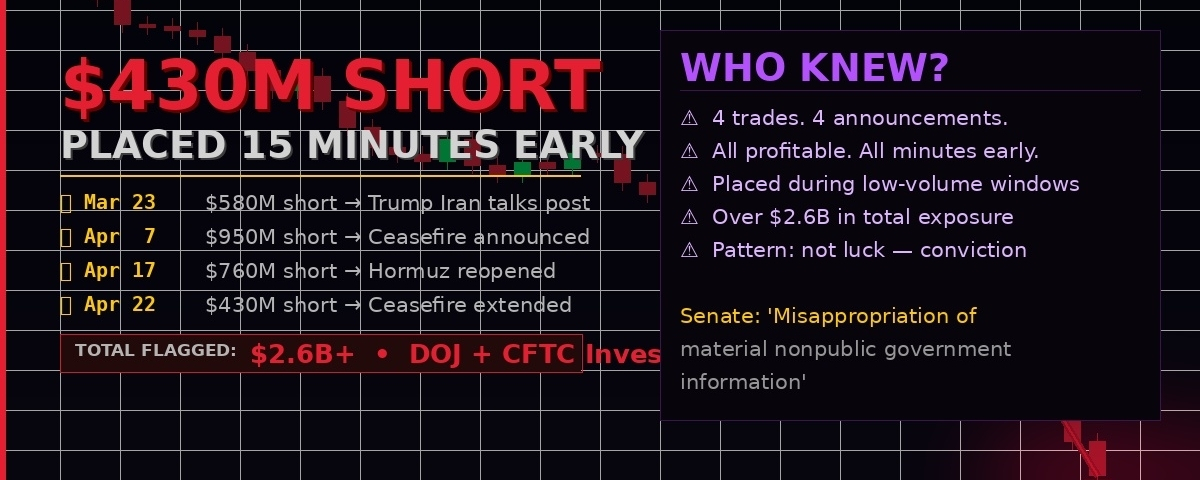
A series of unusually timed, high-volume bets on falling oil prices — placed minutes before major de-escalation announcements by President Donald Trump and Iranian officials — has triggered active investigations by the U.S. Department of Justice (DOJ) and the Commodity Futures Trading Commission (CFTC). The trades, spanning March and April 2026, involve notional values exceeding $2.6 billion and have raised serious concerns about potential misuse of material non-public information (MNPI) from government sources.
### The Documented Pattern
Exchange data analyzed by Reuters, the London Stock Exchange Group (LSEG), Bloomberg, and others reveals a striking pattern of large, directional short positions in oil futures (primarily Brent and WTI contracts on CME Group and ICE platforms) executed in low-volume windows just before market-moving news that caused oil prices to drop sharply.
Key instances include:
- March 23, 2026: Approximately $500–800 million in shorts placed around 6:50 a.m. ET, roughly 15 minutes before Trump posted on Truth Social about delaying strikes on Iranian energy infrastructure and holding productive talks. Oil prices plunged over 10–15% following the announcement.
- April 7, 2026: Roughly $950–960 million bet on declining oil hours before Trump announced a two-week ceasefire with Iran, which sent prices down about 15%.
- April 17, 2026: Around $760 million in positions shortly before Iran announced the reopening of the Strait of Hormuz.
- April 21, 2026: Approximately $430 million placed minutes before Trump extended the ceasefire indefinitely.
These were not routine hedging activities. They occurred in off-hours or thin trading periods with high conviction (heavily one-sided shorts), characteristics that regulators flag as suspicious. Analysts noted the absence of other public catalysts to explain the volume spikes.
Some reports suggest the aggregate exposure across related trades may be even higher, potentially approaching $7 billion when including additional contracts in crude, diesel, and gasoline futures.
### Regulatory and Congressional Response
The CFTC initiated reviews following early reports, focusing on futures trading records from CME and ICE. The DOJ has since escalated involvement, with the U.S. Attorney’s Office for the Southern District of New York leading aspects of the probe into possible insider trading tied to government information.
Senators Elizabeth Warren (D-MA) and Sheldon Whitehouse (D-RI) sent a formal letter to the CFTC on April 9, 2026, demanding an investigation into the March 23 and April 7 trades. They highlighted the pattern as raising “serious questions about whether there has been recurring misappropriation of material nonpublic government information.”
Rep. Ritchie Torres (D-NY) urged expansion of the probe to include the April $430 million trade, calling for coordination with national security agencies.
As of early June 2026, the investigations remain ongoing. Identities of the traders or firms involved have not been publicly disclosed. Authorities are examining beneficial ownership, communications, and potential intermediaries.
### How It Works: Mechanics of Potential MNPI Misuse
Oil futures are highly liquid and leveraged, making them ideal for capitalizing on geopolitical news. A small timing advantage — knowing policy shifts before public announcement — can yield massive profits with limited capital due to margin requirements.
Trades in post-settlement or low-volume windows amplify impact and reduce visibility. Classic insider trading indicators present here include:
- Precise timing relative to announcements.
- Repetition across multiple independent events.
- Lack of apparent legitimate hedging rationale (e.g., no matching long positions or portfolio rebalancing signals).
Proving a direct link to government sources (White House staff, advisors, diplomats, or their networks) is the key challenge for prosecutors. If established, it would constitute illegal insider trading under securities and commodities laws, with potential national security implications.
### Voices and Reactions
Economist Paul Krugman described the pattern in stark terms on Substack, labeling it effectively “treason” — arguing that profiting from leaks on national security decisions (war, strikes, ceasefires) undermines U.S. interests and could signal vulnerabilities to adversaries monitoring markets.
Critics from the left have framed it as emblematic of broader administration ethics issues. Defenders argue it could reflect sophisticated (legal) intelligence from public signals, algorithmic trading, or coincidence — though the repeated alignment strains credulity for many market observers.
### Broader Implications
This episode highlights vulnerabilities in how policy announcements intersect with global commodity markets. Oil prices swung dramatically amid the 2026 U.S.-Iran tensions, affecting energy costs worldwide. If insiders are front-running de-escalation signals, it erodes public trust in government transparency and market fairness.
No charges have been filed, and investigations could take months. Outcomes may range from cleared trades to significant penalties, disgorgement of profits, and referrals for criminal prosecution.
The Bottom Line: The statistical improbability of four (or more) perfectly timed, highly profitable large bets absent non-public information makes this a legitimate scandal worth rigorous scrutiny. Regulators have the data — transparency on findings will be crucial for restoring confidence. Markets should price policy based on public information, not whispers from insiders.
This article draws from reporting by WSJ, ABC News, Reuters, Bloomberg, Senate records, and other outlets. All figures are approximate based on notional values reported as of June 2026 - AI Analysts