Flare ($FLR) is fundamentally positioned to experience a powerful, utility-driven "moon" phase if Ripple ($XRP) captures global cross-border settlement dominance.Because Flare was architected from inception to bring smart contract capability to non-smart contract tokens like XRP, an explosion in XRP adoption creates a direct, compounding demand loop for FLR.
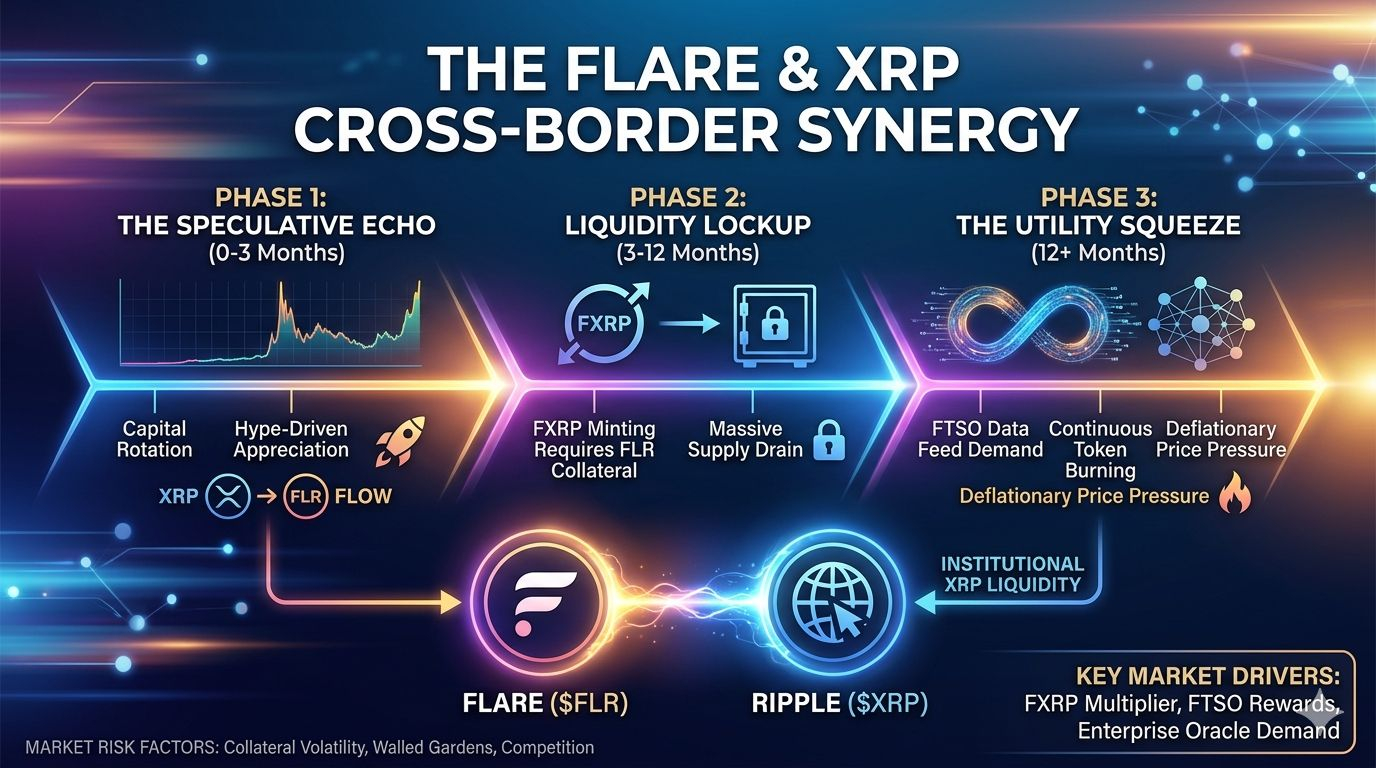
The mechanism connecting a massive spike in XRP cross-border utility to an exponential price surge for FLR spans three core phases.
1. Execute the Multi-Phase Adoption Timeline
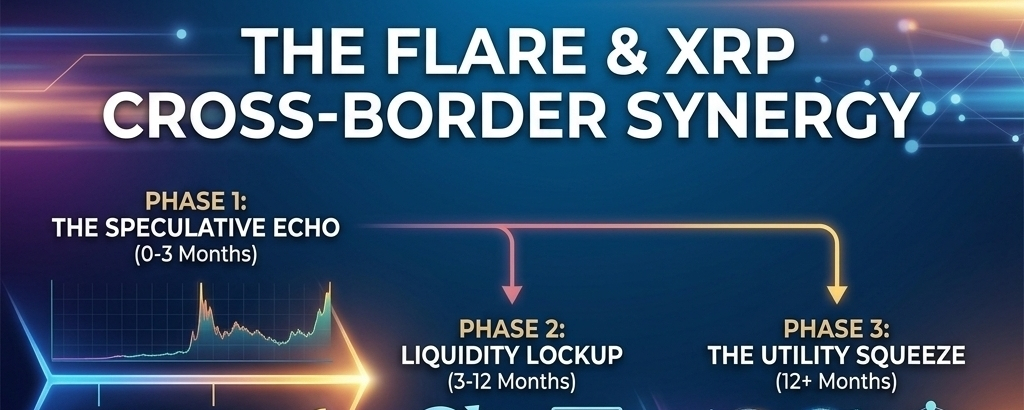
An XRP-driven FLR surge will materialize across three distinct market phases, transforming from speculative hype into a network utility squeeze.
[Phase 1: Speculative Echo] ──> [Phase 2: Liquidity Lockup] ──> [Phase 3: The Utility Squeeze]
(0 - 3 Months After News) (3 - 12 Months Post-Launch) (12+ Months Continuous)
Phase 1: The Speculative Echo (0 to 3 Months)
Capital Rotation: XRP profits immediately cascade into the Flare ecosystem as the closest correlated high-beta asset.
Speculative Arbitrage: Traders front-run the upcoming utility integration, driving rapid, hype-driven price appreciation.
FTSO Metric Spikes: The Flare Time Series Oracle (FTSO) sees a massive volume increase as traders flood decentralized exchanges to pair XRP and FLR.
Phase 2: The Liquidity Lockup (3 to 12 Months)
F-Asset Launch: Ripple’s institutional partners require decentralized finance (DeFi) capabilities for their idle XRP settlement capital.
Collateralization Squeeze: To mint FXRP (bringing XRP onto Flare safely), agents must lock up FLR as over-collateralized backing.
Circulating Supply Drain: As billions in institutional XRP seek yield on Flare, massive amounts of FLR are pulled out of open-market circulation and locked into smart contracts.
Phase 3: The Utility Squeeze (12+ Months)
Data Consumption Fees: High-frequency cross-border settlements require instantaneous, reliable price data.
Institutional Burning: Global financial institutions continuously buy and burn FLR to pay for enterprise-grade data feeds from Flare's Layer 1 network.
Deflationary Velocity: Network transaction volume reaches a tipping point where burned FLR outpaces daily token emissions, creating permanent upward price pressure.
2. Analyze the Compound Utility Value Drivers
When XRP dominates cross-border settlements, FLR does not just rise on positive sentiment; its core infrastructure forces a structural supply deficit.
The FXRP Multiplier: Minting FXRP requires a high collateral ratio (often 1:2 or higher in value). If $10 billion worth of XRP moves onto Flare to participate in lending or automated market-making, $20 billion worth of FLR must be locked to secure it.
Compounded Yield Dynamics: Users who delegate FLR to FTSO data providers earn inflationary rewards while simultaneously earning system fees from the FXRP protocol, creating an incredibly lucrative holding incentive that stops investors from selling.
Enterprise Oracle Demand: Flare’s state connector and oracle networks act as the secure data bridge between legacy banking APIs (like SWIFT) and decentralized ledgers. Financial institutions must hold FLR to access this infrastructure.
3. Evaluate Key Market Risk Factors
While the upside potential is massive, achieving a true "moon" scenario requires navigating specific structural hurdles.
Collateral Volatility Risks: A sudden flash crash in the price of FLR can trigger cascading liquidations of FXRP pools, creating temporary downward sell pressure if the collateral mechanisms are poorly calibrated.
Institutional Walled Gardens: If Ripple deploys its cross-border settlement infrastructure strictly on private, permissioned versions of the XRP Ledger (XRPL), the volume flowing into the public Flare network could face delays.
Network Competition: Alternative Layer 1 protocols and Ethereum Layer 2 scaling solutions will fiercely compete to capture institutional XRP liquidity, requiring Flare to maintain superior data security and lower transaction fees.