
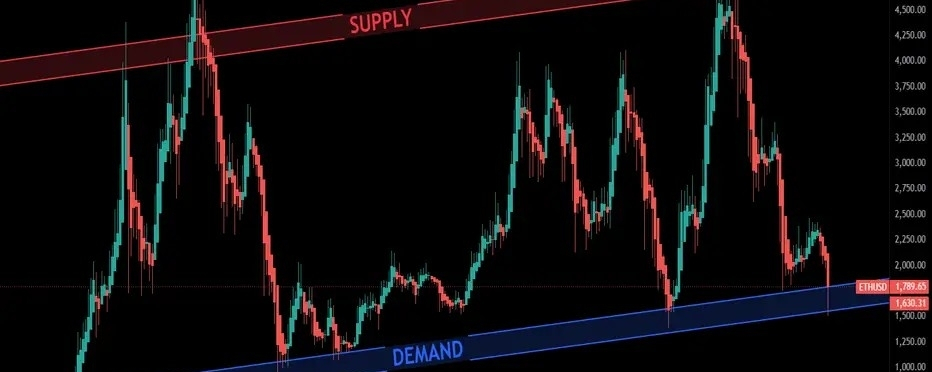
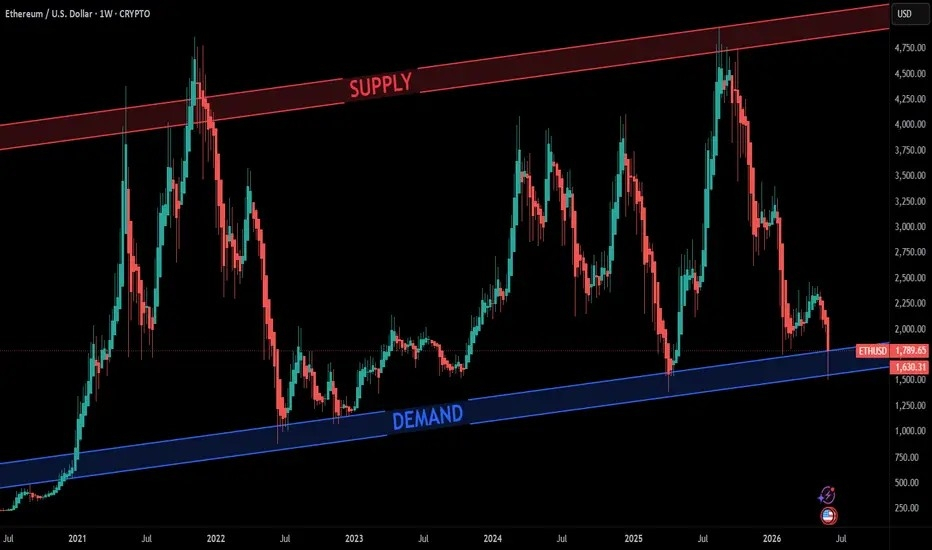

Ethereum (ETH) has found itself in a defining technical zone following a prolonged downtrend. As the asset tests foundational support levels, the market is weighing structural shifts within its core organization against promising macro catalysts.
📊 Market Overview & Technical Health
The broader crypto landscape is currently consolidating near local lows, with Bitcoin hovering precariously around $60,000. For Ethereum, the immediate focus is a crucial defensive battleground on the charts.
💰 Current Price: ~$1,566 - $1,603
📈 24-Hour Change: +2.41%
💎 Market Capitalization: ~$193.5 Billion
🏆 Market Rank: #2 (Recently flipped by Tether's USDT)
🔍 Technical Analysis
Trend Structure: The weekly chart paints a clear bearish picture characterized by consecutive lower highs and lower lows.
🛡️ Line in the Sand: The $1,500 zone stands as the most critical line of defense for buyers, having previously provided strong structural support in late 2023 and April 2025.
🧱 Overhead Resistance: Sellers remain dominant on short-term rallies, actively defending the $1,610–$1,620 range.
⚡ Momentum Indicators: The Relative Strength Index (RSI) has dipped into oversold territory (29), signaling extreme selling fatigue. However, the Moving Average Convergence Divergence (MACD) remains firmly bearish, suggesting that downward momentum has not yet fully dissipated.
As visualized in the long-term weekly chart 1000559589.jpg, the price action is presently testing the lower bounds of a multi-year ascending demand channel.
📰 Key Fundamental Drivers & On-Chain Drama
1. 🏛️ The Ethereum Foundation Restructuring
Recent budget cuts, internal staff departures, and shifts in leadership within the Ethereum Foundation (EF) have sparked intense debate regarding the project's health.
ConsenSys CEO and Ethereum co-founder Joe Lubin has downplayed fears of a crisis, framing the changes as an intentional evolution. According to Lubin, the EF is narrowing its focus strictly to stewarding core protocol technology. By passing the torch of commercialization and mass adoption to external organizations, the ecosystem aims to eliminate potential conflicts of interest and mature its governance framework.
2. 🐋 Co-Founder Liquidates Positions to Counter Risk
Adding to the short-term market anxiety, Joseph Lubin recently initiated his first major wallet activity in over three years. He transferred 110,000 ETH (worth approximately $170M) to collateralize loans via DAI on Sky (formerly MakerDAO).
The move was executed to aggressively lower liquidation risks as ETH dropped below $1,600. While Lubin’s core holdings remain intact, the transaction highlights the reality that even high-profile, early stakeholders are adjusting capital to navigate the current downturn.
3. 🚀 The Long-Term Macro Narrative
Despite immediate price headwinds, institutional and tech-driven catalysts continue to build in the background:
⚖️ Regulatory Tailwinds: The introduction of the GENIUS Act (US Stablecoin Bill) formally recognizes payment stablecoins. Given that a vast portion of dominant stablecoins like USDC and USDT utilize Ethereum architecture, this bill provides a clearer regulatory highway for institutional capital.
🤖 Agentic Commerce: Industry leaders see a massive future wave in "agentic commerce"—autonomous AI agents conducting financial transactions entirely on-chain, which will inherently rely on Ethereum’s secure smart contract rails.
📜 Historical Milestones: How Ethereum Got Here
To understand the current stakes, it helps to look at the protocol's history of surviving extreme market cycles:
🌱 2013–2015 (The Genesis): A 19-year-old Vitalik Buterin conceived Ethereum in a 2013 whitepaper, envisioning a decentralized "world computer" capable of executing smart contracts. Following an $18 million crowdsale in 2014, the network officially launched its Frontier release on July 30, 2015, with ETH trading under a dollar.
⚔️ 2016 (The DAO Hack Split): Following a catastrophic $60M hack of "The DAO" fund, a contentious community hard fork voted to alter the ledger to return investor funds, birthing modern Ethereum (ETH) while leaving the original unaltered chain behind as Ethereum Classic (ETC).
🎈 2017–2018 (ICO Boom & Bust): The creation of the ERC-20 standard fueled a global crowdfunding mania. ETH skyrocketed from roughly $8 to a historic peak of $1,400 in January 2018, before plummeting below $100 in the ensuing crypto winter.
🎨 2020–2021 (DeFi & NFT Summer): Decentralized Finance (DeFi) platforms and digital art collectibles (ERC-721) exploded on the network, driving ETH to an all-time high of $4,878 in November 2021.
🐼 2022 (The Merge): Ethereum pulled off its most complex technical upgrade, switching from Proof-of-Work to Proof-of-Stake, cutting the network's electricity consumption by 99.95% and shifting its tokenomics model.
🏦 2024 (Wall Street Entry): The U.S. SEC formally approved Spot Ethereum ETFs (managed by heavyweights like BlackRock and Fidelity), solidifying ETH's status as a regulated, investable macro asset class.
🔮 Trading Outlook: The Make-or-Break Scenarios
The market finds itself at a defining inflection point. Traders are watching two distinct paths unfold:
🟢 The Bullish Scenario: If buyers successfully defend the $1,500 zone and manage to reclaim the $1,620 resistance, it clears a path for a relief rally targeting $1,835.
🔴 The Bearish Scenario: A weekly candle close beneath the $1,500 threshold will officially confirm a structural breakdown, likely triggering an aggressive sell-off toward $1,380 or deeper into the demand channel.