

Beyond the daily noise of green and red price tickers lies the real heart of blockchain innovation. We dive straight into the engine rooms where teams are quietly building the future of decentralized tech.
Key TakeawaysSantiment tracks architecture changes, bug fixes, and peer reviews.Eight of ten AI protocols maintain steady development baselines.$ALEPH and $PHA are the only two showing velocity spikes.$PHA developer merges surged, signaling an active deployment phase.
Methodology Breakdown: Why Santiment’s Data Filters Matter
When evaluating open-source Web3 architectures, basic data aggregators often make the mistake of counting every single "commit." This allows project teams to artificially inflate metrics through automated scripts, such as bulk-modifying spacing or formatting text in documentation files.
To protect market participants from superficial metrics, Santiment's analytics framework applies a rigorous filtering algorithm. It monitors only high-impact Notable GitHub Activity events:
Core Architecture Modifications: Code changes that directly impact mainnet or testnet runtime structures.
Issue Resolution Velocities: The speed at which complex technical bugs are closed out by verified internal contributors.
Pull Request Peer Reviews: Collaborative code reviews between core engineering members.
Structural Layer Breakdown by Real-World Utility
The umbrella term "AI & Big Data" blends entirely different technologies together. To provide helpful consumer context, we have categorized Santiment's top 10 most actively developed projects into their native architectural layers:
Layer 1: The Decentralized Oracle & Data Consensus Layer
Chainlink ($LINK): Chainlink consistently commands a leading position in sector activity. This volume stems from major updates to its Cross-Chain Interoperability Protocol (CCIP). Because artificial intelligence models require high-integrity, tamper-proof external data feeds, Chainlink serves as the vital decentralized pipeline bringing that real-world information securely on-chain.
Layer 2: Sovereign Compute & Decentralized AI Model Hosting
Internet Computer ($ICP), NEAR Protocol ($NEAR), Injective ($INJ), Phala Network ($PHA): These networks seek to break the corporate monopoly held by centralized server farms like AWS or Google Cloud. Based on repository tracking, Internet Computer and Phala Network are building out hardware-enforced Trusted Execution Environments (TEEs). This allows enterprise AI workflows to process sensitive private data safely. Concurrently, NEAR’s sharding architecture scales the immense throughput demanded by autonomous AI agents.
Layer 3: Verifiable Knowledge Graphs & Data Provenance
OriginTrail ($TRAC): A primary bottleneck for corporate AI deployment is model hallucination. OriginTrail addresses this by advancing decentralized knowledge graphs. Their ongoing code sprint focuses on multi-chain tracking, allowing AI systems to definitively prove the origin, ownership, and authenticity of their training datasets.
Layer 4: Distributed Compute & Decentralized Storage Rails
Livepeer ($LPT), Filecoin ($FIL), Aleph.im ($ALEPH), Oasis Network ($ROSE): AI models scale exponentially and require monumental storage capacity. Filecoin and Aleph.im provide the distributed server architectures needed to store terabytes of structured datasets securely without a single point of failure. Livepeer tackles the compute side, routing idle global GPU networks to slash execution costs for heavy workloads like generative AI video rendering.
Structural Stability vs. Sudden Spikes
Santiment's real-time directional tracking allows us to distinguish between mature protocols maintaining a baseline and aggressive upstarts shifting momentum.
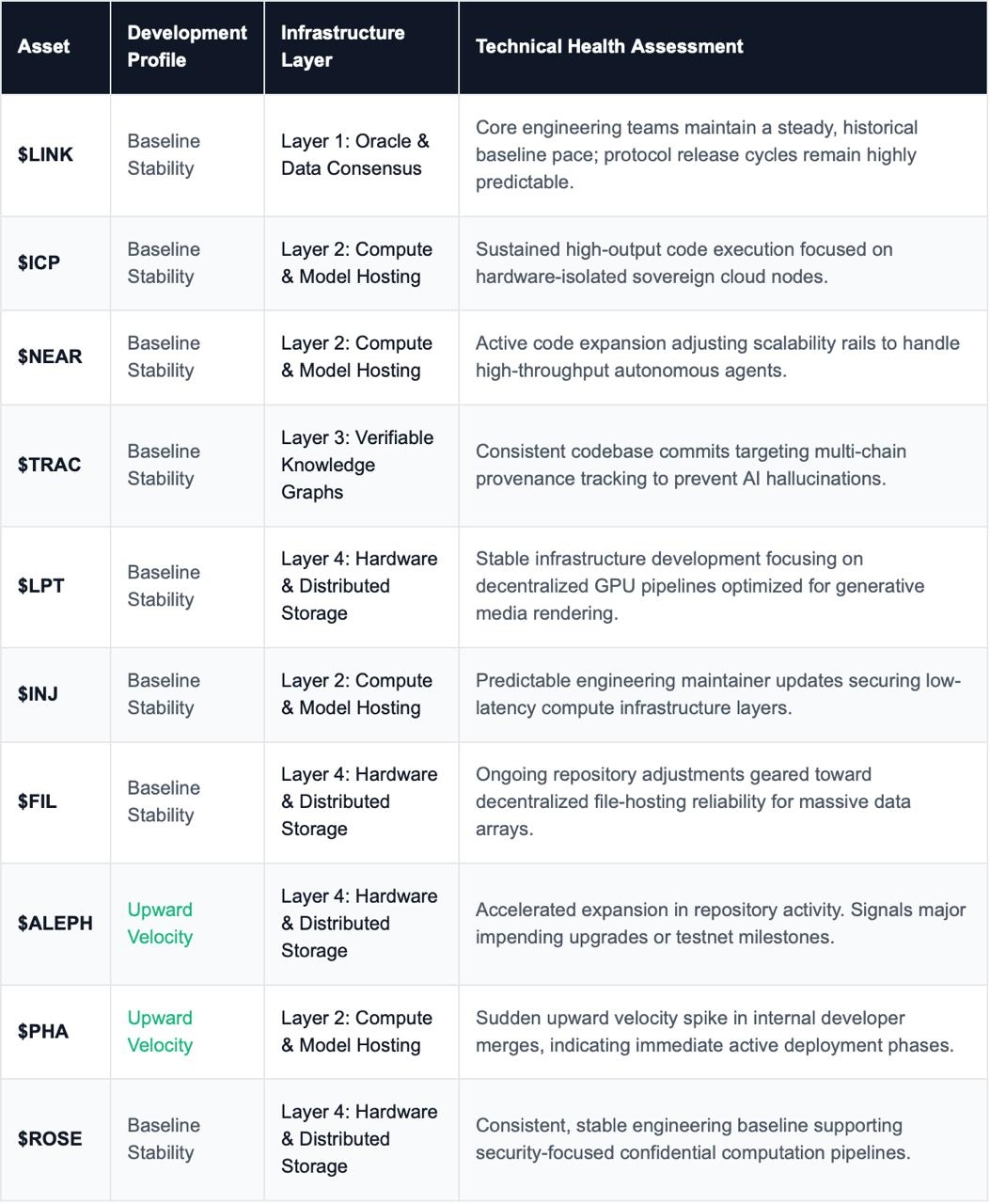
Data extracted from Santiment • Compiled by the Coindoo Editorial Team
Unbiased Risk Analysis & Operational Counter-Indicators
True transparency requires strict neutrality. While developer velocity is an exceptional network health metric, it presents specific operational limitations that market participants must factor into their risk models:
The Valuation Disconnect: A cross-examination of Santiment's metrics reveals that despite highly aggressive development schedules, short-term token prices often trend downward concurrently. Shipping clean code does not immediately generate short-term market buying pressure.
The Open-Source Blindspot: This index monitors public GitHub repositories exclusively. If an enterprise AI project executes a significant portion of its breakthrough data processing algorithms within proprietary, closed-source corporate environments prior to publication, the public metric will temporarily underrepresent its momentum.
The Adoption Chasm: An impeccably built codebase does not guarantee real-world traction. If a protocol team struggles with ecosystem marketing, web3 developer onboarding, or consumer user friction, the network token may still depreciate over time regardless of engineering consistency.