
OpenGradient, a decentralized AI infrastructure network behind the OPG token, is drawing attention in the crypto market after OPG was listed for spot trading on Binance on May 22, 2026. The project targets AI developers, blockchain applications, and on-chain agents, aiming to handle AI inference in a more verifiable manner instead of relying entirely on centralized cloud infrastructure. Interest in OPG is rising as the AI crypto sector continues to attract capital inflows and market liquidity.
OpenGradient Explained
OpenGradient is an infrastructure project that combines AI and blockchain, built for applications that need to run or integrate AI models in a decentralized environment. The core focus of the project is “verifiable AI inference,” meaning AI tasks can be executed and checked using verification mechanisms such as Trusted Execution Environments (TEE) or zero-knowledge machine learning (ZKML).
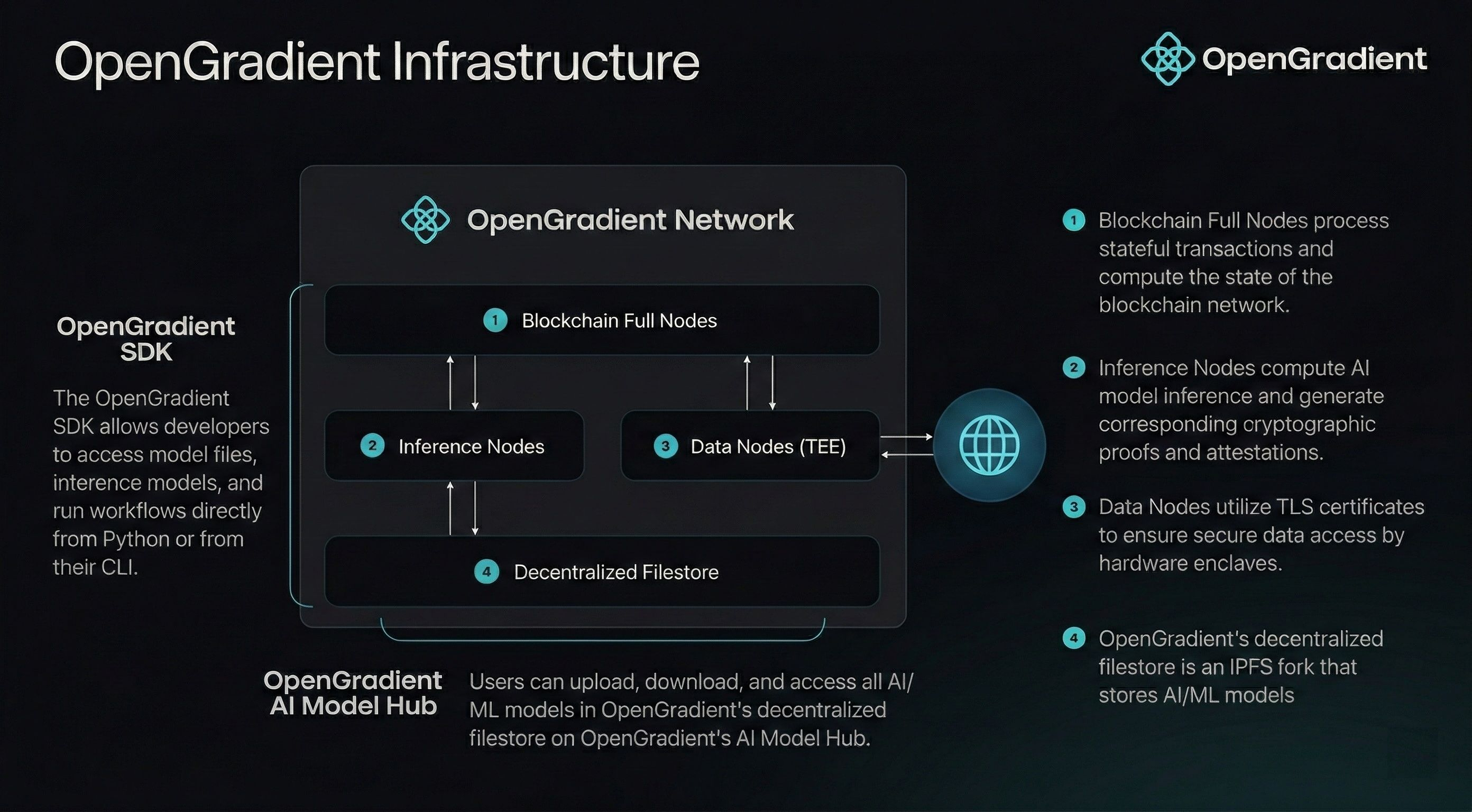
According to OpenGradient’s documentation, the network utilizes the Hybrid AI Compute Architecture (HACA), an architecture designed specifically for the unique nature of AI workloads, which cannot be processed like standard financial transactions on a blockchain. If every validator had to re-run the same AI model, costs and latency would be massive. Therefore, OpenGradient separates the roles of nodes: inference nodes process the models, full nodes verify proofs and maintain the ledger, while data nodes support access to external data.
This approach allows OpenGradient to target use cases such as AI agents, DeFi risk models, model hosting, verifiable LLM execution, and applications requiring proof that an AI model was run in an auditable way.
How OpenGradient Works
OpenGradient operates by separating AI execution from verification. When an application or developer submits an inference request, the task is routed to an appropriate inference node. These nodes can use GPUs to run the model locally or provide secure access to an external model provider. After the inference is complete, the results and associated proofs are settled and verified afterward, following an asynchronous model, rather than forcing the blockchain to process the entire AI task in real-time.
In the technical documentation, OpenGradient allows developers to choose between multiple verification modes, depending on their needs for speed, cost, and reliability:
ZKML: provides stronger cryptographic proof but can be 1,000 to 10,000 times slower, making it more suitable for small models or high-impact use cases.
TEE: faster than ZKML and generally suitable for medium or large models.
ZK-CRV: combines ZKML with a challenge-response mechanism to reduce cost and latency.
Vanilla inference: has almost no overhead, but also does not provide an equivalent level of verification.
The project does not attempt to force all AI computation onto the blockchain in the traditional way. Instead, the network processes AI at a specialized layer, then uses the blockchain for payment, verification, settlement, and maintaining a trail of the tasks.
OPG Token Utility And Tokenomics
OPG is the native token of OpenGradient. According to the OpenGradient Foundation, the token is used to support verifiable AI inference, governance, and ecosystem growth. The project’s MiCA white paper also describes OPG as a utility token for AI inference and execution, decentralized model hosting, and protocol governance.
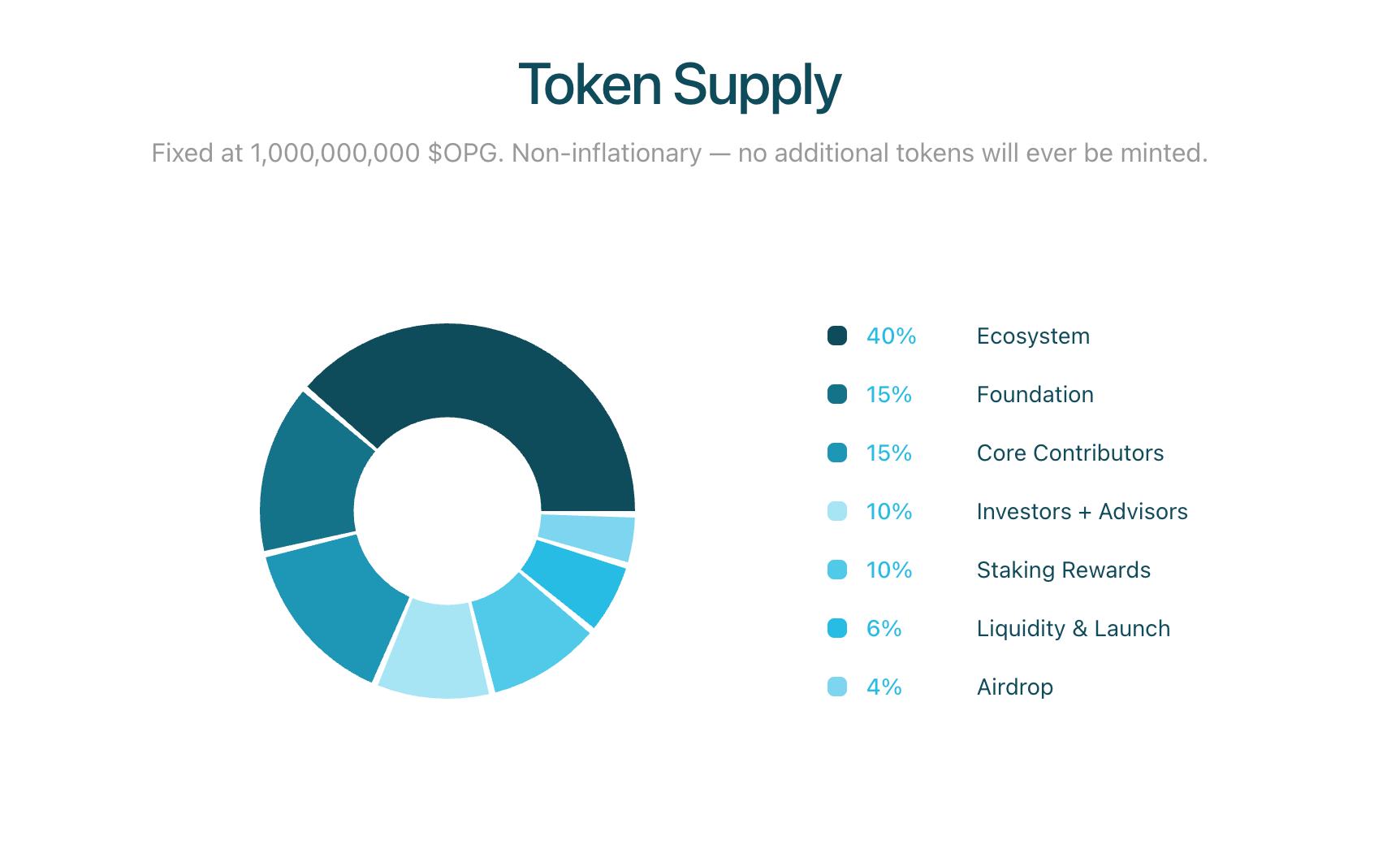
The maximum supply of OPG is 1 billion tokens. According to the official tokenomics, the OPG allocation consists of:
Ecosystem: 40%
Foundation: 15%
Core contributors: 15%
Investors and advisors: 10%
Staking rewards: 10%
Liquidity provisioning and launch: 6%
Airdrop: 4%
The Bottom Line
OpenGradient is a decentralized AI infrastructure project, and OPG is the native token used within this ecosystem for activities such as inference, model hosting, staking incentives, and governance. The key point of the project is building an infrastructure layer so that AI models can be run and verified on the blockchain, rather than just creating another AI application for end-users.
The attention surrounding OPG stems from the Binance listing, the AI crypto narrative, and the growing demand for verifiable AI systems. However, OpenGradient’s long-term prospects still depend on the actual usage of the network, the quality of the developer ecosystem, token liquidity, and how the market absorbs future unlocks.#opg $OPG @OpenGradient #creatorpad #TradingTales #BinanceSquareFamily #Binance $