
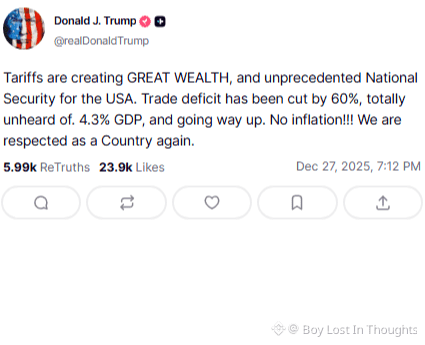
Building on your statement, the argument you've outlined presents a specific and highly favorable interpretation of recent U.S. trade and economic policy, primarily associated with the Trump administration and continued in certain respects under the Biden administration. Let's expand on each point to provide context and the broader debate surrounding these claims.
1. Tariffs, "GREAT WEALTH," and National Security
Claim: Tariffs (taxes on imports) are portrayed as a direct source of wealth and a tool for national security.
Expansion: The argument is that tariffs protect domestic industries (like steel, aluminum, and manufacturing) from foreign competition, allowing them to grow, reinvest, and create high-paying jobs. This allegedly creates "wealth" within the U.S. economy. From a national security perspective, it's argued that securing critical supply chains (for semiconductors, medical supplies, or infrastructure materials) is vital to avoid dependency on potential adversaries like China, especially after vulnerabilities exposed during the COVID-19 pandemic. The goal is to "onshore" or "friendshore" essential production.
Counterpoint/Cost: Critics argue tariffs are a tax paid primarily by U.S. importers and consumers, leading to higher prices. They can also trigger retaliation against U.S. exports (e.g., agricultural goods), harming other sectors. While strategic decoupling in key areas is widely supported, broad tariffs may reduce overall economic efficiency and global trade.
2. Trade Deficit Cut by 60%
Claim: The U.S. trade deficit has been dramatically reduced.
Expansion: The U.S. goods trade deficit with the world did see a significant narrowing (around 60% at one point from its 2022 peak) during 2023-2024. This was driven by:
Resilient U.S. consumer demand for services over goods post-pandemic.
A strong dollar and shifting global dynamics.
Policies aimed at reducing the specific deficit with China. The deficit with China did fall considerably, partly due to tariffs and trade tensions, which shifted some sourcing to Vietnam, Mexico, and other nations (a phenomenon called "trade diversion").
Context: Economists are divided on the importance of the trade deficit as a scorecard. A deficit is not inherently bad—it can reflect a strong, consuming economy and investment inflows. The reduction is also cyclical and closely tied to post-pandemic normalization and energy production shifts.
3. 4.3% GDP Growth and "Going Way Up"
Claim: Strong GDP growth demonstrates the success of the policy mix.
Expansion: The U.S. economy has shown remarkable resilience and growth, notably in 2023-2024, defying earlier recession forecasts. Q3 2024 GDP growth was reported at 4.3% (annualized). This strength is attributed by proponents to a combination of pro-business deregulation, tax policies, and strategic protectionism driving investment.
Context: This growth occurs within a complex post-pandemic recovery. Major drivers include significant fiscal stimulus (both previous and recent legislation like the CHIPS Act and Inflation Reduction Act), strong consumer spending, and a robust labor market. The impact of tariffs alone on this broad GDP number is difficult to isolate and is heavily debated.
4. "No Inflation!!!"
Claim: The policies have fueled growth without causing inflation.
Expansion: This is a point of major contention. The U.S. experienced its highest inflation in 40 years in 2022, peaking at over 9%. While inflation has cooled significantly ("disinflation") towards the Federal Reserve's target by late 2024, the claim of "no inflation" refers to the current period of control after a severe bout.
Critical Context: Most economists argue that tariffs are inherently inflationary, as they raise the cost of imported goods and can allow domestic producers to increase prices. The Federal Reserve's aggressive interest rate hikes are widely credited as the primary tool for taming inflation. Supply chain normalization and lower energy prices also played major roles. The "no inflation" environment is seen as occurring despite tariffs, not because of them.
5. "We are respected as a Country again."
Claim: A more aggressive, unilateral trade stance has restored global respect for U.S. power.
Expansion: This is a subjective claim about national perception and foreign policy. Proponents argue that confronting China on trade, renegotiating deals like USMCA (replacing NAFTA), and demanding fairer burden-sharing from NATO allies demonstrated strong, transactional leadership that commands respect.
Counterpoint: Many allies viewed the unilateral "America First" trade actions as destabilizing to the international rules-based order. They created diplomatic friction, even as shared concerns about China later led to greater alignment (e.g., with the EU). Respect, in this view, was strained among traditional partners, even if adversaries took note of U.S. resolve.
Summary
The statement presents a hawkish, nationalist view of economic policy where tariffs are a primary tool to rebuild industry, cut deficits, and assert sovereignty, all while achieving strong growth without current inflation. It links economic policy directly to national power and security.
The broader economic consensus acknowledges strong GDP growth and a reduced trade deficit as facts but attributes them to a much wider set of factors (fiscal stimulus, monetary policy, post-pandemic cycles). It views tariffs as a costly, often inflationary tool useful only in very specific strategic circumstances, and argues that the trade deficit is a poor metric for policy success. The restoration of "respect" is a deeply debated matter of diplomatic perspective.


