

As blockchains move beyond experiments and into real world use, one issue keeps coming up again and again: data. Blockchains are great at reaching consensus and keeping records transparent, but they struggle when it comes to handling large amounts of information. Walrus steps in here with a very down to earth idea. Let the blockchain focus on coordination and rules, and let a decentralized network handle the heavy data work.
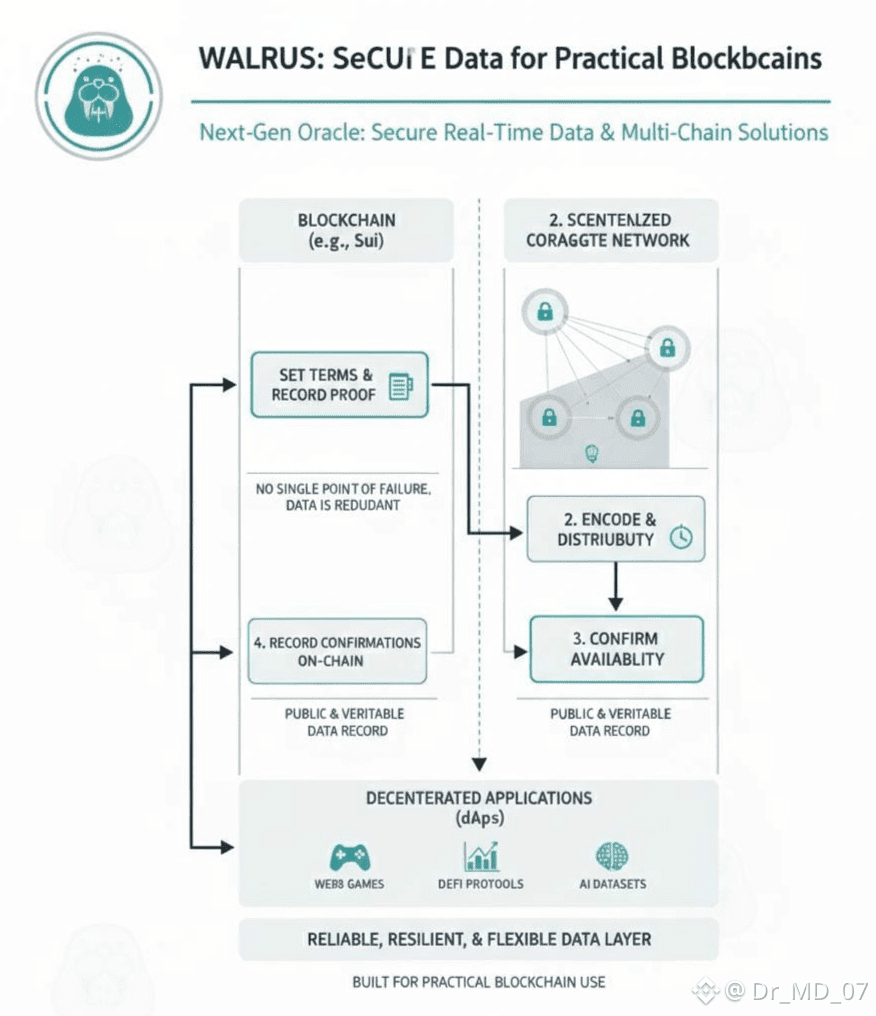
@Walrus 🦭/acc is not a classic oracle that pushes prices or market feeds on chain. Instead, it plays a quieter but equally important role. It makes sure that the data applications depend on actually exists, stays available, and can be verified by anyone. For many decentralized apps, this is just as critical as knowing a token price.
The way Walrus works feels practical rather than theoretical. When someone stores data, the blockchain is used to set the terms and record proof, not to store the data itself. The data is encoded and spread across multiple independent storage nodes. This means there is no single point of failure and no central party to trust. If some nodes go offline, the data can still be recovered.
What really builds confidence is how Walrus proves availability. Data is only considered stored after enough storage nodes confirm they are holding it. Those confirmations are written back to the blockchain, creating a clear and public record. For developers, this removes a lot of guesswork. They can build applications knowing the data layer is enforced by rules, not promises.
This becomes especially valuable for real time use cases. Think about decentralized games updating world states, DeFi protocols referencing complex datasets, or AI driven applications pulling large files. In all of these cases, missing or unavailable data can break the experience. Walrus helps reduce that risk by making data availability something you can actually verify.
Walrus also keeps verification simple. Instead of checking full files, users can rely on compact cryptographic proofs to confirm integrity. This keeps costs low and interactions fast, which matters a lot as applications scale.
While Walrus currently uses Sui as its coordination layer, it is not locked into one ecosystem. Its design allows it to work with other blockchains as well, making it a natural fit for a future where applications live across multiple chains.
At its core, Walrus is about building dependable infrastructure. It does not chase hype or flashy features. It focuses on a real problem that becomes more serious as Web3 grows. By making data storage verifiable, resilient, and flexible, Walrus quietly supports the next wave of practical blockchain applications.

