

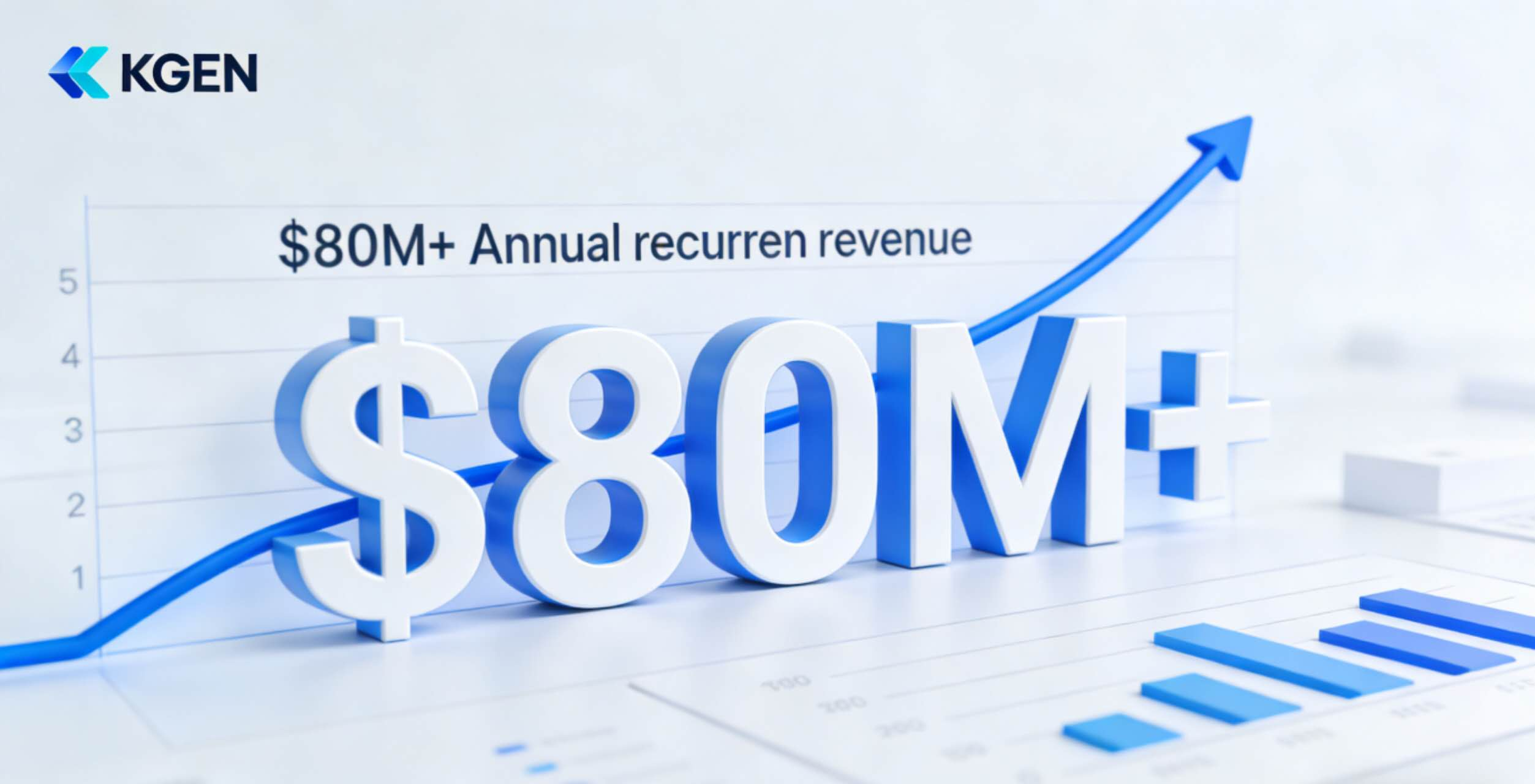
While the Web3 market is still wrapped in speculative hype, KGeN has torn open the value gap with solid business results—anchoring a stable annual recurring revenue (ARR) of $80M+, escaping the industry's common ailment of 'relying on emotional swings', allowing token value to anchor on sustainable business growth, becoming one of the few 'cash cow' protocols in Web3.
The support for this revenue confidence comes from KGeN's dual-core business running in parallel and its innovative value capture mechanism. In the AI sector, its flagship KAI engine holds 48.9M+ globally verified real user resources, covering 60+ countries and 20+ language systems, precisely targeting the RLHF market with an annual compound growth rate of 23.4%, providing technology giants with full-stack enterprise-level AI training data services from human feedback reinforcement learning (RLHF) to speech synthesis (TTS). These real users, verified through the POGE reputation engine's multi-dimensional checks, completely resolve the AI industry's pain point of 'machine labeling impersonating human', making KAI the core data supplier for large model training, continuously harvesting the explosive dividends of the AI industry.
In the gaming field, KGeN has restructured the business logic of user acquisition (UA). By filtering precise players through on-chain real identity profiles, it helps game developers bid farewell to ineffective 'broad net' advertising, achieving a 40%-55% reduction in customer acquisition costs in collaboration with Karate Combat, Game7, and others, becoming the core infrastructure for efficient user acquisition in the gaming industry. The most critical value closed loop lies in: the KGEN token is the revenue receiving end of the entire protocol, whether it is the sales return from AI data services or the service revenue from game developers' user acquisition, will flow back into the token ecosystem according to the mechanism—some used for buybacks, and some redistributed to holders through staking, forming a strong binding link of 'business growth → revenue increase → token appreciation', allowing holders to directly share in the development dividends of two trillion-level tracks.

Unlike projects that rely on inflation subsidies, KGeN proves the commercial viability of Web3 protocols with $80M+ in revenue: a moat formed by 48.9M+ real users allows the KAI engine to establish a foothold in the AI data market; the essential scenario of game UA continues to contribute stable cash flow; and the hard connection between tokens and real revenue further breaks the industry's vicious cycle of 'speculating concepts and lacking value'.
KGeN's rise marks the transition of Web3 from the 'narrative era' to the 'value capture era'—here, each token corresponds to real business revenue, and every holding means sharing in the growth dividends of the AI and gaming industries.
