
@Plasma made a decision to build its execution layer on Reth. This was on purpose. They wanted to get from the performance constraints that have been a problem for traditional EVM chains for a long time. Most EVM networks use clients that were made a time ago and have been updated a little bit at a time from old Ethereum designs.. Plasma is using a new execution engine that is based on Rust and it is fast and easy to change and scale in a predictable way. This change in the way Plasma is built gives it an advantage when it comes to performance and it still works perfectly with EVM for developers. Plasma is still fully compatible with EVM which's good, for developers who use Plasma.
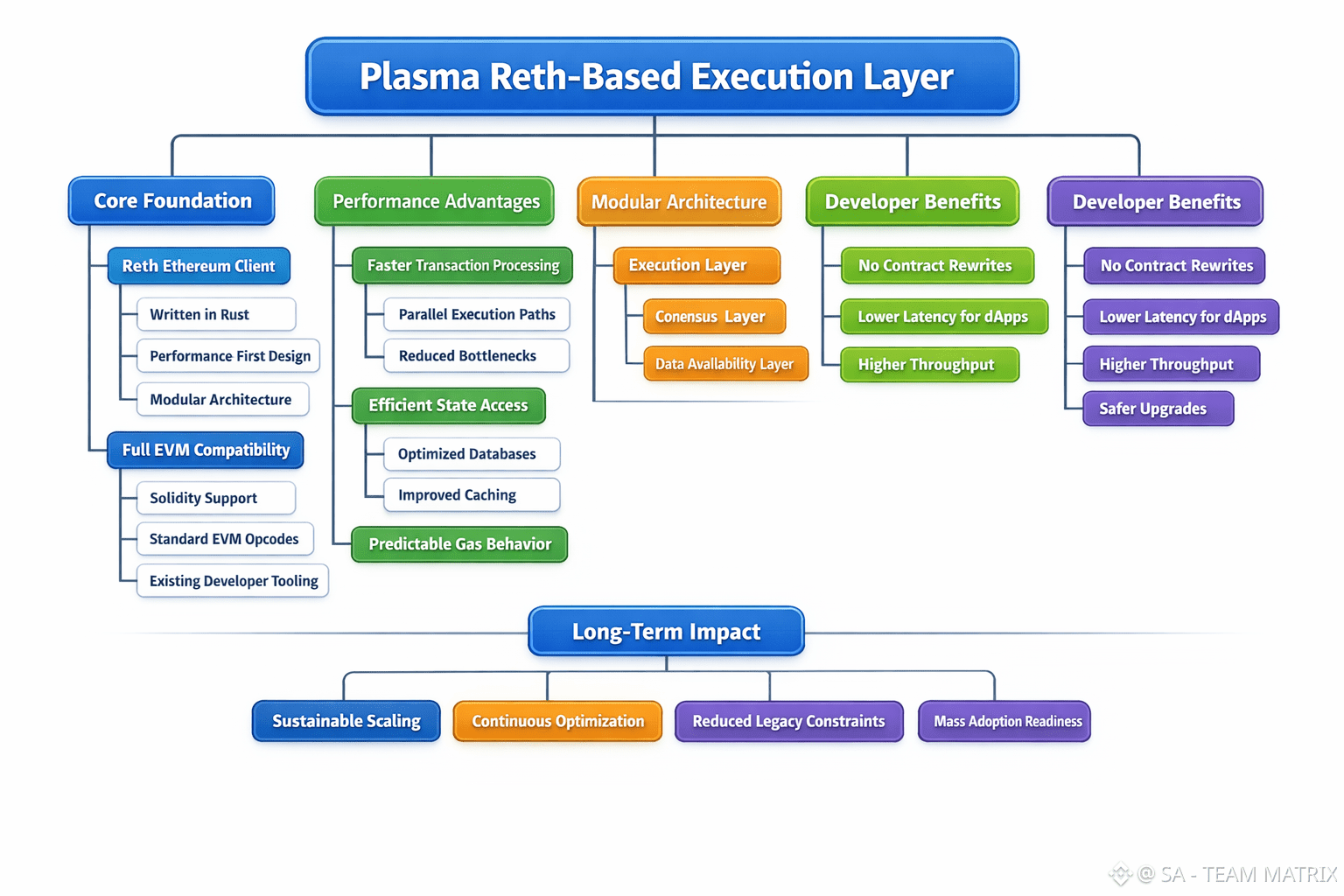
The core of Plasma is made up of Reth, which's a high-performance Ethereum client that is written in Rust. Reth is different from versions because it is designed to handle things in parallel manage memory in a smart way and has parts that can be improved on their own. This means that Plasma can handle transactions quickly and consistently even when it is very busy. Older Ethereum chains often have problems because they only use one path to execute things and they make assumptions, about how to handle data. Plasma does not have many of these problems because it started with a clean and fast codebase. Plasma uses Reth to avoid these issues and to make sure that it can handle a lot of transactions at the time.
One big benefit of Plasma is the way it brings Reth into its system. The part that does the work is separate from the parts that make sure everyone agrees and that things get settled. This makes it so Plasma can make each part better on its own without having to change everything at the time. A lot of EVM chains are connected in a way that makes it hard to change one thing without messing with the whole thing. This can make the network less safe. Take a long time to upgrade. Plasma does things differently which means it can try things faster and make changes more safely over time. Plasma is really good, at making Reth work well in its system.
Reth is really good at making it easier to get to the state and process transactions. It does this by using database layouts and caching strategies. This is what Plasma does. It reduces the time it takes to read and write to the state. This is a problem for old EVM networks. When you can get to the state faster it means that things can happen a lot quicker. There is also less waiting for things to happen.. The gas behavior is more predictable, for applications. For people who make things like developers this means that smart contracts work better. They work better even when the network is being used a lot. Reth and Plasma make smart contracts more reliable.
From a developer point of view Plasmas Reth-based execution layer gives us performance without making things too different. We can still use Solidity tooling and EVM opcodes and our existing smart contract workflows work fine.
Teams can move their applications to this system or build new ones without having to redo the main parts and they get faster and more stable execution.
Plasmas execution layer is important because it helps us get more people to actually use our applications not just try them out.
This is what Plasmas Reth-based execution layer does for developers it makes Plasmas execution layer a good choice.
In the long term Plasma’s execution strategy positions the network for sustained growth. As demand increases and applications become more complex the efficiency gains from Reth compound over time. Instead of relying on short-term scaling hacks Plasma builds on a modern execution foundation designed for continuous optimization. By rethinking the execution layer itself Plasma demonstrates how next-generation EVM networks can deliver meaningful performance improvements without abandoning the ecosystem that developers already trust.

