
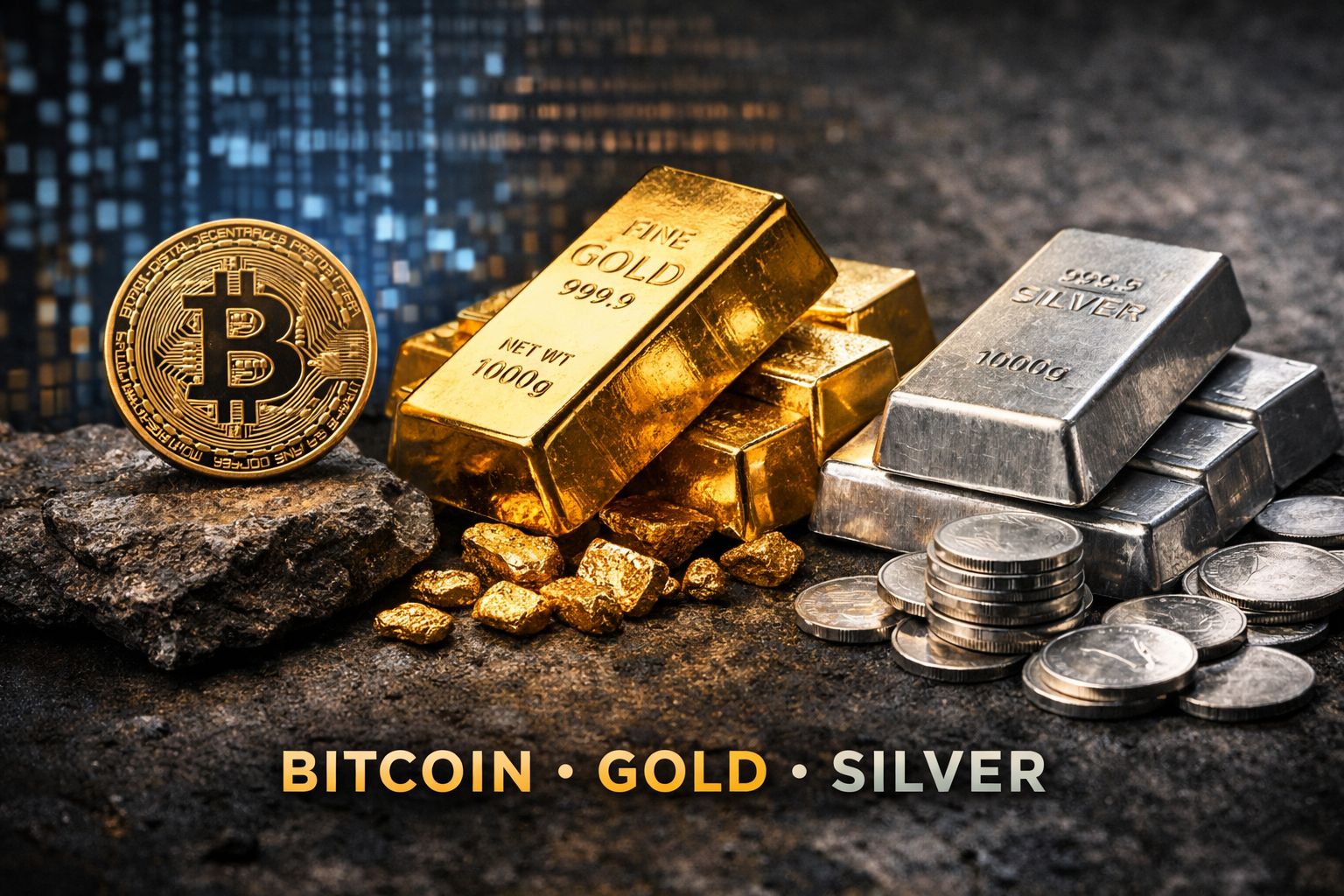
 In the evolving landscape of financial assets, Bitcoin, gold, and silver each hold distinct positions. While gold and silver have long been regarded as reliable stores of value, Bitcoin represents a new form of money, tailored for a digital-first world. This comparison starts from a Bitcoin-first perspective—not because gold or silver are without merit, but because they are often viewed through the lens of tradition, without fully examining their utility in the context of modern constraints. The objective of this analysis is to identify the core functions of gold and silver, separate inherited beliefs from actual utility, and explore where each asset breaks down under current global pressures, with Bitcoin placed alongside them as a contrast.
Gold: Utility vs. Storage
Gold has long been prized for its intrinsic properties, which make it highly useful in various industries. These properties include:
High electrical conductivity
Extreme resistance to corrosion
Chemical stabilit
These features have made gold valuable in several sectors:
Electronics and connectors
Aerospace components
Medical and dental applications
Precision manufacturing
However, despite these valuable industrial applications, the majority of gold demand arises from its role as a storage asset rather than as a material used for industrial purposes. The primary drivers of gold's value are:
Jewelry
Central bank reserves
Private and institutional vaults
After satisfying industrial demand, additional gold mined is often stored as idle stock, rather than contributing to further utility. This role as a store of value is rooted in its historical monetary function rather than its ability to expand utility in modern industries. Today, gold remains the largest asset class by market capitalization globally, valued at around $35.6 trillion. However, its size is largely driven by its historical use in finance and as a store of wealth, rather than its functional utility.
Silver: Industrial Demand Comes With Tradeoffs
Unlike gold, silver is primarily consumed rather than stored. Its main applications are:
Solar panels
Electronics
Batteries
Antimicrobial coatings
Industrial chemicals
Silver's direct link to economic activity makes it a cyclical asset, with strong performance during periods of industrial expansion. However, its value is highly sensitive to economic conditions, making it less reliable as a long-term store of value. This creates a distinct tradeoff:
Strong performance during industrial booms
Weakness during economic downturns
Although silver plays a vital role in industrial sectors, its price stability is not its strong suit, rendering it less effective as a long-term store of wealth compared to gold. Additionally, silver shares several structural weaknesses with gold:
Extraction costs
Environmental impact of mining (e.g., water contamination and land damage)
Verification and custody risks
Storage and transportation challenges
These systemic issues highlight the limitations of precious metals in an increasingly digital financial system.
Shared Structural Weaknesses: Gold and Silver
Both gold and silver face several systemic issues:
Extraction Costs: Gold mining involves the use of toxic substances like mercury or cyanide, while silver mining often generates heavy metal tailings.
Environmental Damage: Mining practices can lead to water contamination and permanent damage to the landVerification and Custody: Both metals rely on third-party custodians, refiners, and vaults for verification and storage, creating risks of counterfeit and fraud.
Friction: Physical storage, transportation risks, insurance costs, and delays in settlement all contribute to the inefficiencies of holding gold and silver as stores of value.
These issues point to the challenges of using physical assets in a modern, digital-first financial ecosystem.
Bitcoin as the Structural Contrast
Bitcoin offers a stark contrast to both gold and silver. It is a digital asset that removes entire categories of risk associated with traditional precious metals. Here’s how Bitcoin contrasts with these legacy assets:
No extractive pollution after issuance: Unlike gold and silver, Bitcoin has no environmental impact once created.
No physical storage or transport: Bitcoin exists entirely in the digital realm, removing the need for physical storage or transportation, which are major sources of risk for gold and silver.
No reliance on custodians or third-party verification: Bitcoin operates on a decentralized network that allows for self-verification without the need for intermediaries.
Authenticity is cryptographically provable: Bitcoin’s authenticity is built into its blockchain, ensuring trust without relying on third parties.
Monetary value by design: Bitcoin does not require industrial utility to justify its value. Its value comes from its fixed supply (21 million), its decentralized nature, and its ability to be self-custodied.
These core properties highlight Bitcoin’s advantages over gold and silver in the digital era:
Fixed supply (21 million)
Self-custody by default
Permissionless global settlement
Verification without intermediaries
While Bitcoin is not without its own tradeoffs, such as the risk of losing private keys and its varying regulatory environments, these challenges are manageable within the context of a digital world. Unlike gold and silver, Bitcoin operates entirely within a digital framework, making it more suited to the needs of modern economies.
Acknowledging the Downsides
While Bitcoin offers many advantages, it is not without its own risks:
Loss of Private Keys: Losing access to a Bitcoin wallet means the permanent loss of the assets, an irreversible risk.
Regulatory Uncertainty: Bitcoin’s legal status varies by jurisdiction, and regulatory environments can change unexpectedly.
These risks, however, are largely manageable by the user, provided they take the necessary precautions to protect their keys and stay informed about regulatory developments.
Conclusion: Stripping Away Tradition
Gold and silver continue to hold value, but when stripped of tradition and historical narrative, they increasingly resemble legacy systems with unresolved structural issues. Bitcoin, by contrast, is built for the digital, global, and adversarial world we live in today. It removes many of the friction points associated with precious metals, offering a new model of money that is designed for the digital age. While Bitcoin does not come without risks, it represents a forward-thinking alternative to legacy assets like gold and silver.
Bitcoin’s potential as a store of value and a medium of exchange in the digital age cannot be overstated. As the global financial system continues to evolve, Bitcoin may offer a viable path forward, free from the structural limitations that burden traditional assets.
This perspective is not without bias, but it is grounded in the reality of the modern financial world. The question remains: What asset do you trust most, and why?