
Executive Summary
MegaETH represents a fundamental architectural breakthrough in EVM execution performance, achieving 100k+ TPS and 10ms block times through specialized node architecture and novel state management via the SALT database. The protocol successfully addresses the historical I/O bottleneck that has constrained EVM chains, positioning itself as the first credible "real-time blockchain" for latency-sensitive applications like on-chain gaming and high-frequency trading. Backed by Vitalik Buterin and Dragonfly Capital with $20M seed funding, MegaETH has demonstrated 35k TPS in production stress tests processing 11B transactions. However, the project faces significant decentralization challenges with current single-sequencer operation and partially opaque tokenomics involving 53% of supply tied to undisclosed KPI milestones. At $2B FDV pre-market, MegaETH offers compelling technical differentiation but requires careful monitoring of its decentralization roadmap and economic transparency. MegaETH Research
1. Project Overview & Strategic Positioning
MegaETH is an EVM-compatible Layer 2 blockchain architected specifically for real-time applications, targeting sub-10ms block times and 100,000+ TPS throughput. The protocol launches its public mainnet on February 9, 2026, following a successful stress test that processed 11 billion transactions at sustained 15-35k TPS. Bankless
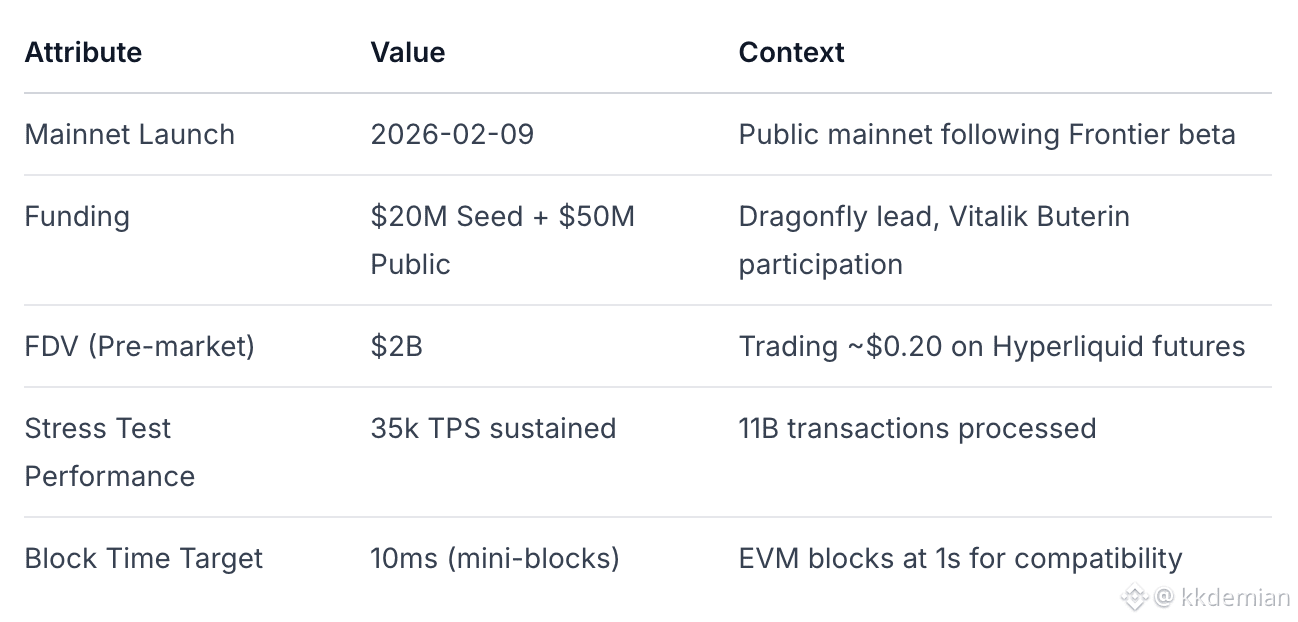
The core thesis centers on enabling applications requiring real-time interaction previously impossible on blockchains: competitive gaming, order book trading, and interactive social protocols. MegaETH's architectural approach represents a fundamental rethinking of EVM execution constraints rather than incremental optimization. MegaETH Architecture Docs
2. System Architecture: Specialized Nodes & State Management
Node Specialization Model
MegaETH employs a radical departure from traditional blockchain architecture through specialized node types with dramatically different hardware requirements:
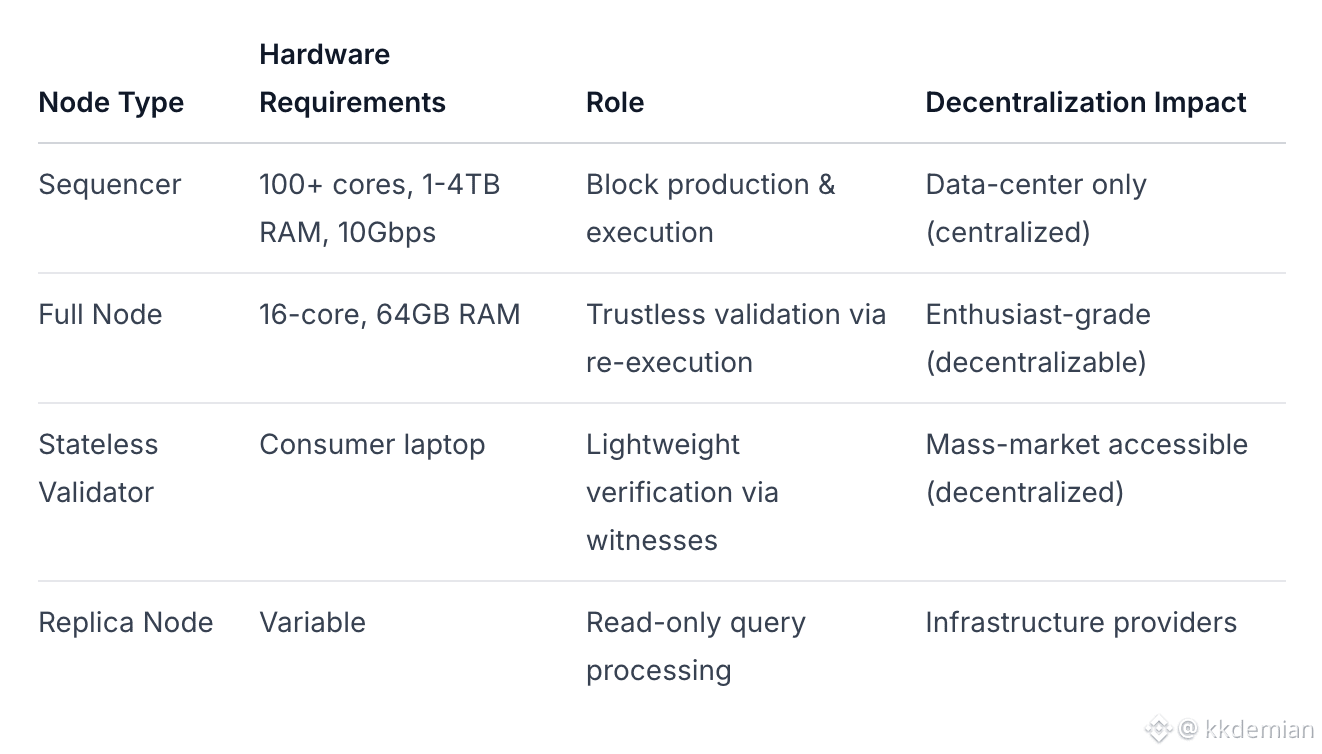
This specialization enables the sequencer to achieve unprecedented performance while maintaining verification accessibility. The stateless validator model is particularly innovative, allowing validators to verify blocks without storing state by using cryptographic witnesses provided by the sequencer. ENDGAME: Maxing Performance
SALT Database: Solving the I/O Bottleneck
The SALT (Small Authentication Large Trie) database represents MegaETH's core technical innovation, addressing the fundamental I/O bottleneck that has limited EVM performance:
100% In-RAM State Trees: Entire authentication structure resides in RAM, eliminating disk I/O delays
Performance Independence: Throughput remains constant regardless of state size (millions vs billions of keys)
Parallelizable Updates: CPU-bound design scales linearly with additional cores
Vector Commitments: Replaces Merkle Patricia Tries with more efficient cryptographic structures
In traditional Ethereum, state root updates consume up to 10x more time than transaction execution itself. SALT reduces this overhead to near-zero, enabling the sequencer to focus on execution rather than I/O wait states. ENDGAME: SALT Breakthrough
Execution Model: Mini-Blocks & Parallelization
MegaETH utilizes a dual-block architecture to balance performance with compatibility:
Mini-Blocks: 10ms intervals with lightweight metadata for real-time execution
EVM Blocks: 1-second intervals with full metadata for ecosystem compatibility
Execute-Then-Order: Parallel transaction processing before final ordering
No Gas Limits: Removal of computational constraints for applications
The mini-block implementation provides the same rollback guarantees as conventional blocks, making them first-class citizens in the security model rather than optimistic pre-confirmations. ENDGAME: 10ms Blocks
3. Technical Comparison: MegaETH vs. Monad Parallel EVM
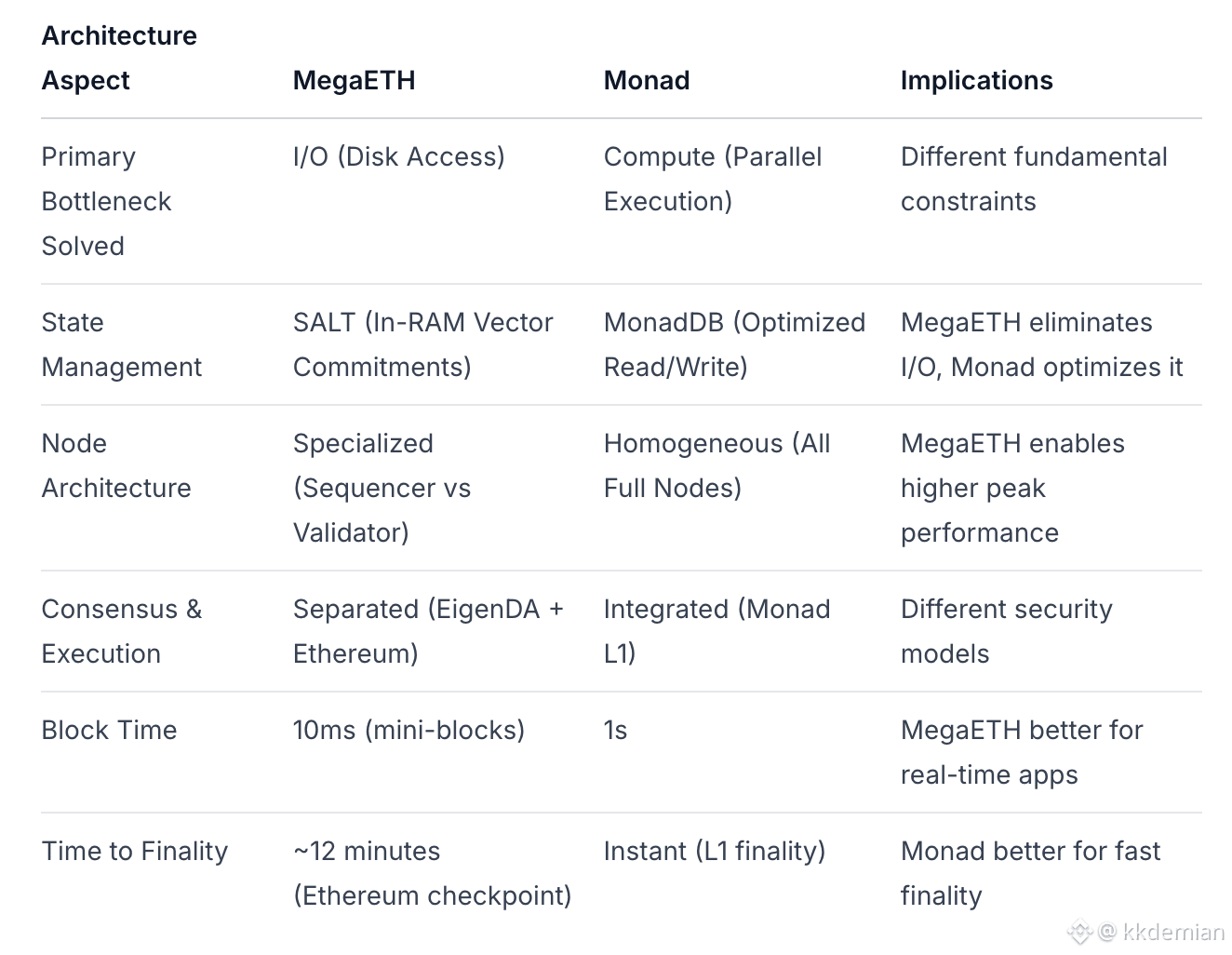
Key Differentiation: MegaETH's specialization allows it to push performance further than homogeneous architectures, but requires trusting the sequencer for liveness. Monad maintains tighter integration between consensus and execution but faces traditional scalability constraints. Monad Testnet Dashboard
4. Performance Analysis & Trade-offs
Demonstrated Capabilities
The January 2026 stress test provided empirical validation of MegaETH's performance claims:
35,000 TPS Sustained: Under mixed workload of ETH transfers and AMM swaps
11 Billion Transactions: Processed in 7-day test window
Sub-$0.0002 Fees: Ultra-low transaction costs during stress test
Real-Time Gaming: Multiple games operated smoothly during peak load
These results significantly exceed current EVM L2 capabilities and approach Solana-class throughput while maintaining EVM compatibility. 99Bitcoins
Hardware Decentralization Trade-offs
The specialized architecture creates inevitable centralization tensions:
Sequencer Centralization: Current single sequencer requires data-center hardware (100+ cores, 1-4TB RAM)Verification Democratization: Stateless validators enable consumer hardware verificationProgressive Decentralization: Roadmap includes multiple sequencers and permissionless nodes
This model mirrors modern cloud infrastructure where heavy computation is centralized but verification is distributed. The security model depends on Ethereum for ultimate settlement and EigenDA for data availability. ENDGAME: EigenDA Integration
5. Protocol Economics & Tokenomics
MEGA Token Distribution
MegaETH employs a structured token distribution with significant allocation to performance-based incentives:
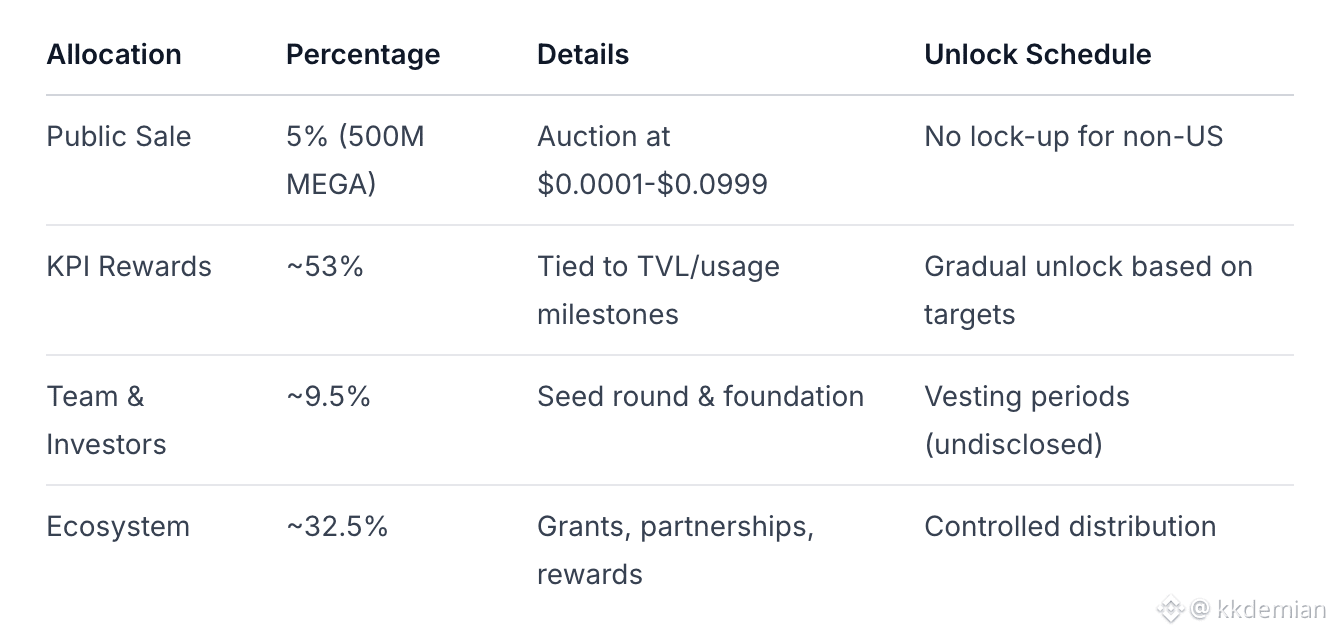
The KPI-based allocation (approximately 5.3B tokens) represents an innovative mechanism that aligns token issuance with actual network utility rather than fixed emission schedules. However, specific performance triggers and vesting details remain undisclosed as of January 2026. The Block
USDm Stablecoin Integration
MegaETH features a native yield-bearing stablecoin ecosystem:
USDm: Native stablecoin whitelabeled from Ethena
Backing: BlackRock BUIDL treasury products + crypto collateral
Yield Generation: Underlying assets generate yield for protocol subsidy
Fee Reduction: Yield used to subsidize sequencer fees for real-time apps
This integration provides a built-in economic mechanism for sustaining low transaction fees while generating protocol revenue. DL News
6. Ecosystem Development & Adoption Signals
MegaMafia Ecosystem Portfolio
The curated ecosystem demonstrates focus on latency-sensitive applications:
Gaming & Interactive Apps:
Showdown TCG (digital trading card game)
Stomp GG (PvP battling platform)
Smasher (real-time arcade game)
AveForge (on-chain arena combat)
Crossy Fluffle (transaction-based platformer)
DeFi & Trading Infrastructure:
SectorOne (dynamic liquidity market maker)
Kumbaya (ecosystem DEX with culture assets)
Prism (DeFi superapp aggregator)
World Markets (unified CLOB exchange)
Hit.One (gamified leverage platform)
Infrastructure & Interoperability:
Aori (cross-chain intent protocol)
RedStone (push-oracle network)
LayerZero & Wormhole (cross-chain bridges)
Telis (settlement netting engine)
The concentration on gaming and trading applications strategically leverages MegaETH's latency advantages while building a differentiated ecosystem from general-purpose L2s. MegaETH Twitter
7. Risk Assessment & Governance
Centralization Risks
Sequencer Control: Single sequencer operation during Frontier beta represents critical centralization risk Upgrade Authority: Team controls protocol upgrades until decentralization roadmap implemented Prover Dependence: Stateless validators rely on sequencer-provided witnesses for verification
Technical Risks
Novel Cryptography: SALT vector commitments less battle-tested than Merkle Patricia Tries Throughput Assurance: 100k TPS claims not yet demonstrated under adversarial conditions EigenDA Dependency: Reliance on external data availability layer for security
Decentralization Roadmap
The protocol outlines a progressive decentralization path:
Multi-Sequencer Rotation: Introduce multiple approved sequencers post-mainnet
Permissionless Provers: Enable community-operated proof generation
Governance Transition: Move upgrade control to token-based governance
Full Permissionless Validation: Open sequencer role to competitive marketplace
Timelines for these milestones remain unspecified beyond the February mainnet launch. MegaETH Docs
8. Investment Assessment & Strategic Verdict
Dimension Scores (1-5 Scale)
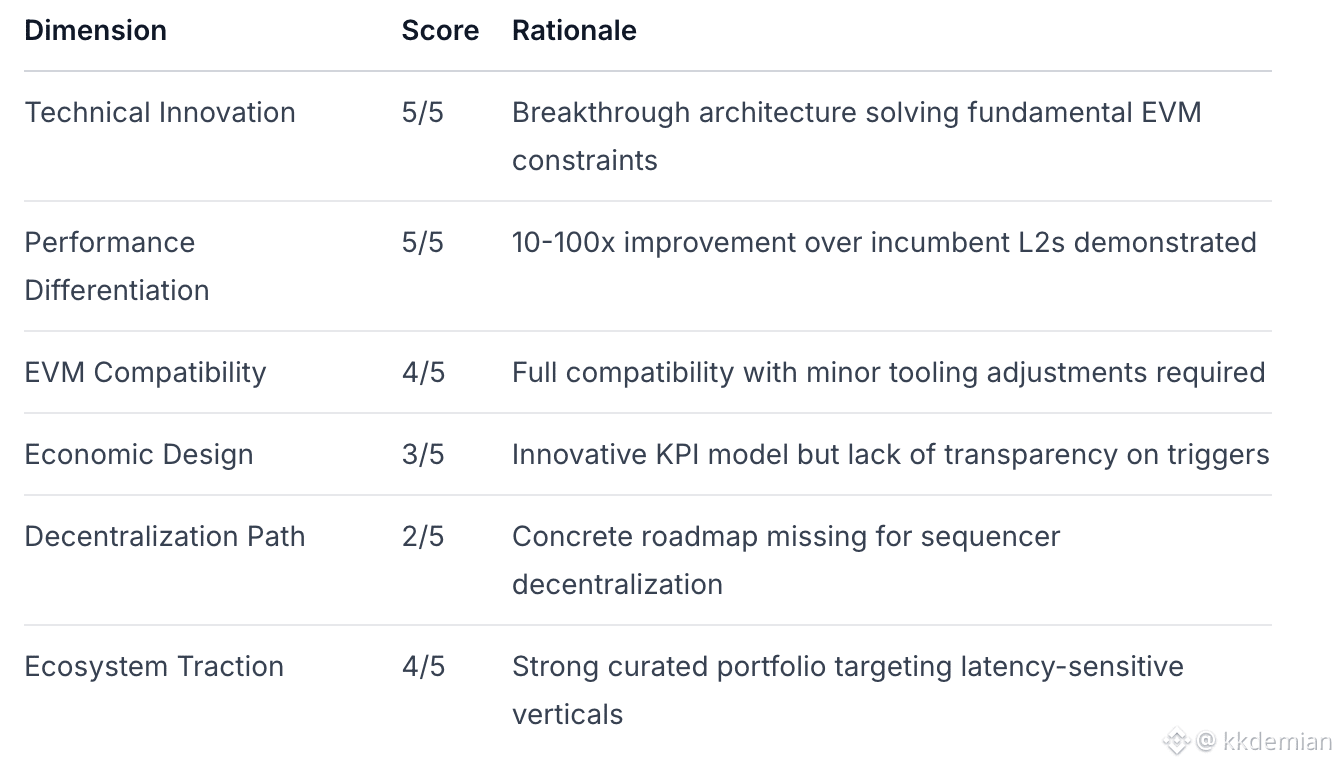
Strategic Investment Recommendation
MegaETH represents a compelling technical investment for tier-1 funds with strong Ethereum alignment, offering architectural innovation that addresses fundamental limitations in EVM execution. The protocol's performance advantages are structurally defensible through its specialized node architecture and SALT database, creating a sustainable moat for latency-sensitive applications.
Key Investment Considerations:
Technical Due Diligence: Verify SALT cryptography and stateless validation security proofs
Decentralization Milestones: Require concrete timelines for multi-sequencer implementation
KPI Transparency: Demand disclosure of specific performance triggers for 53% token allocation
Ecosystem Development: Monitor gaming/trading application migration from other chains
Ethereum Alignment: Assess long-term compatibility with Ethereum's modular roadmap
Verdict: Invest with progressive milestones based on decentralization progress. MegaETH's technical achievements warrant investment at current $2B FDV, but continued investment should be contingent on delivering promised decentralization milestones and transparent tokenomics. The protocol represents the most significant advancement in EVM execution performance since the initial rollup breakthroughs, potentially unlocking entirely new application categories for Ethereum.
Report Limitations: This analysis is limited by undisclosed elements of MegaETH's tokenomics and governance roadmap. Specific KPI triggers for token rewards and detailed vesting schedules for team/investor allocations remain unavailable from public sources as of January 31, 2026.