
When I read Plasma’s direction and watch how the pieces fit together, it comes across less like a typical “new Layer-1” pitch and more like a payments system that happens to be a blockchain, because almost everything they emphasize points to one obsession: making stablecoin movement feel effortless at scale, even when the user is not a crypto-native person and even when the volume looks more like real commerce than onchain hobby traffic.
The strongest part of the project, from my perspective, is that Plasma is not treating stablecoins as just another token standard living on top of generic infrastructure, because they are clearly trying to design the chain around stablecoins as the default unit of value, which is why the experience they keep pushing is “send USDT without worrying about gas,” since the gas-token problem is one of the most quietly destructive frictions in crypto payments, and it is exactly the kind of friction that turns a simple action—sending money—into a confusing tutorial that most normal users never finish.
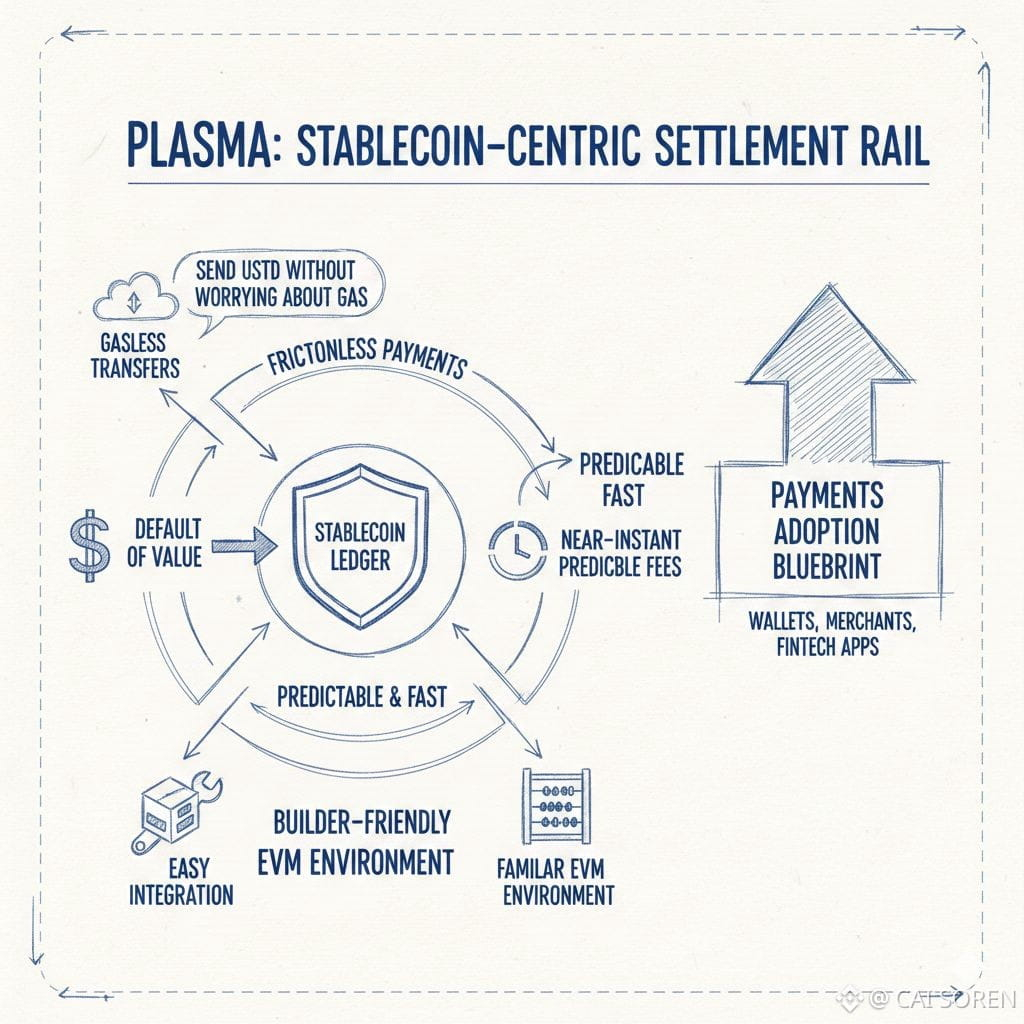
What feels deliberate is how the project tries to remove multiple layers of friction at once, because “gasless transfers” is only one part of a broader pattern where they want the network to behave like a settlement rail, meaning finality should feel near-instant, fees should feel predictable and low, and the EVM environment should feel familiar so builders can ship without reinventing their whole stack, and the combination of those three ideas is basically a blueprint for payments adoption, since you rarely win stablecoin payments by having a slightly better block explorer or a slightly higher TPS claim, and you usually win by making the process boringly reliable while keeping integration costs low for wallets, merchants, and fintech-style applications.
The “behind the scenes” design choices also signal that they understand how payments actually spread, because a chain can be technically strong and still fail if it relies only on developers to create demand, while Plasma is putting weight into distribution by building an end-user surface where stablecoins feel like money rather than like tokens, and that matters because the fastest way to validate a payments thesis is to make the product accessible in the places people already behave like consumers, which is why an app-and-card style approach is not just a marketing accessory but a practical funnel for real transaction flow, real retention, and real habit formation.
On the token side, the way I interpret the story is that Plasma wants the network to be secured and incentivized in a conventional way, while simultaneously refusing to force the end user into holding a volatile asset just to send a stable asset, and that separation is important because it keeps the user experience clean while still allowing the chain to build a security budget and validator economy over time, and if Plasma executes this balance properly it can end up with a network where users primarily think in stablecoins, builders primarily think in EVM workflows, and the protocol quietly handles the complexity that usually spills onto the user.
The real test, in my eyes, is sustainability under genuine usage, because anything that makes transfers feel “free” always attracts the wrong kind of attention unless the protocol is disciplined about guardrails, rate controls, and incentive alignment, and it also creates a long-term question about how the system carries the cost of that convenience as volume grows, since the difference between a growth hack and a durable payment rail is whether the economics and operational model can survive the moment the chain stops being a small ecosystem and starts being infrastructure that people depend on.
If I project forward based on how these systems usually mature, what comes next is less about one dramatic announcement and more about a slow accumulation of proof, because Plasma will increasingly be judged by whether stablecoin-first UX remains smooth under load, whether liquidity access becomes easier rather than more fragmented as the ecosystem expands, whether the user-facing distribution keeps bringing consistent organic activity rather than one-off spikes, and whether the network’s credibility improves as the technical design, security assumptions, and operational maturity line up with the ambition of being a stablecoin settlement layer rather than a speculative playground.
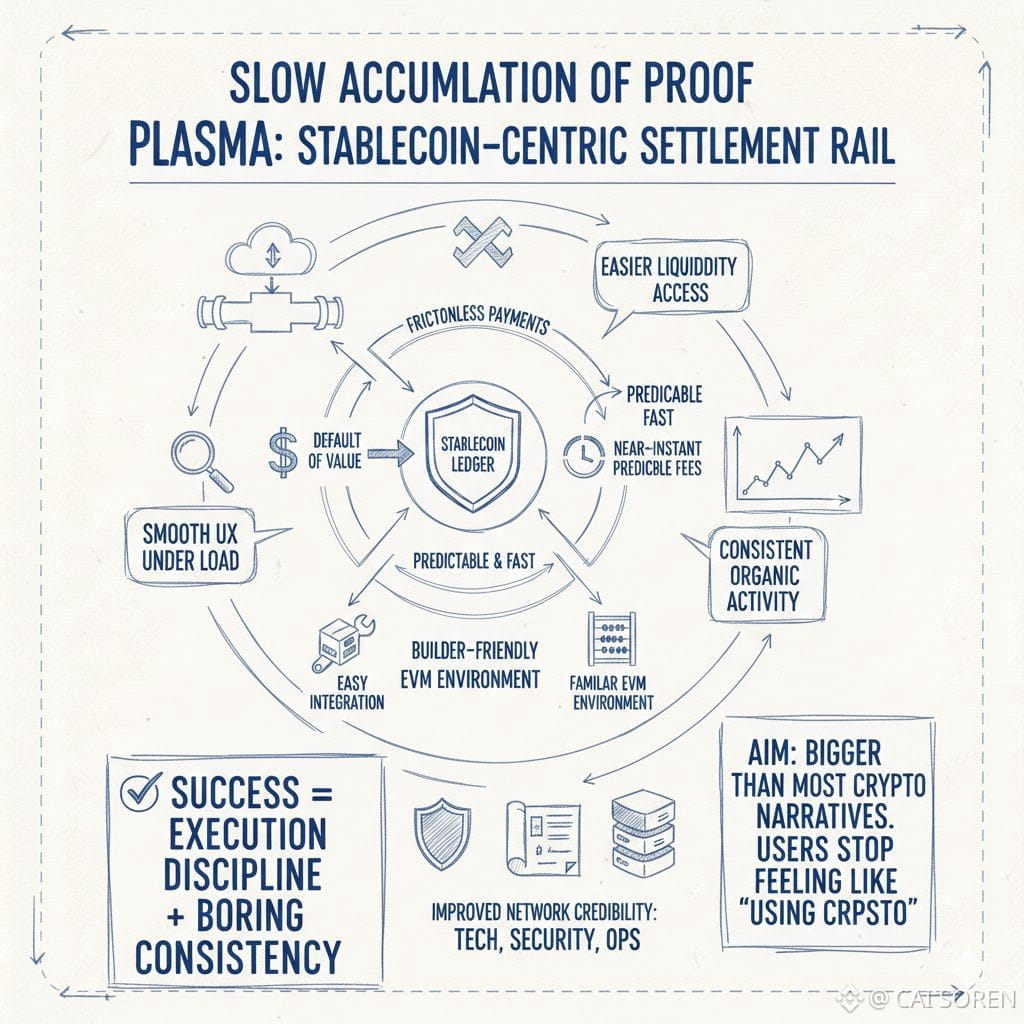
My personal takeaway is that Plasma is aiming at a category that is bigger than most crypto narratives, because stablecoin settlement is one of the few areas where the market is already behaving like the future arrived early, and the winners in that category tend to be the networks that reduce friction so aggressively that users stop feeling like they are “using crypto” at all, while the risk is that payments is an unforgiving business where reliability, compliance posture, and distribution partnerships matter as much as block times, meaning the project’s success will come from execution discipline and boring consistency more than from hype cycles.
What makes this project worth watching, in short, is not the promise that it is faster than everything else, but the way it is trying to make stablecoins feel native, everyday, and scalable in a manner that can actually survive contact with real users, real merchants, and real payment behavior, and if Plasma keeps shipping in a way that preserves that simplicity while strengthening the underlying economics and operational maturity, it has a very believable path to becoming the kind of infrastructure people rely on without even thinking about it, which is exactly what a serious payments rail is supposed to become.