
Most blockchain discussions begin with ambition. Faster execution, broader composability, radical decentralization, new governance models. The industry is conditioned to judge systems by how much they promise to change. Plasma feels different because its core idea is not transformation, but reliability. It does not ask to be admired before it is used. It feels designed to function first, and only later to be interpreted.
The defining characteristic of Plasma is not speed in isolation, but consistency. Transactions confirm quickly, but more importantly, they confirm in predictable ways. Latency does not swing dramatically between similar interactions. Fees behave in a way that feels deliberately unremarkable. They rise with usage without becoming punitive, and they avoid artificial suppression that would raise questions about sustainability. In an environment where fee instability often signals deeper structural issues, this restraint stands out.
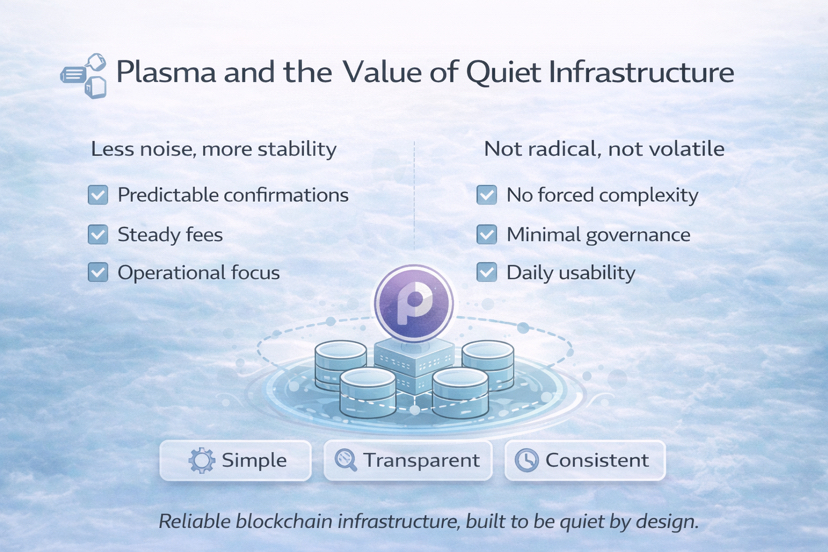
That predictability does not feel accidental. Plasma appears optimized for regular, repeated use rather than sporadic experimentation. The system behaves as if it expects to be relied upon daily, not showcased occasionally. That assumption changes how the network feels in practice. There is little sense of hidden mechanics or surprising edge cases. State transitions are straightforward, and the execution environment avoids unnecessary cleverness. For developers, this matters. Systems that behave consistently are easier to reason about, easier to maintain, and easier to debug under pressure.
Over time, Plasma reveals itself as a settlement-oriented network rather than a playground for maximal expressiveness. It does not seem built for deeply synchronous, highly composable contract interactions across large surfaces. Instead, it fits environments where transactions are discrete, frequent, and economically meaningful. Payments, trading systems, and high-volume flows align naturally with this posture. By narrowing its focus, Plasma gives up certain possibilities, but it gains clarity. The system knows what it is trying to be, and just as importantly, what it is not trying to be.
That clarity extends to governance and network structure. Validator roles appear clearly defined rather than theatrically expanded. Governance mechanisms exist, but they are not positioned as a form of constant engagement or narrative participation. The protocol avoids solving every problem at the base layer, suggesting a preference for operational reliability over ideological completeness. Plasma seems comfortable with the idea that not all complexity belongs inside the protocol itself.
The role of the network’s token follows the same grounded logic. Its relevance is tied to usage, validation, and participation rather than constant attention. Demand is not assumed or inflated through narrative importance. As activity grows, the token becomes more economically meaningful. If activity stagnates, it does not rely on conceptual justification to defend its existence. This alignment does not guarantee success, but it avoids internal contradiction.
From the outside, Plasma may appear quiet compared to other high-performance chains. That quietness feels intentional. There is no aggressive attempt to capture mindshare through constant announcements or rhetorical escalation. The system appears designed to operate regardless of whether it is being discussed. Historically, infrastructure projects that take this approach either fade quietly or become indispensable over time. Which outcome Plasma reaches remains uncertain.
There are unresolved risks. Plasma has not yet been tested across multiple extreme market cycles. Long-term security assumptions require time and adversarial conditions to validate. Ecosystem depth is still developing, and technical quality alone does not guarantee relevance without sustained usage. These risks are not unique, but they are real.
What distinguishes Plasma is restraint. It does not attempt to solve every problem simultaneously. It behaves like a system meant to be used repeatedly rather than demonstrated occasionally. In an industry that often confuses motion with progress, that restraint is rare. Plasma’s core idea is simple but uncommon: build infrastructure that behaves predictably, accept the limits of specialization, and allow real usage not narrative to decide its future.

