


It is a question best pondered upon: when you store information about a person, what are you storing? The majority of digital systems constructed nowadays revolve around data: names, dates, records of transaction, identification number. Data alone do not inform you on the truthfulness of something. It records what one wrote down. That is a minor, yet non-negligible distinction and one that @SignOfficial has made its whole infrastructure on.
The internet has never been a bad data storage medium. What it has never been especially good at is certifying it. An image of a diploma, a picture of a transaction, a government-issued document uploaded to a form - they are files. They are manipulable, replicable or even counterfeit using tools that any person can locate on the internet. The level of checking that you know this is real and is a certified source has never been taken seriously. It is typically a phone call, some third party service, or the hope that a database somewhere has not been manipulated. None of them can be trusted at scale.
This is the gap that $SIGN is endeavoring to bridge. Instead of creating a new system to store data, SIGN is constructing infrastructure to store evidence. In particular, it is an omni-chain attestation layer - a protocol that enables any individual, organization or government to issue verifiable records of any statement, cryptographically signed by them, on multiple blockchains at once. An attestation is not a document that it happened. It is a signed and structured document that could be verified freely by any person, any time without the necessity to refer to the initial issuer.
The difference is more than it would appear. Consider what occurs when a government is interested in making payments related to welfare, or when a company requires assurance that a contractor has cleared a background check, or when a university is interested in issuing a diploma that can be accepted in another country. In both scenarios, the problem behind is not storing the information but ensuring that that information can be checked by the parties who was not involved with the creation of the information previously. The Sign Protocol provided by $SIGN deals with this by binding attestations to digitally signed schema, cryptographic proofs, and digital signatures. A verifier verifying an attestation does not need to call anybody. They check the chain.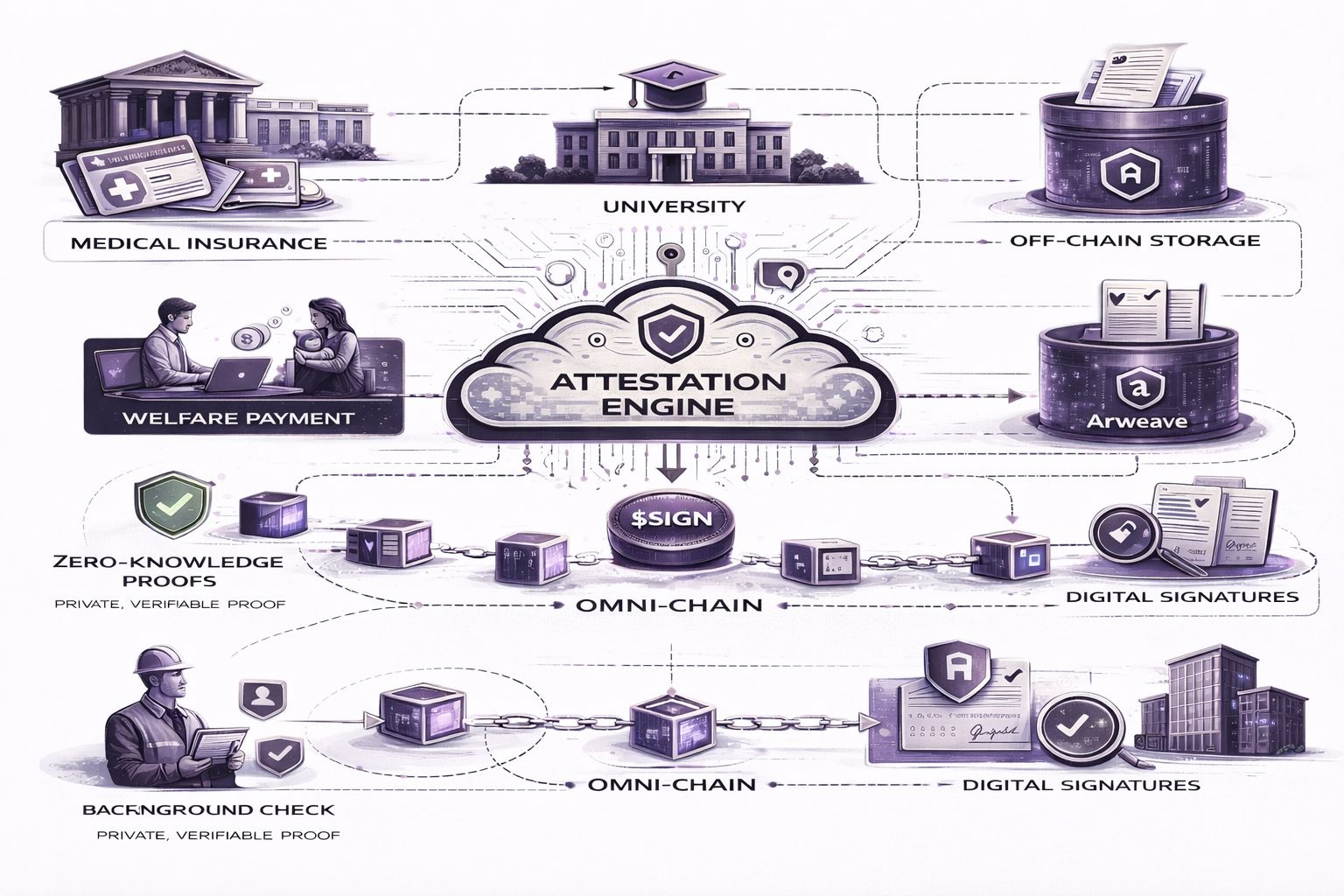
The truly interesting fact about the architecture is that it does not push everything into the blockchain. Sign Protocol also features on-chain and off-chain storage, in which durable off-chain storage is done with Arweave but the verification layer remains on-chain. This is practically important since a full on-chain storage is both costly and sluggish in the case of big credential systems. Separating data whereabouts and proof whereabouts lets SIGN scale to the government scale without making a verifiability and cost-efficiency compromise. The evidence is ever available. The information is kept in the reasonable place.
This separation also addresses a privacy issue which most credential systems silently neglect. In the case that all of your personal information resides on a publicly accessible blockchain, privacy and transparency are mutually exclusive. SIGN solves this by zero-knowledge proof support, that is, the holder of a credential can prove that something is true (I am over 18, I passed this compliance check, I have this qualification) but without showing the underlying data that demonstrates it. The proof exists. The data stays private. That is a radically different model to the majority of the digital identity work being done today.
All this is executed by the $SIGN token - this is how the network executes attestation transactions, this is how governance decisions are executed, and this is how the participants in the ecosystem are rewarded to participate in its infrastructure. It's not decorative. The more SIGN spreads out to additional chains, additional uses, additional government implementations, the more it acts as a connective tissue of the economic layer underlying it all.
The direction that SIGN is assuming is towards something that is, technically, not an easy task to accomplish: a world where credentials are served with the proof attached, where you do not need to trust someone to make a claim before it is proved, but where cryptography does. This infrastructure is already being implemented by governments in the UAE, Thailand and Sierra Leone. This year Kyrgyzstan became a signatory of CBDC infrastructure. These are not evidence of concept they are some of the first signs that the data warehouse transition is already in progress, and the plumbing to realize it is being installed as we speak.