

Plasma is presented as a Layer 1 blockchain tailored for stablecoin settlement, and the reason this idea instantly matters is because stablecoins are already doing the quiet heavy lifting of onchain life, carrying salaries, family support, merchant payments, savings protection, and emergency money when someone needs help right now, yet the experience around stablecoins still too often feels like walking through a maze where fees spike without warning, confirmations feel uncertain, and users are forced to juggle extra assets just to press send, so Plasma’s promise is not to be everything for everyone but to be dependable for the people who simply want stable value to move with clarity and dignity. I’m describing it in human terms because that is where payment infrastructure succeeds or fails, since people do not remember which algorithm a chain uses when they are anxious about money arriving on time, They’re remembering whether the system felt calm or stressful in the moment that counted, and Plasma’s whole identity is that stablecoin settlement should feel predictable, fast, and emotionally safe, not like a technical puzzle you must solve before you can participate.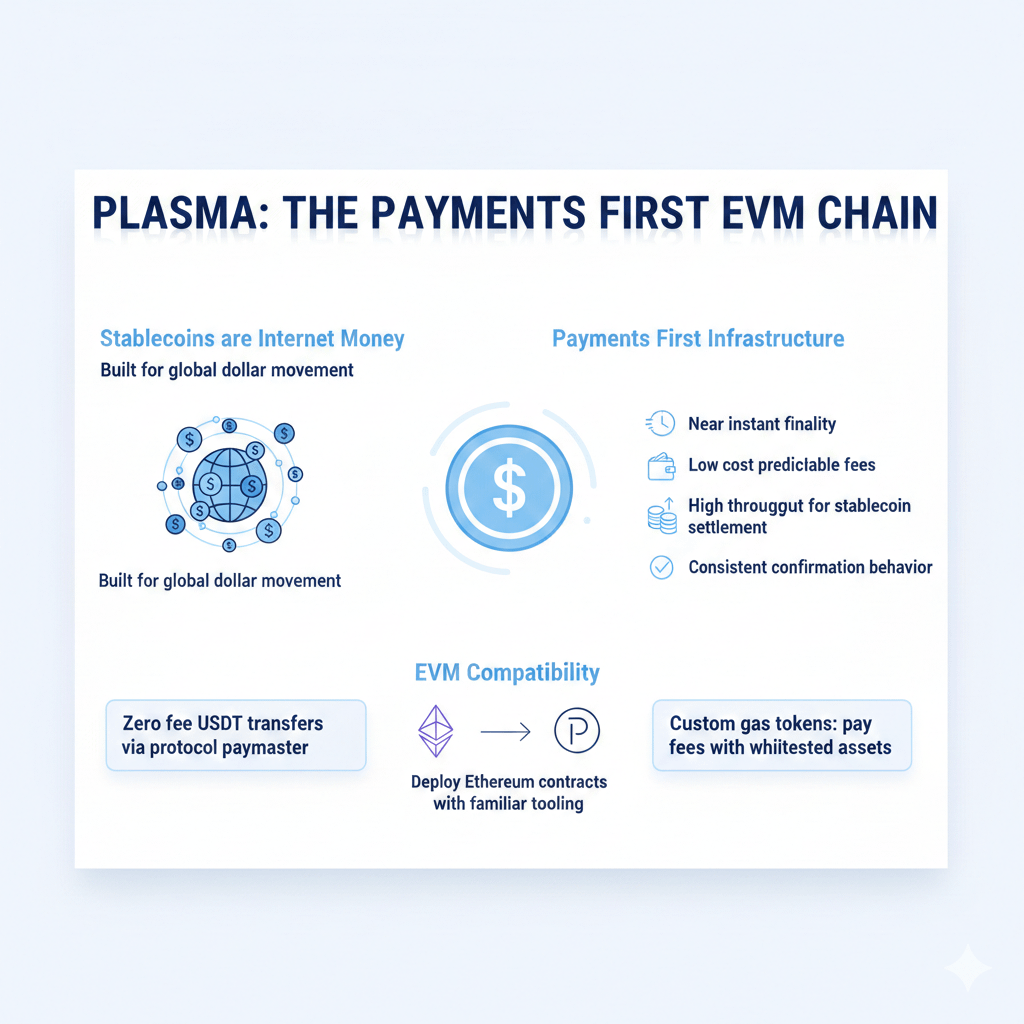
At the core of the chain, Plasma documents a consensus system called PlasmaBFT, described as a pipelined Rust based implementation of Fast HotStuff, and the simple meaning behind that choice is that the chain is trying to finalize blocks quickly and reliably by running stages in parallel rather than making them wait in line, because when settlement is the product, latency is not an inconvenience, it is fear, and fear spreads fast when money is involved. Plasma explains that this pipelined approach increases throughput and reduces time to finality, with deterministic finality typically achieved within seconds, and that last phrase is the emotional center of the design, because deterministic finality is the difference between a transfer that feels done and a transfer that feels like it might still slip away, and in a stablecoin world where payments can happen in bursts during market stress, business deadlines, or personal emergencies, certainty becomes a form of comfort, not just a performance statistic.
On top of that consensus layer, Plasma presents itself as fully EVM compatible, using a modern Rust based Ethereum execution engine design, which is an important decision because payment rails only become real when builders can ship real products quickly, and the fastest path to that is letting developers use familiar tooling, familiar security practices, and familiar contract patterns rather than asking them to relearn everything in the middle of building something that people will trust with money. Plasma’s own architecture overview describes a modular approach that combines its performance oriented consensus with Ethereum style execution and a broader interoperability vision that includes a trust minimized Bitcoin bridge, and while the bridge topic will always deserve extra scrutiny in any ecosystem because bridges expand the attack surface, the strategic intent is easy to understand, since many participants want settlement networks that connect to deep sources of value and credibility rather than living in isolation.
Where Plasma tries to feel truly different is in the stablecoin native features that aim to remove the most common point of user friction, which is the moment someone realizes they must acquire a separate gas asset just to move stable value, because that moment is where confidence collapses for many normal users and small businesses, and it is where the promise of simple digital dollars turns back into complexity. Plasma’s documentation describes a protocol maintained paymaster mechanism that can sponsor gas for eligible stablecoin transfers, with the design intent of making basic stablecoin sending smoother while restricting what is sponsored so the system does not become a free for all for attackers, and this is the part that speaks directly to ordinary human behavior, because if the act of paying becomes too many steps, people do not adapt, they leave, and If the system can make the most common transfer path feel natural, It becomes easier to imagine stablecoins as daily money rather than a specialized tool only power users can handle.
The reason the team would build a chain this narrowly is not because they lack ambition but because they are aiming at a specific kind of ambition, the ambition of becoming invisible infrastructure, and invisible infrastructure must be boringly reliable even when demand surges and attention shifts, which is why a settlement focused chain should be judged differently from a general purpose chain. The metrics that matter most are the ones that reveal whether the network stays stable under stress, meaning deterministic finality time that does not wobble when load increases, transaction success rates that remain high during spikes, fees that are predictable rather than occasionally brutal, and evidence that stablecoin transfers reflect real user intent rather than looped activity that exists only to inflate numbers. Plasma’s positioning materials and independent research coverage lean into the same message, that stablecoin settlement is strategically relevant because stablecoins are already a massive and growing use case, and the missing piece is infrastructure that treats payment flows as the default rather than as traffic that must compete with everything else, and We’re seeing that idea echoed across the broader industry conversation about stablecoins as next generation payment and settlement instruments.
Risks matter even more than promises in a settlement story, because payments punish weakness quickly and publicly, so the first obvious risk is subsidy and abuse risk, since any gas sponsored or low fee lane will attract spammers and adversaries who try to drain it, congest it, or twist it into a weapon, and that means the chain must constantly balance generosity for real users with strict constraints that stop exploitation. The second risk is governance and centralization pressure, because early phase networks often rely on coordinated upgrades and curated infrastructure to deliver a smooth experience, yet settlement credibility grows only when users believe the network will not change the rules in ways that harm them, and that belief takes time, transparency, and decentralization that is demonstrated, not merely announced. The third risk is interoperability risk, especially where high value assets and bridging are involved, because cross chain components expand the number of places a failure can occur, and in stablecoin settlement, one dramatic failure can permanently scar user trust even if the underlying design is strong. Plasma’s public materials show an awareness of production grade needs by emphasizing integrated infrastructure and standard tooling, including an official oracle relationship through the Chainlink Scale program, which is one way to reduce the risk of fragile data dependencies for DeFi and payment applications, but the honest truth is that operational resilience is earned through real world performance over time, not through architecture diagrams alone.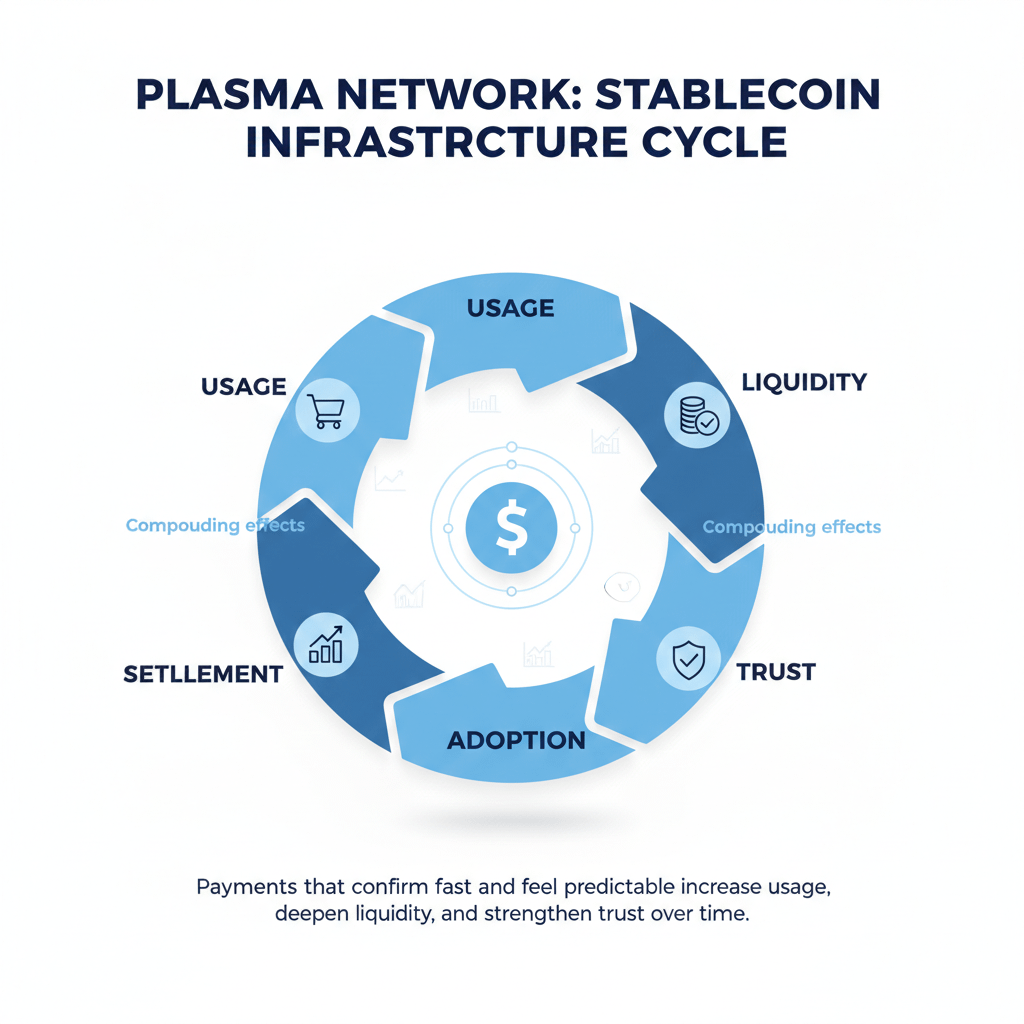
If Plasma executes well over the long arc, the far future is not a flashy one, it is a quietly powerful one where stablecoin payments feel ordinary, merchants do not fear network chaos, families do not worry about strange fee tokens or confusing steps, and developers can build money movement products that behave more like modern finance and less like a fragile workaround. In that world, a settlement focused Layer 1 becomes a kind of global utility that people touch without thinking, because the system is not demanding attention, it is simply doing its job, and when that happens, the technology stops being the story and the human outcomes become the story, the rent that arrives on time, the supplier payment that clears without stress, the support that reaches home when it matters, the small business that can finally accept stable value without feeling like it is stepping onto a cliff edge. It becomes easier to believe in a future where stablecoins are not just liquid instruments but trusted everyday money, and if Plasma stays faithful to the idea that settlement must feel calm, then it has a chance to build something rare in this space, not just a chain, but a sense of certainty that people carry with them each time they press send and feel, in that quiet second after, that it worked, and that the world can be a little more connected than it was yesterday.

