
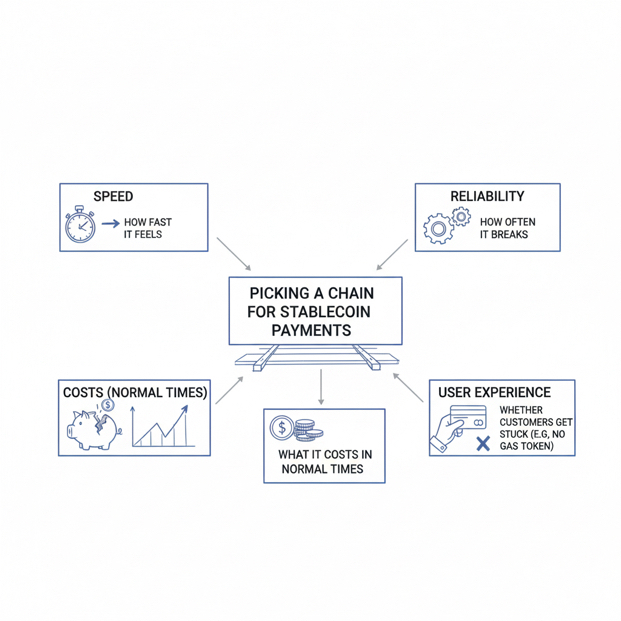
If you’re picking a chain for stablecoin payments, you’re not really picking “a blockchain.” You’re picking the thing your users will experience as a payments rail: how fast it feels, how often it breaks, what it costs in normal times and in ugly times, and whether customers get stuck because they don’t have some random gas token.
That’s the lens Plasma is built for. Plasma isn’t trying to win the “best general-purpose chain” contest. It’s trying to win one specific contest: high-volume, low-cost stablecoin settlement where stablecoin UX is the default, not something you duct-tape on later. The pitch is basically: keep full EVM compatibility so developers don’t have to relearn everything, but change the payments experience so it feels like sending money, not like “doing crypto.”
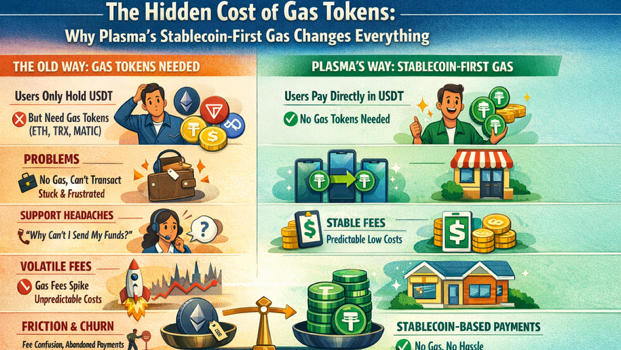
The first big “why Plasma” point is the gas problem. In normal EVM chains, users might hold USDT but they still need the chain’s gas token to move it. In payments products, that’s not a minor inconvenience—it’s the moment where users churn, merchants get confused, and support costs start eating your margins. Plasma’s approach is to make stablecoin movement behave more like what people expect: it supports gasless USDT transfers for simple sends, and it pushes a “stablecoin-first gas” idea where apps can structure fees so users can pay in stablecoins rather than being forced into a separate gas token. That isn’t just a marketing feature; it’s the kind of thing that changes conversion rates and reduces the number of failed transactions caused by “insufficient gas.”
Now compare that to TRON, which is the obvious default if you ask most people “what’s the cheapest way to move USDT?” TRON’s biggest strength is distribution and habit. A lot of people already do USDT transfers there, exchanges and wallets support it widely, and that familiarity matters in payments more than crypto folks like to admit. The trade-off is that TRON’s model isn’t the same as “plain fees”—it uses resources like bandwidth and energy, and the real experience depends on whether you’re staking, renting resources, or relying on service-layer “gasless” systems. TRON can be very cheap, but it can also be operationally fiddly in a way that only shows up once you’re doing serious volume. If you have a team that understands the resource model and you care most about riding the existing USDT transfer habit, TRON is still hard to beat.
Solana is a different kind of competitor. It wins on speed and low fees in a way that’s very hard to ignore, and it has real momentum in payments conversations. The difference is that Solana isn’t EVM, and the default expectation is still that fees are paid in SOL. If you want a gasless stablecoin experience, you can absolutely build it at the application layer, but it’s not the “native, stablecoin-first” worldview Plasma is trying to establish. Solana is the strongest choice when performance is the top requirement and you’re happy being Solana-native, but it doesn’t automatically solve the “user only holds stablecoins” problem unless you design around it.
Polygon PoS is the “safe EVM default” competitor. It’s familiar, widely integrated, and usually cheap enough that many teams don’t bother looking further. The difference is that Polygon is still basically a general-purpose EVM network with standard gas behavior: users typically need POL for gas, and stablecoin-first UX is something you build yourself with sponsorship systems and wallet flows. Polygon tends to win when you value EVM compatibility plus broad ecosystem support and you don’t want to adopt something more specialized. Plasma is trying to win the cases where “cheap and EVM” isn’t enough because the gas-token friction becomes a product killer.
Security and neutrality is where the decision gets more nuanced, because different buyers have different tolerances. Plasma uses a BFT-style consensus approach designed for fast settlement and talks about Bitcoin-anchored security/neutrality as part of its long-term direction. That story is attractive if you think stablecoin settlement should lean toward censorship resistance and neutrality over time. But the honest version is: you should separate what is already true today on the chain from what is a roadmap execution story (like deeper Bitcoin anchoring/bridge assumptions). TRON, by contrast, has a more concentrated block producer structure, which can be totally acceptable for many payment use cases—but if your business is highly sensitive to censorship risk, governance capture, or perceived neutrality, you’ll scrutinize it harder. Solana and Polygon sit in more “mainstream chain security models,” with their own trade-offs, but neither is making the “stablecoin-first at the protocol level” bet Plasma is making.
The moat question is basically: can Plasma make its specialization sticky? If stablecoin payments become genuinely gasless and stablecoin-fee-native at the protocol level, that’s not a small improvement—it changes the shape of your onboarding funnel, it reduces failures, and it makes your product feel like normal money movement. Once you build around that expectation, switching back to “users must hold gas tokens” feels like a downgrade. That’s the kind of moat that shows up as lower customer support burden and higher completion rates, not just as a nicer whitepaper.
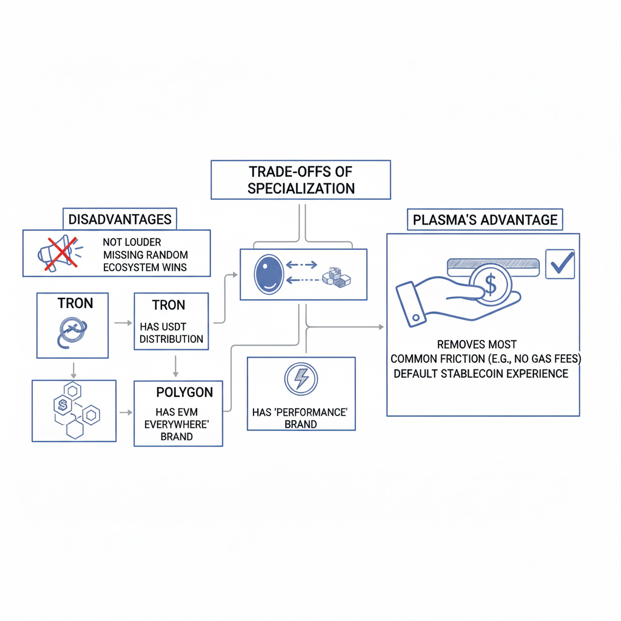
But you also have to acknowledge the trade-offs. Specialization usually means you don’t get every random ecosystem win that general-purpose chains get. Plasma has to earn its distribution; TRON already has it for USDT behavior. Solana already has the “performance” brand. Polygon already has the “EVM everywhere” brand. Plasma’s advantage is not that it’s louder; it’s that it’s trying to remove the most common friction point in stablecoin payments and make that the default experience.
So if you want the cleanest practical rule of thumb: Plasma makes the most sense when your product lives or dies on stablecoin payments UX at scale—especially when your users should be able to live entirely in stablecoins without thinking about gas. TRON makes the most sense when you want to ride existing USDT transfer habits and you’re comfortable operating within its resource economics. Solana makes the most sense when raw performance and low fees are the headline requirement and you’re happy being Solana-native. Polygon makes the most sense when you want the EVM default with broad integrations and you can tolerate the standard gas-token friction or build around it.
