
The crypto market these days makes me feel like I’m standing next to an old steam locomotive. Loud, hot, trembling at the seams, and everyone screaming speed. I watch it for a moment and then the same question comes back, after all these years of saying blockchain will change the world, how much has it actually changed real human experience.
DeFi has TVL, it has APR, it has every kind of capital optimization you can name, but the moment you open a wallet, the feeling is still unfamiliar and dry. Like you’re operating a financial machine with no face and no voice, only buttons and risk warnings. It’s ironic. The more permissionless it becomes, the more it feels like a maze. And in a place that should touch everyday life like gaming, that maze becomes a death sentence.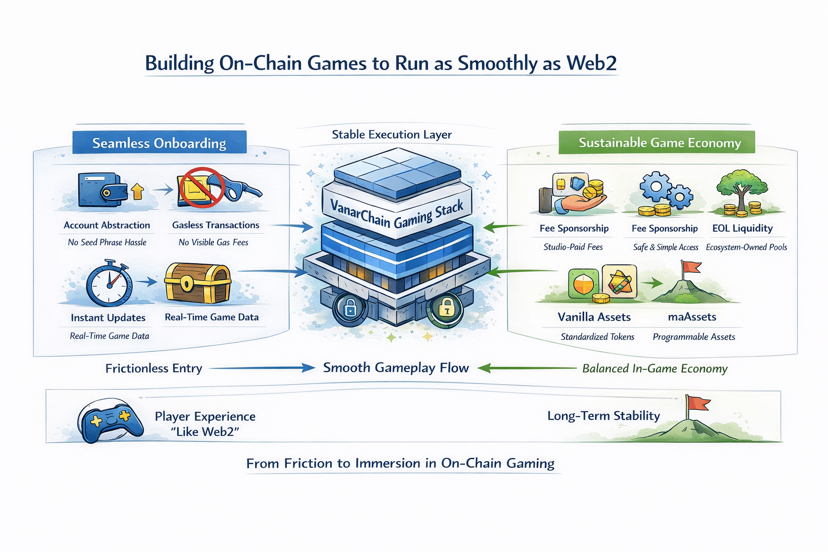
If I’m being blunt, on chain games haven’t been losing because the ideas are bad. They’ve been losing because the stack isn’t complete enough for games to run smoothly the way traditional games do. Players don’t care which chain it’s on. They care whether the game launches, whether their input gets an instant response, whether winning and losing feels fair and trustworthy. But blockchain forces them to learn wallets, seed phrases, gas, signing transactions, waiting for confirmations. To a gamer, that’s like being told to read a contract before firing your first shot. It kills rhythm. It kills emotion. It turns a game into a technical exam instead of play.
And then I started reading about VanarChain in the middle of that same looped question. If you want an on chain game to feel smooth, what pieces do you actually need, and in what order do you assemble them. VanarChain’s gaming stack made me pause because it didn’t start with the slogan of high TPS. It started with something very human. The path from downloading the game to entering a match has to be frictionless, like sliding on ice. Onboarding has to be invisible, or nearly invisible. The wallet can’t be a psychological barrier. Fees need to be handled so players don’t feel like they’re paying gas. And in game state, items, scores, match results, must update fast enough that players never feel yanked out of flow.
Here, the stack isn’t just a base chain layer. It’s an entire support system so blockchain can survive the tempo of games. I think of it like a body. The chain is the spine, but a game lives because of the heart, lungs, and blood vessels. You need stable execution so small actions can happen continuously without clogging. You need something like account abstraction so players can log in in a normal way, while the system handles signing and security behind the scenes, instead of demanding private key literacy on day one. You need flexible fee mechanics that let studios sponsor fees or batch them by session, so the experience feels closer to traditional games. You need indexers and strong data infrastructure so the interface can show near real time state, because if a player opens a chest and waits forever to see an item appear, it no longer feels like a game. It feels like submitting a form.
But deeper than that, what makes on chain gaming hard isn’t just transaction speed. It’s in game economics. Traditional games live on a loop of play, earn rewards, upgrade, play again. On chain adds another loop. Assets can be traded, can leave the game, can be speculated on. That’s both an opportunity and a fracture line. If the economy is designed poorly, the game becomes a liquidity extraction machine. People enter not to play, but to farm, and when they’re done farming, they leave behind an empty world. I’ve seen too many GameFi projects die that way. Shallow gameplay, tokenomics like a vacuum hose, incentives like short term painkillers.
That’s why I paid attention to how VanarChain talks about liquidity and assets in its ecosystem, as something that can breathe. They mention programmable liquidity, vanilla assets, maAssets, and EOL. If I translate that into builder language, it sounds like an attempt to lay a more durable foundation for game economies, less dependent on rented, mercenary capital. Vanilla assets can be seen as a basic, standardized asset layer, helping games and apps inside the ecosystem share one asset language instead of each building its own isolated format. maAssets sound like assets with mechanics attached, meaning the asset isn’t just a token sitting still, it carries logic for distribution, locking and unlocking, rewards and penalties tied to behavior in the game. EOL is the idea that the ecosystem owns part of its liquidity, so it doesn’t have to keep running incentives and praying people won’t pull out.
In a gaming context, that matters because games need stability the way they need gravity. Item markets can’t break liquidity every other week. Item prices can’t be violently jerked around by a small farm and dump crowd. Studios can’t build an economy on ground that constantly collapses.
If VanarChain’s gaming stack works the way it’s supposed to, what they’re trying to build isn’t just infrastructure for games. It’s a pipeline that lets emotion pass through blockchain without breaking rhythm. Players enter, play normally, smooth like Web2. But the assets have real ownership, real transferability, and can outlive a single server’s lifespan. Builders get a toolkit so they don’t have to reinvent everything from scratch, from login to wallets to fees to data to programmable economic frameworks. And most importantly, the ecosystem doesn’t live entirely on hype as its bloodstream.
I’m not naive. A stack that looks good on paper is easy. The hard part is attracting real studios, shipping real games with real players, and keeping the experience stable when traffic spikes. A breakout game exposes every weakness, latency, congestion, interface desync, state mismatches. And gaming is ruthless. Players don’t give you extra time to be decentralized. They quit the moment it feels laggy. But what makes me want to keep watching VanarChain is that the direction feels clear. It’s not trying to dress DeFi up as a game. It’s trying to make blockchain sit underneath the game, like electricity under a switch.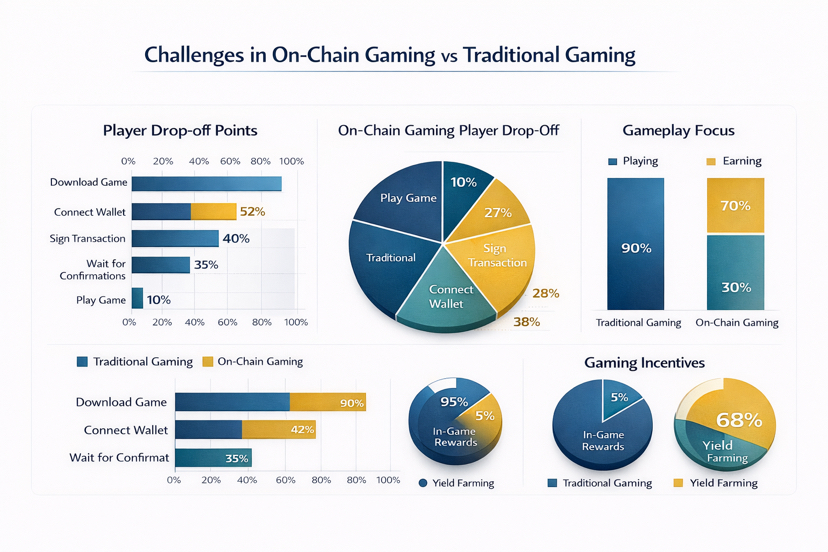
Maybe blockchain doesn’t need another story about being the fastest. It needs a story about being the easiest to feel. On chain gaming doesn’t need more tokens to pump charts. It needs the missing pieces that keep gameplay smooth, keep economies stable, and keep worlds from turning into extraction machines.
I’m still skeptical, because I’ve seen too many promises. But if there’s a place where blockchain can learn to have a heartbeat in mainstream experience, then a gaming stack built like this, if it’s executed all the way, might be where it starts breathing.