
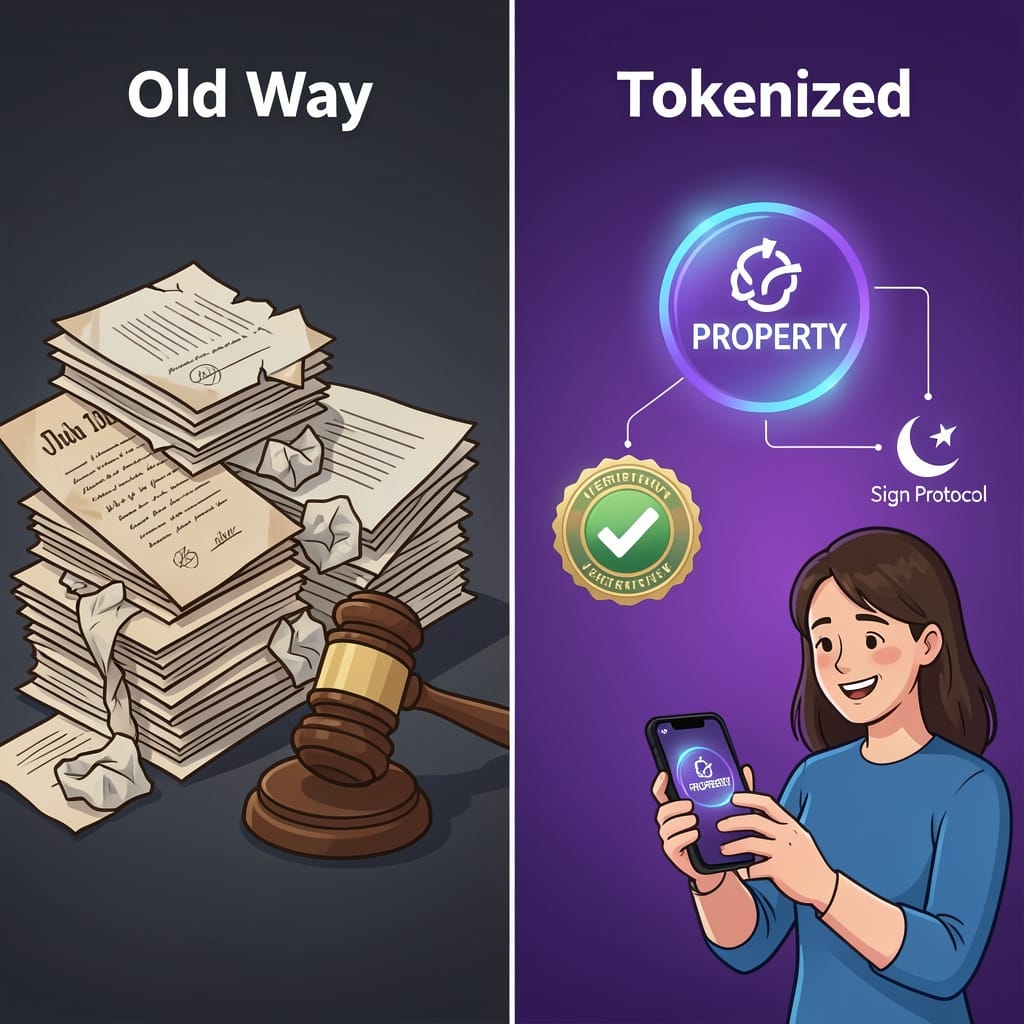
 I was talking to a friend last week who owns a small apartment in Dhaka. He bought it three years ago. Still waiting for the deed. The paperwork is stuck somewhere between the developer, the registry office, and a lawyer who stopped returning his calls.
He asked me something I hadn't thought about before. "In crypto, if I buy something, it's mine instantly. Why can't property work like that?"
Turns out, some people are already making this happen.
The real estate problem nobody fixed
Buying property anywhere in the world involves layers of paperwork, months of waiting, lawyers reviewing documents, banks verifying funds, and at the end of it all, a piece of paper that says you own something.
That piece of paper can get lost. It can be forged. It can be disputed in court for years.
A relative of mine spent six years proving she owned land her father bought in 1985. Six years. The original documents existed. But someone else claimed they had them too. Court didn't know who to believe.
This is what happens when ownership proof is just paper.
How tokenization changes this
Imagine the same apartment, but instead of waiting for a deed, you receive a digital token. That token links directly to an attestation that proves:
The property exists
The seller actually owns it
The government recognizes the transfer
You now own it
All of this lives on chain. No papers to lose. No lawyer needed to verify. Anyone with internet can check.
Where Sign comes in
Sign Protocol creates something called attestations. Think of them as digital stamps that can't be faked.
When a property gets tokenized, an independent authority verifies everything. They check government records, confirm the seller's ownership, ensure no disputes exist. Then they create an attestation on Sign.
This attestation becomes the proof. Not a piece of paper. Not a PDF. Something cryptographically verified that anyone can check.
When you buy the token, you're not trusting a developer or a lawyer. You're trusting math and verification that happened before the token existed.
What this means for buyers
No more waiting months for documents. The transfer happens when you pay.
No more hiring lawyers to verify ownership. The attestation already did that.
No more losing deeds in a fire or a flood. The proof lives on chain.
No more court battles over who owns what. The attestation shows the chain of ownership.
The parts that still need work
I'm not pretending this is fully ready for every property in the world. It's not.
Government recognition varies by country. Some places accept digital records. Some still want physical papers. The law hasn't caught up everywhere.
But in places where governments are already on board, this is working. UAE is one example. Sierra Leone is another. More are looking at it.
A conversation I had recently
I asked someone building this what happens when someone tries to tokenize a property they don't own.
He laughed and said, They can try. The attestation system stops them. Before anyone can mint a token, the attestation needs to exist. And no authority is creating an attestation for a property they haven't verified.
That's the difference between tokenization and real estate tokenization. The token itself is just code. The attestation is the proof that makes it worth something.
He's still waiting for his deed. But he started asking around about tokenized property options in Dubai. He heard some projects there are using Sign's attestations.
He told me, If I can buy something and own it instantly, why would I ever go back to the old way?
I didn't have a good answer for that.
What do you think? Would you buy property that exists only as a token with attestation proof? Or do you prefer the old paper system?
#Sign $SIGN @SignOfficial #BTC #Binance #OpenAIPlansDesktopSuperapp #AnimocaBrandsInvestsinAVAX