
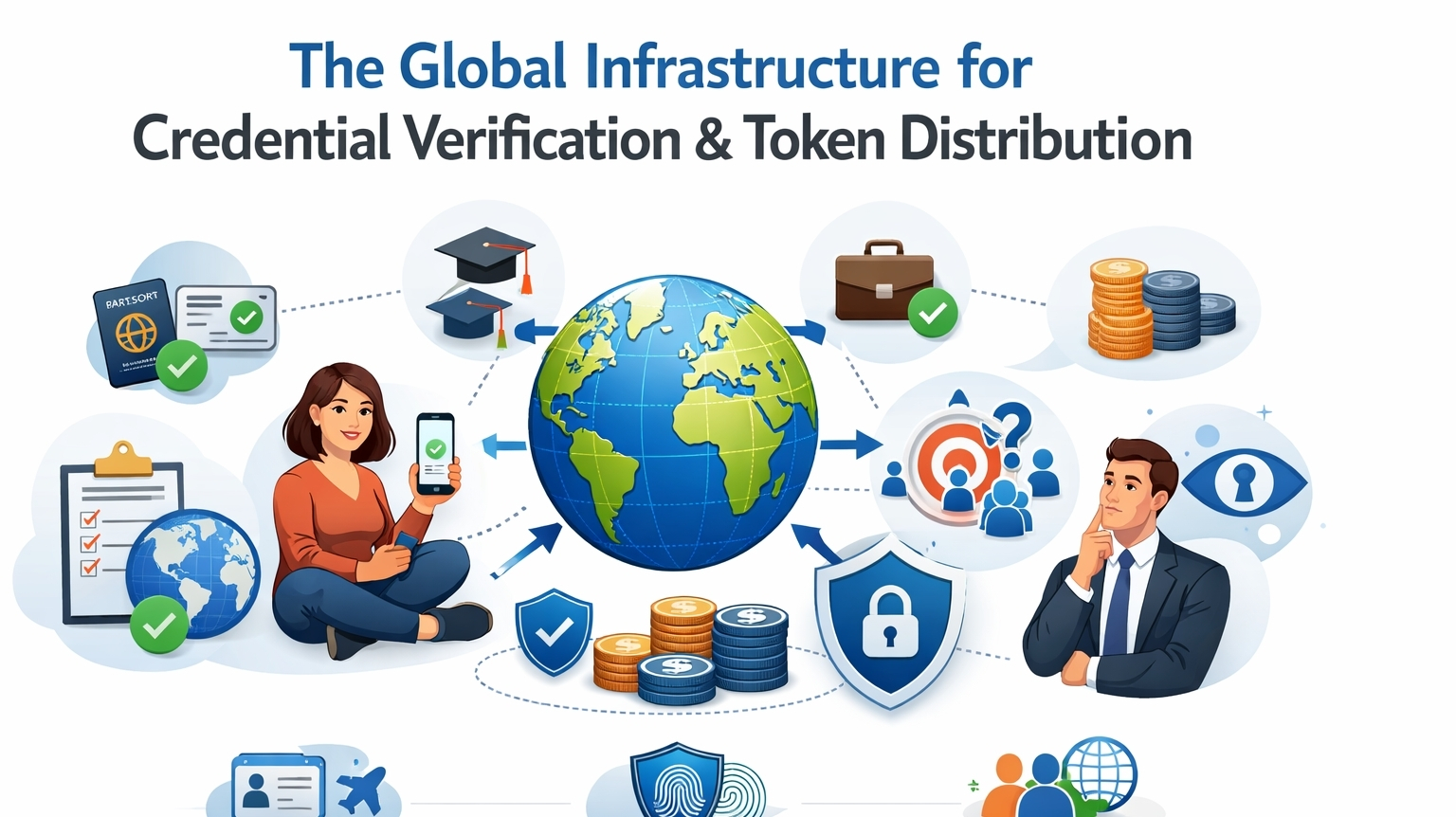
There is something oddly outdated about the way we prove who we are and what we have earned online. For all the talk about innovation, speed, and digital transformation, a huge part of modern life still runs on repetition, delay, and trust held together by paperwork. You finish a degree, earn a certificate, build a work history, or qualify for a program, and then spend an exhausting amount of time proving it again and again to different institutions that do not talk to each other.
It is a strange system when you think about it. The achievement is real. The identity is real. The experience is real. Yet the burden of proof keeps falling back on the individual, over and over, as if nothing can be accepted unless it passes through another slow checkpoint. A university has one format. An employer has another. A government office asks for something else entirely. If you move across borders, the friction gets worse. Suddenly your qualifications are not rejected exactly, but they are not smoothly accepted either. They enter that gray zone of “under review,” which can feel like a polite way of saying your life is now waiting on someone else’s process.
That is why the idea of a global system for credential verification feels so powerful. On paper, it sounds like a clear fix to a very real problem. Instead of scattered databases and endless document requests, people could hold credentials in a form that is portable, verifiable, and recognized across platforms, employers, schools, and even countries. Instead of re-uploading the same files for the tenth time, you could simply prove what is true, instantly and securely. That vision is compelling because it speaks to something basic: people want their records to travel with them. They want their effort to count without having to re-argue for it every time they enter a new system.
And then tokens enter the conversation.
This is usually the point where the idea starts to split in two. One version stays simple and human. The other starts drifting into abstraction. In the simple version, digital infrastructure helps people prove qualifications, access opportunities, and participate in systems more easily. In the abstract version, everything becomes tokenized, wallet-based, and layered with technical assumptions that normal users never asked for. What was supposed to remove friction starts introducing a new kind of it.
That is the tension at the center of this whole space. A better infrastructure for credentials is genuinely needed. But a lot of the proposed solutions risk becoming more complex than the problem they claim to solve.
Because the truth is, most people do not care about the architecture. They care about the experience. They want to apply for a job in another country without weeks of verification limbo. They want to prove they completed a course without chasing an institution for paperwork. They want access to grants, services, communities, or financial tools without learning how to manage a fragile set of keys and signatures first. The average user is not asking for a digital identity labyrinth. They are asking for a smoother life.
That is where the idea of token distribution becomes both interesting and complicated. In theory, tokens can be used to reward participation, allocate access, coordinate incentives, and create portable digital ownership. That sounds useful. But distribution is never neutral. The moment value enters the system, questions of fairness, power, and control arrive with it. Who decides what gets rewarded? Who qualifies? Who verifies the verifier? These are not technical side notes. They are the core of the issue.
A system can look decentralized on the surface and still concentrate power underneath. It can promise openness while quietly privileging the institutions, standards, or communities that got there first. It can talk about inclusion while making access dependent on digital literacy, device security, or familiarity with tools that much of the world still finds confusing. And once credentials and tokens become deeply linked, another question appears: are people being empowered, or are they just being turned into entries inside another governed digital system they do not control as much as they think?
Privacy matters here too, maybe more than people realize at first. A global credential layer sounds efficient until you ask what kind of visibility it creates. If everything becomes easy to verify, what else becomes easy to track? If credentials are portable, are they also easily exposed, profiled, or exploited? There is a difference between being able to prove something and being forced to reveal everything. Any system that gets this wrong will not feel empowering. It will feel invasive.
So the real challenge is not just building infrastructure that works. It is building infrastructure that respects people while it works. That means keeping verification simple, but also keeping disclosure limited. It means making systems interoperable without making users transparent. It means reducing fraud without turning every person into a permanently inspectable record.
And maybe that is the part the industry still underestimates. The hardest problem is not creating a new credential format or attaching a token to an identity layer. The hardest problem is trust design. It is building something that institutions can accept, people can use, and bad actors cannot easily exploit, all without making the experience miserable. That is a high bar. Technology can help, but it cannot magically erase governance problems, social inequality, or the messiness of international recognition.
Still, the direction matters. A world where credentials are portable, verification is faster, and opportunities are less trapped inside disconnected systems would be a meaningful improvement. That is not hype. That is practical. But practical systems only succeed when they stay grounded in human reality. If this infrastructure ends up demanding more effort, more risk, and more confusion from the people it is supposed to help, then it has missed the point.
The future of credential verification and token distribution should not be about making people adapt to technology. It should be about making technology finally adapt to people. That is the standard. Not whether it sounds revolutionary, but whether it quietly removes friction from real lives. Because in the end, the best infrastructure is the kind that feels almost invisible. It does its job, respects the user, and gets out of the way.