
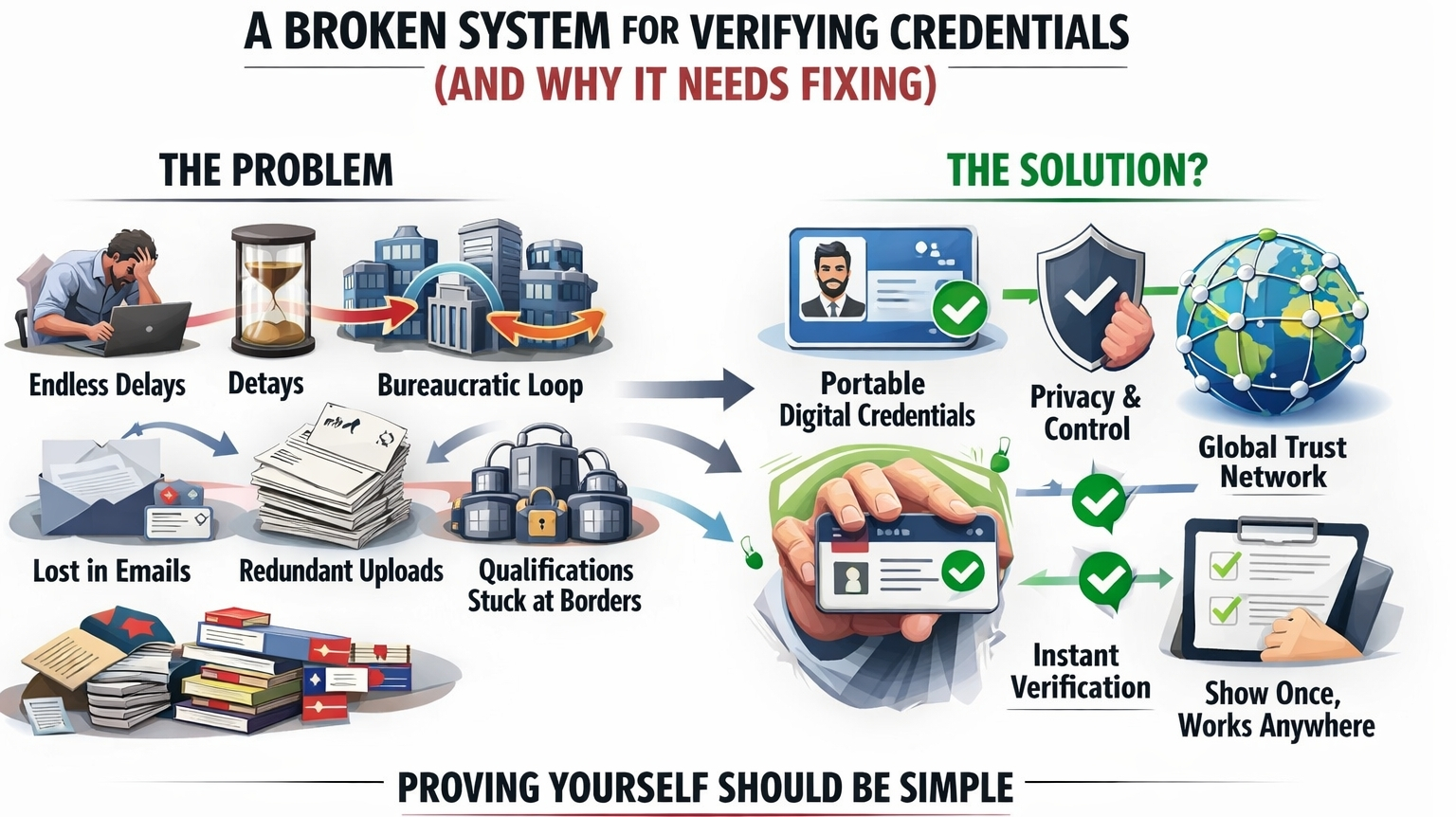
It’s kind of ridiculous when you really think about it.
You spend years studying, working, building up skills. Then one day someone asks you to prove it, and suddenly you’re digging through old emails, downloading certificates, uploading the same files over and over like it’s your full-time job. And even then, they don’t fully believe you. They want “verification.” Always that word.So you wait.And wait.And nothing happens.Or worse, you get stuck in some loop where one office tells you to contact another office, and that one tells you to go back to the first. It’s like nobody actually owns the process, but everyone controls a piece of it. That’s the problem. Too many pieces. And every piece slows things down.
Right now, credentials are basically stuck in silos. Universities have their own systems. Employers have theirs. Governments have another layer on top. None of them talk properly. So every time you move, switch jobs, or apply somewhere new, you’re forced to rebuild trust from scratch. Again.
It doesn’t matter that you already proved it somewhere else. That proof doesn’t travel. And that’s the part that feels broken. Not outdated. Broken.
People keep suggesting fixes, but most of them miss the point. They try to improve the existing mess instead of replacing it. More portals. More verification services. More steps. It’s like adding more locks to a door that barely opens.
Then there’s the whole “token” idea. And yeah, I get why people roll their eyes at it. It sounds like another buzzword. Another thing tied to crypto hype that nobody asked for. But strip all that away, and the idea is actually simple.
What if your credential wasn’t just a file?
What if it was something that could prove itself?
No emails. No callbacks. No waiting. Just check it. Done.
That’s all people want. Something they can show once, and it works everywhere.
Right now, that doesn’t exist. Everything depends on the issuer being available. If they’re slow, you’re slow. If they don’t respond, you’re stuck. Your own achievements are locked behind someone else’s system. That’s insane when you think about it. You did the work, but you don’t control the proof.
A global system would flip that a bit. Not completely, but enough to matter. You’d hold your credentials. You’d present them directly. And whoever needs to check them could do it instantly. No chasing. No delays.
Sounds obvious, right? Like something we should already have. But we don’t. Because getting everyone on the same page is a nightmare.
Different countries, different standards, different ideas of what counts as valid. Some places trust certain institutions, others don’t. Some require extra layers of approval. Some just don’t care. So even if you build the perfect system, you still have to convince people to use it. And that’s where things usually fall apart.
Also, let’s be honest. People don’t trust new systems. Especially ones that sound technical. You say “token” and half the room checks out immediately. They think scams. They think speculation. They think it’s another thing that’ll disappear in a year. Hard to blame them.
And then there’s privacy. Big issue.
If credentials become easy to verify, they also become easier to expose if you’re not careful. Nobody wants their full history out there for anyone to see just because it’s convenient. So now you need control. You need selective sharing. You need a way to prove something without revealing everything. That’s not simple. And if you mess that part up, the whole system falls apart.
There’s also this weird push to break everything into tiny pieces. Every skill, every course, every small achievement turned into its own little unit. On paper, that sounds flexible. In reality, it might just turn into clutter. Too many small things. No clear picture.
Sometimes people just want to know: can you do the job or not? Not scroll through a list of 200 micro-certifications.
Still, even with all these issues, it’s hard to argue that the current system is fine. It’s not. It wastes time. It creates friction where there shouldn’t be any. It blocks people from opportunities for no good reason. Especially across borders.
That’s where it really falls apart. You move to another country and suddenly your qualifications don’t mean much until they’re re-verified, translated, approved again. It’s like starting over, even when you shouldn’t have to.
A global setup could fix that. Or at least reduce the pain. Same proof. Same system. Works anywhere. That alone would make a difference.
But again, the idea is simple. The execution is not.
You need cooperation. Real cooperation. Not just tech people building stuff in isolation. You need institutions, governments, companies actually agreeing on how things should work. And that’s slow. Painfully slow.
Everyone has their own interests. Their own systems. Their own reasons not to change. So things drag.
Meanwhile, people are still stuck emailing PDFs back and forth.
It’s frustrating because the problem isn’t even that complicated. Proving something should not be this hard. Not in 2026.
We don’t need something flashy. We don’t need hype.
We just need a system where proof actually works the first time.
That’s it.
And somehow, we’re still not there.