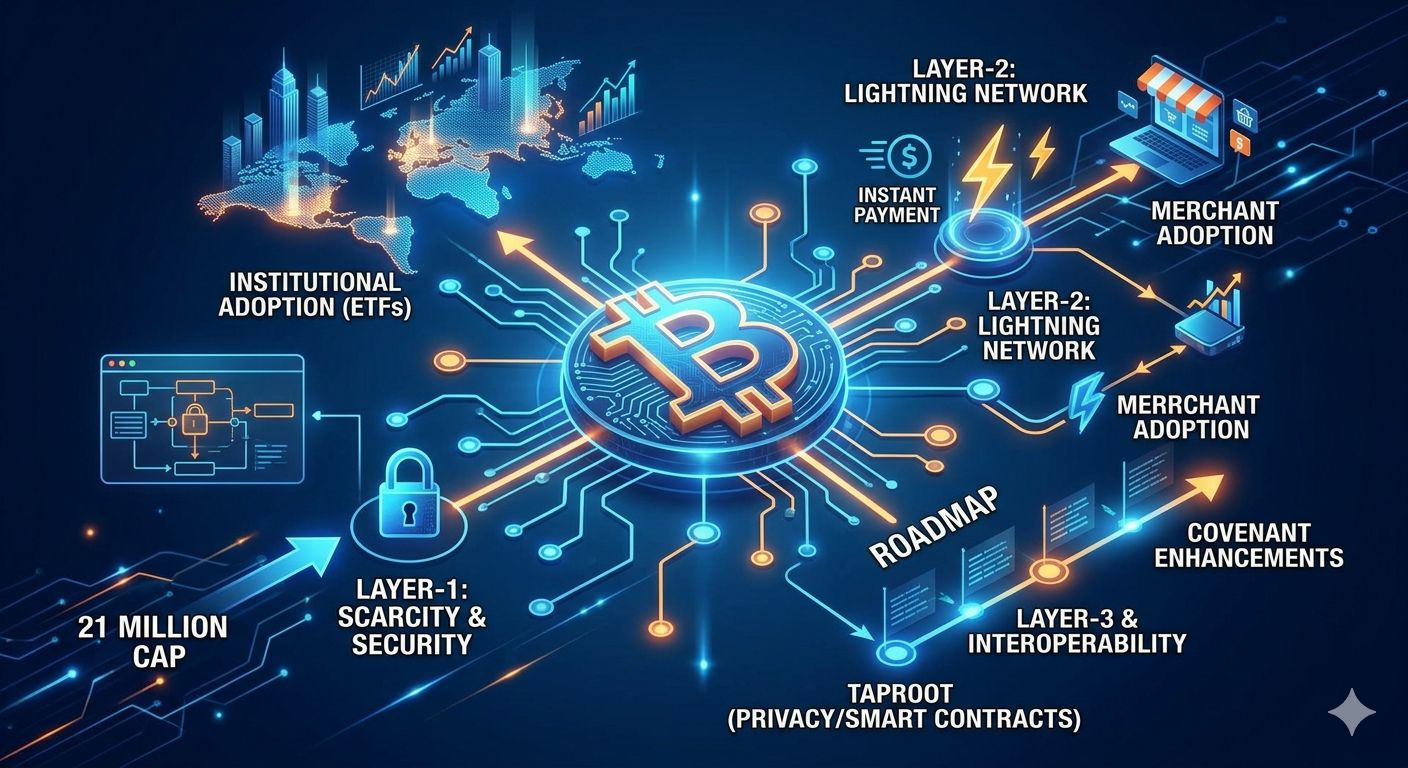
While the daily price movements of $BTC Bitcoin are often defined by volatility, its long-term fundamental thesis has grown increasingly robust. For years, $BTC Bitcoin was viewed purely through a speculative lens. Today, its role as a decentralized, trustless, and immutable store of value is being validated by institutional and regulatory actions.
The following is a natural human assessment of Bitcoin’s fundamentals, its ecosystem development, and where its technological roadmap is heading.
The Core Fundamental Value: Scarcity and Security
The primary driver of $BTC Bitcoin's value lies in its mathematical guarantee of scarcity. Unlike fiat currencies, which can be printed indefinitely, Bitcoin is capped at 21 million units. This is enforced not by a central bank but by global consensus and distributed computing power (Proof-of-Work). This mechanism ensures security and immutability, requiring tremendous energy to alter the ledger, making it the most secure blockchain in existence.
Fundamentally, Bitcoin is the first successful realization of digital ownership without a centralized intermediary. This core utility only grows as global economies grapple with inflation and debasement.
Highlights of Key Developments
Bitcoin is often criticized for being slow to change, but its evolution is deliberate, prioritizing security above all else. Recent developments highlight a maturing ecosystem:
1. Institutional Adoption and spot ETFs:
Perhaps the most significant fundamental shift is the mainstream institutional validation. The approval of spot Bitcoin ETFs in major financial markets (like the US) has opened the floodgates for traditional capital. BlackRock, Fidelity, and other massive asset managers now offer Bitcoin exposure, legitimizing it as an investable asset class and providing consistent buying pressure that was absent in previous cycles.
2. The Lightning Network (Layer-2 Scaling):
For Bitcoin to function as a medium of exchange, it needs to be fast and cheap. The Lightning Network solves this by facilitating near-instant, low-cost transactions off-chain, which are later settled on the main Bitcoin blockchain. This network's capacity and adoption have grown significantly, powering remittance payments and everyday purchases (like those seen in El Salvador) without clogging the main network.
3. Taproot Upgrade:
Implemented in late 2021, Taproot was the most significant protocol upgrade in years. It improved transaction privacy, enhanced efficiency, and, crucially, expanded smart contract capabilities on Bitcoin. This paved the way for new innovations that were previously limited to other blockchains.
4. Ordinals and BRC-20:
Leveraging the Taproot upgrade, developers introduced Ordinals (Bitcoin-native NFTs) and BRC-20 tokens. While controversial within the community due to network congestion and increased fees, they fundamentally prove that demand for Bitcoin's secure blockspace extends beyond simple value transfer. This has ignited a new wave of developer interest and utility within the ecosystem.
The Future Roadmap: Scaling and Programmability
Bitcoin does not have a formal, centrally planned roadmap. Its development occurs via Bitcoin Improvement Proposals (BIPs) which require broad consensus. However, clear areas of focus are emerging:
Further Layer-2 and Layer-3 Development:
The core network (Layer-1) will remain the settlement layer. The roadmap forward is almost entirely focused on scaling through layers. Innovations like Ark (a new L2 protocol) and advancements in Statechains are being researched to offer different trade-offs between speed, cost, and custody. The goal is to make Bitcoin transactions ubiquitous and accessible for all utility cases.
Covenant Enhancements (e.g., CTV, CAT):
Several BIPs are currently under discussion (like OP_CHECKTEMPLATEVERIFY or reintroducing OP_CAT) aimed at introducing more complex "covenants." These are essentially rules attached to how bitcoins can be spent in the future. This would allow for advanced security features (like vaulting protocols that delay withdrawals) and powerful, native smart contracts, further expanding Bitcoin’s programmability.
Cross-Chain Interoperability:
Connecting Bitcoin securely to other financial ecosystems (DeFi) will continue to be a focus. This involves trustless bridges or decentralized protocols that allow Bitcoin to be used as collateral or payment in diverse applications without relying on wrapped versions managed by central entities.
Hashrate Decentralization:
As mining becomes more industrialized, there is ongoing technological development focused on keeping the network distributed. This includes innovations in strata (the communication protocol used between miners and pools) to grant individual miners more control and prevent centralization of block creation.
Conclusion
Fundamentally, Bitcoin is stronger today than at any point in its history. Its scarcity remains unassailable, its security is unmatched, and its network effects are exponentially larger than its closest competitors. While scalability challenges persist, the deliberate, layered development approach provides a sustainable pathway. As the technology evolves to support daily utility and complex financial tools, its value as an uncensorable, globally recognized asset continues to solidify.