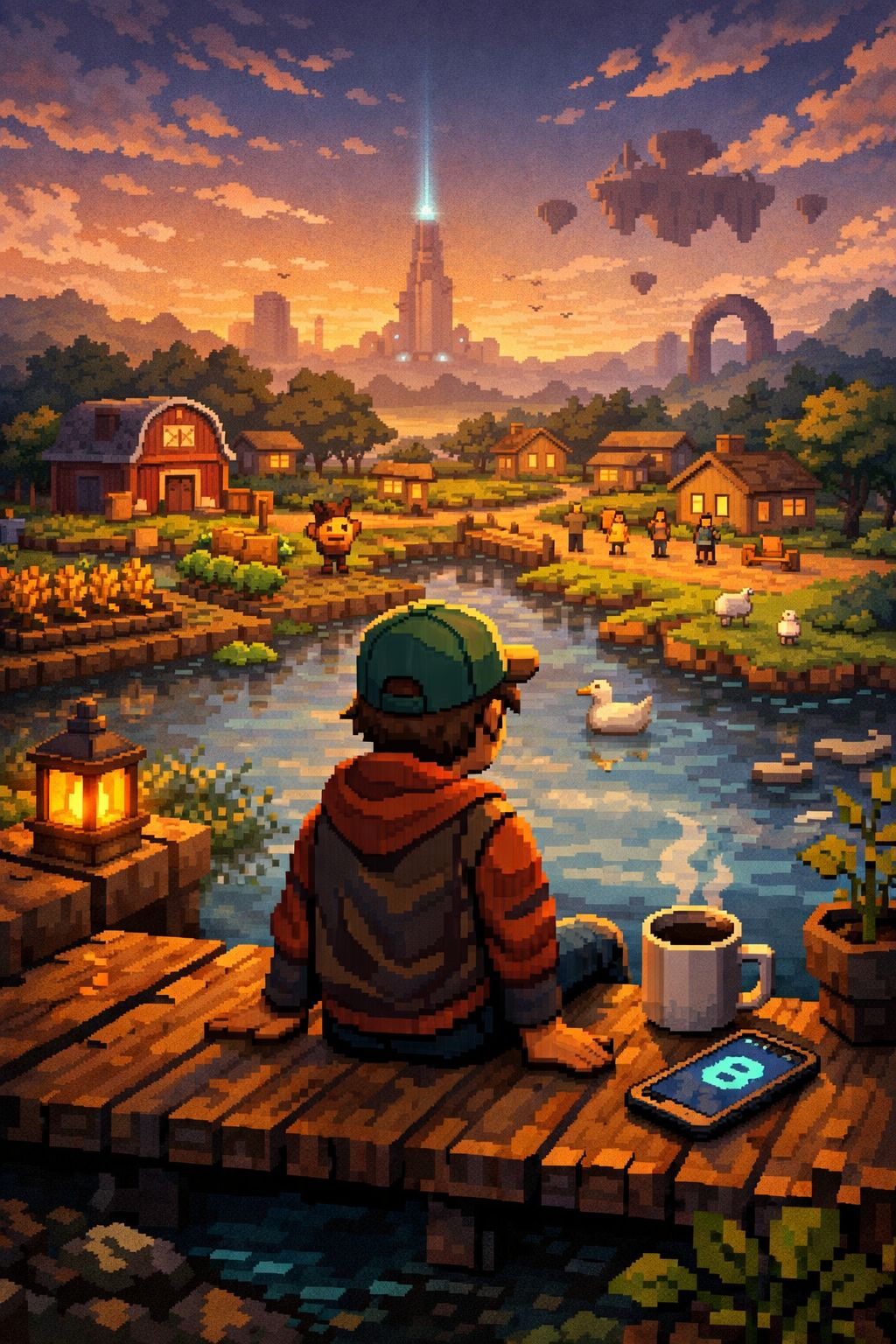
I’ve been around crypto long enough that most things don’t really land the way they used to. You start recognizing the rhythm of it all—the buildup, the excitement, the flood of takes, and then the slow fade when reality catches up. It doesn’t matter if it’s DeFi, NFTs, or gaming. The story changes, the structure stays the same.
So when Pixels started getting mentioned here and there, I didn’t think much of it. It sounded familiar in all the usual ways. A Web3 game, a token, some kind of open-world farming loop layered on top of blockchain infrastructure. I’ve seen that combination before, or at least versions of it dressed up differently. Most of them don’t last long enough to even be remembered properly.
But this one didn’t disappear.
It didn’t explode overnight either, which is usually what I’ve come to expect. Instead, it just kept… existing. I’d see people mention it casually, not like they were trying to sell it, just like they’d spent some time there. That alone felt unusual. In most Web3 games, people don’t talk about playing—they talk about earning, flipping, optimizing. The “game” part tends to sit somewhere in the background, almost like an afterthought.
I’ve seen that pattern too many times. The whole play-to-earn wave looked convincing for a while. I’ll admit that. There was a moment where it felt like something had actually shifted—people were showing up in large numbers, economies were forming, and it all seemed to feed into itself. But underneath it, the structure was fragile. It relied too heavily on constant growth, on new users coming in to sustain the system. Once that slowed down, everything started to unravel.
That’s the thing about crypto. It doesn’t always break immediately. Sometimes it works just long enough to convince people it’s sustainable.
So when I look at Pixels now, I can’t help but carry all of that with me. I don’t approach it with excitement. If anything, I approach it with a kind of quiet suspicion. Not because it’s doing something wrong, but because I’ve learned that the real problems don’t show up early.
And yet… something about it keeps pulling my attention back.
It’s simple, almost to a fault. Farming, gathering, moving around a shared space. No grand claims about redefining gaming, no overwhelming layers of mechanics trying to prove how advanced it is. A few years ago, I would’ve dismissed that immediately. It would’ve felt too basic to matter.
Now I’m not so sure.
I keep noticing that people stick around. Not everyone, obviously—this is still crypto—but enough that it feels different. They’re not all there for the same reason, which is rare in this space. Some are clearly chasing rewards, that part never goes away. But others seem to be there because they don’t mind being there. That’s a subtle distinction, but it matters more than people think.
Still, I don’t fully trust it. I don’t think I can anymore, not in the way people expect. The moment you introduce a token into any system, everything shifts, even if it’s gradual. People start thinking differently. Time becomes an investment. Actions become strategies. It stops being just a game, whether anyone admits it or not.
I’ve seen good ideas slowly get reshaped by that pressure. Not because the teams wanted it, but because the environment demands it. Attention turns into speculation faster than anything else here. And once that happens, it’s hard to pull things back.
There’s also the fact that it’s built on Ronin. That ecosystem has been through its own ups and downs, and I can’t ignore that history. Nothing in crypto exists in isolation. Where something is built matters almost as much as what it is.
But even with all that, I keep coming back to the same thought: this doesn’t feel forced.
It’s not trying too hard to convince anyone. It’s not wrapped in layers of narrative designed to make it sound bigger than it is. If anything, it feels a bit unfinished, a bit uncertain about where it’s heading. And strangely, that makes it easier to take seriously.
I’ve seen projects that looked perfect on paper fall apart the moment people actually interacted with them. Everything aligned until it didn’t. Pixels doesn’t have that polished certainty, and maybe that’s a good thing.
I find myself wondering what happens when things scale. When more users show up, when more money flows in, when expectations start forming around it. That’s usually where things get complicated. It’s easy to feel stable when you’re small. It’s much harder to maintain that when the spotlight turns on.
I’m not sure Pixels can handle that. I’m not sure any project really can, at least not without changing in ways that weren’t originally intended.
But right now, it’s in that rare space where it hasn’t fully tipped in either direction. It’s not purely a game, not purely an economy. It’s somewhere in between, still figuring itself out.
And maybe that’s why it stands out to me.
Not because I think it’s the future, or because I believe it’s going to break the cycle, but because it hasn’t given me a clear reason to write it off yet. In a space where most things reveal their flaws almost immediately, that’s enough to make me pause.
I’ve learned not to get carried away by things that feel different. Sometimes “different” just means the same story, told more carefully. But every now and then, something comes along that doesn’t quite fit the usual pattern.