
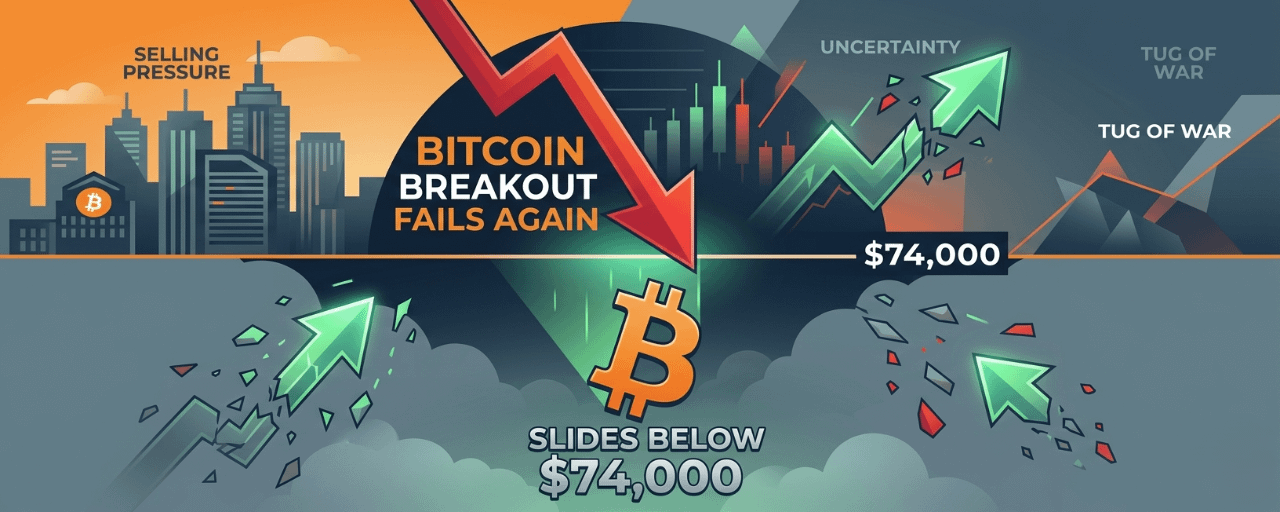

Bitcoin slipped back below the $74,000 level, once again failing to sustain a breakout that many traders had been watching closely. The move highlights a pattern that has become familiar in recent weeks. Each attempt to push into higher territory has been met with selling pressure, suggesting that the market is not yet ready to commit to a stronger uptrend.
At first glance, the setup looked promising. Momentum had been building, sentiment was turning more optimistic, and technical indicators pointed toward a potential continuation move. But as price approached resistance, buyers lost control. The rejection was quick, and the drop below $74,000 followed soon after.
This kind of behavior often reflects uncertainty rather than outright weakness. Buyers are present, but not aggressive enough to absorb the supply sitting at higher levels. Sellers, on the other hand, are taking advantage of each rally to lock in profits. The result is a market that moves up in bursts but struggles to hold those gains.
Volume patterns support this view. Breakout attempts have not been backed by strong, sustained buying activity. Without that conviction, price moves tend to fade. It is not just about reaching a new level. It is about holding it, and that is where Bitcoin has been falling short.
Macro factors are also playing a role. Broader financial conditions remain mixed, with shifting expectations around interest rates and global liquidity influencing risk assets. Bitcoin does not move in isolation, and when the wider environment lacks clarity, it often shows up in the form of choppy price action.
At the same time, the structure of the market is not entirely bearish. Despite the rejection, Bitcoin is still trading within a relatively high range compared to earlier cycles. Higher lows are still intact on longer timeframes, which suggests that the broader trend has not been broken. What is missing right now is follow-through.
For traders, this creates a difficult environment. Breakouts are less reliable, and false signals become more common. Chasing strength near resistance has proven costly, while waiting for confirmation often means missing early moves. It is a phase where patience matters more than prediction.
For longer-term holders, the situation looks different. Short-term volatility is part of the process, especially after strong rallies. Consolidation phases can last longer than expected, but they often serve as a base for future moves. The key question is whether Bitcoin can eventually build enough support to turn these failed breakouts into a sustained trend.
Until then, the market remains in a tug of war. Buyers are trying to push higher, sellers are defending key levels, and neither side has fully taken control. The drop below $74,000 is not just a price move. It is a signal that the breakout story is still incomplete.
What happens next will depend on whether demand strengthens at current levels or if further downside is needed to reset expectations. Either way, the pattern is clear. Bitcoin is testing patience before making its next decisive move.
