Every few months, the Web3 gaming space decides it’s evolving.Usually, that just means a fresh coat of paint on the same old farm to dump cycle. But when I dug into the Pixels whitepaper and started tracking the on-chain activity for $PIXEL ,I realized this team isn’t just iterating they’re fundamentally changing the economic engine while the player is still having fun.
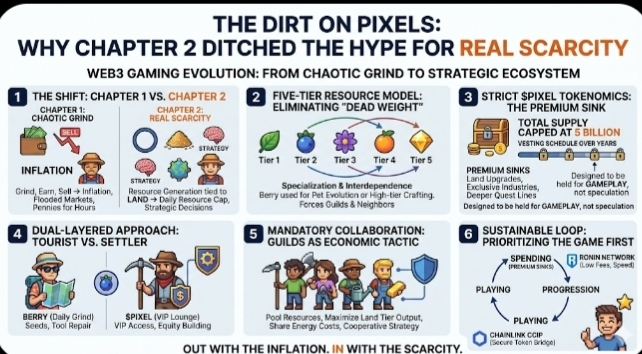
We need to talk about the shift from Chapter 1 to Chapter 2. If you weren’t paying attention, you missed the real bridge between chaotic crypto speculation and mainstream gaming adoption. The old model was simple: grind, earn, sell. It worked until it didn’t. Inflation would hit, the market got flooded, and the casual player left because their hours of work were suddenly worth pennies. The team over at @Pixels looked at that broken wheel and decided to throw it away entirely.
Instead of generating unlimited resources every time a new wallet connected, the developers tied resource generation directly to the land itself.This is the kind of change that sounds small on paper but is seismic in practice. We now have a global cap on daily resource output. Suddenly, supply and demand isn't just an abstract concept it's hardcoded into the server logic. If you want to be a top-tier farmer or crafter, you can’t just grind for 18 hours a day; you have to be strategic about what you harvest and when.
This naturally leads to the five-tier resource model. Everything has a specific purpose now. That berry you used to throw away because your inventory was full? It’s now a key component for pet evolution or a high-tier crafting chain . This eliminates the "dead weight" resources that plague most MMOs. It forces specialization. You cannot be a master of everything anymore, which means you need your neighbors. You need a guild. You need an economy.
And at the center of this web sits Pixel. I’ve watched a lot of utility tokens come and go, but the tokenomics here are unusually strict. With a total supply capped at 5 billion and a vesting schedule stretched over years, there is no room for the pump and dump crews to comfortably settle in . More importantly, the team designed $PIXEL to be a premium sink, not just a reward. You aren't holding this token hoping the price goes up you are holding it because it’s the only way to unlock the higher tiers of gameplay. You need it for land upgrades, exclusive industries, and accessing deeper quest lines .
I also find the dual-layered approach to be incredibly smart for onboarding. They use a softer currency, BERRY for the daily grind buying seeds, repairing tools, the boring stuff But Pixel is the key to the VIP lounge. It separates the tourist from the settler. If you are just here to click and leave, you never touch the crypto layer. But if you want to own a piece of this digital nation, you need the token. This structure reduces the over financialization that scares away traditional gamers while preserving the upside for those who want to build real equity.
The social aspect can’t be ignored either. Because the land is scarce and the resources are finite, collaboration is mandatory. The introduction of Guilds isn't just a social feature; it's an economic survival tactic. You pool resources to maximize your land's tier output. You share the burden of the energy costs. It transforms the game from a solo grind into a cooperative strategy session . That is how you build retention. Not through airdrops, but through dependency and friendship.
For a long time, I was skeptical of the play-to-earn label because it always felt like work. Pixels feels different because the team is clearly prioritizing the game first. They built a sustainable loop where spending feels like progression, not a tax. They moved to the Ronin network for the speed and low fees, and they’ve even bridged Pixel securely using Chainlink’s CCIP to ensure that when you move your assets, they don’t disappear into a black hole .
#pixel l isn't just a ticker symbol. It’s the fuel for a digital agrarian society that is growing smarter every day. If you haven’t looked at the Chapter 2 changes yet, you’re still thinking about Web3 gaming the old way. Out with the inflation. In with the scarcity.