
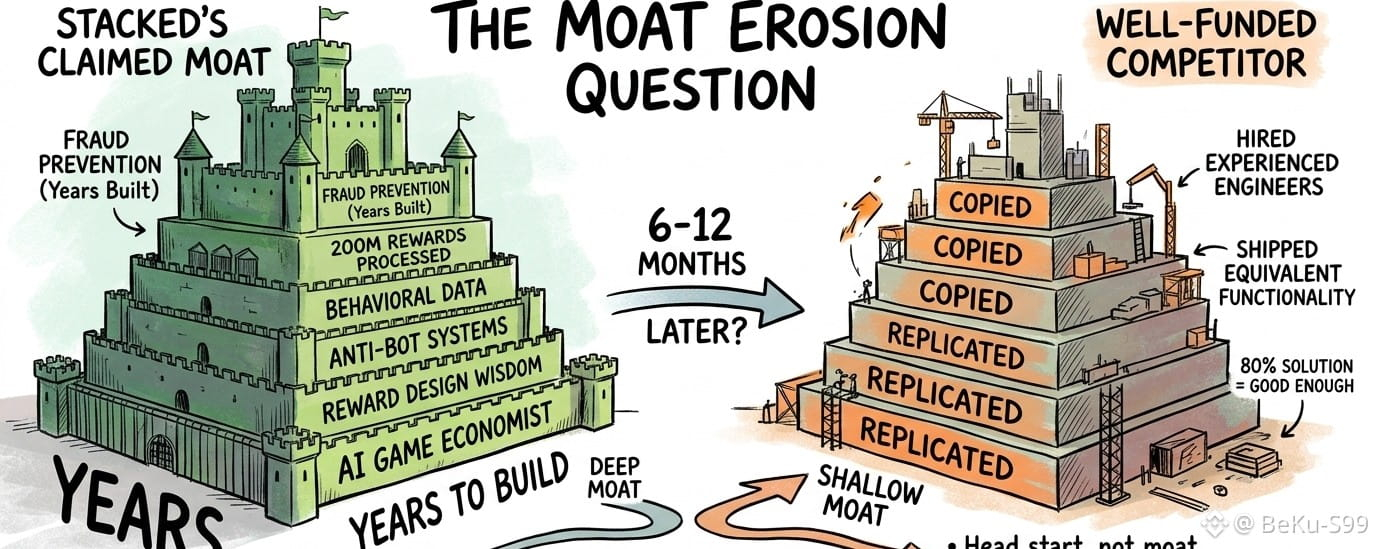
I keep watching @Pixels and trying to figure out if Stacked's moat is actually defensible or if it's just a temporary lead that gets competed away once someone decides to build the same thing.
What I'm watching isn't whether Stacked has advantages today. It does. What I'm watching is whether those advantages persist when competitors show up with capital.
The moat question in B2B gaming infrastructure.
Not the differentiation narrative. The reality where first movers build capabilities over years, then competitors replicate them in months once they see validation.
That's where most technical moats erode.
Pixels says Stacked's moat is real. Fraud prevention built over years. Anti-bot detection at scale. Behavioral data from millions of players. Reward design wisdom from surviving adversarial usage.
All legitimate. What I can't tell is whether it's defensible when competitors target it.
With B2B infrastructure the moat is usually technical capability, operational knowledge, or data. Those are replicable if someone wants to replicate them.
Fraud prevention systems seem defensible. They take years because you need to see fraud patterns at scale. You need actual adversarial behavior and adaptation.
Real barrier. What I don't know is how high that barrier actually is.
@Pixels processed 200 million rewards. Significant volume. But is it irreplaceable. Could a competitor with good initial fraud detection catch up in 12 months of production usage.
Most technical moats are shallower than founders claim. "Years of development" sounds defensible until a well-funded competitor ships equivalent functionality in quarters.
The behavioral data moat is interesting. Stacked has data from millions of players. That informs the AI game economist.
Valuable proprietary data. What I can't tell is whether it's uniquely valuable. Does behavioral data from one game transfer meaningfully to different games with different mechanics. Or does each studio need their own data.
If insights transfer across games, the data moat is real. If they're mostly game-specific, the moat is narrower.
The reward design wisdom moat is the softest. "We've learned what works" isn't proprietary technology. It's institutional knowledge. That walks out when people leave. Gets copied when competitors hire key team members.
Most institutional knowledge moats erode faster than technical moats.
What keeps me coming back is whether Stacked's moat is "we figured it out first" or "we have something competitors can't replicate." The first isn't a moat. It's a head start.
The question's what specifically can't be replicated. Is it fraud prevention sophistication. Is it behavioral data scale. Is it the integration of AI economist with reward distribution.
Most of those seem replicable given time and capital. Maybe not all together. But enough that a competitor could build "good enough" infrastructure faster than Stacked expands market share.
That's how most B2B infrastructure moats get tested. Not by identical systems. By 80% solutions that are good enough for most customers.
Maybe Stacked's moat is deeper than I'm giving it credit for. Maybe fraud prevention really does require years of adversarial learning that can't be accelerated.
Maybe the moat's shallower and a well-funded competitor ships equivalent infrastructure in 2025.
I'm watching to see which one.
What I'm particularly watching is whether Stacked patents or open-sources key components. Patents suggest they think the moat needs legal protection. Open source suggests execution matters more than IP.
$PIXEL's value depends on whether Stacked maintains technical leadership. If competitors catch up, $PIXEL loses its infrastructure advantage.
Most infrastructure tokens don't maintain technical moats long-term. Best engineers spread across companies. Institutional knowledge diffuses. Head starts erode.
I'd prefer Stacked has a real moat. I'm just not convinced most B2B infrastructure moats are as defensible as the pitch assumes.
The moat question's fundamental. You can build better infrastructure today. If competitors can build equivalent infrastructure tomorrow, the advantage doesn't persist.
And honestly, I trust teams that identify specific defensible advantages more than teams that claim everything they built is a moat.
