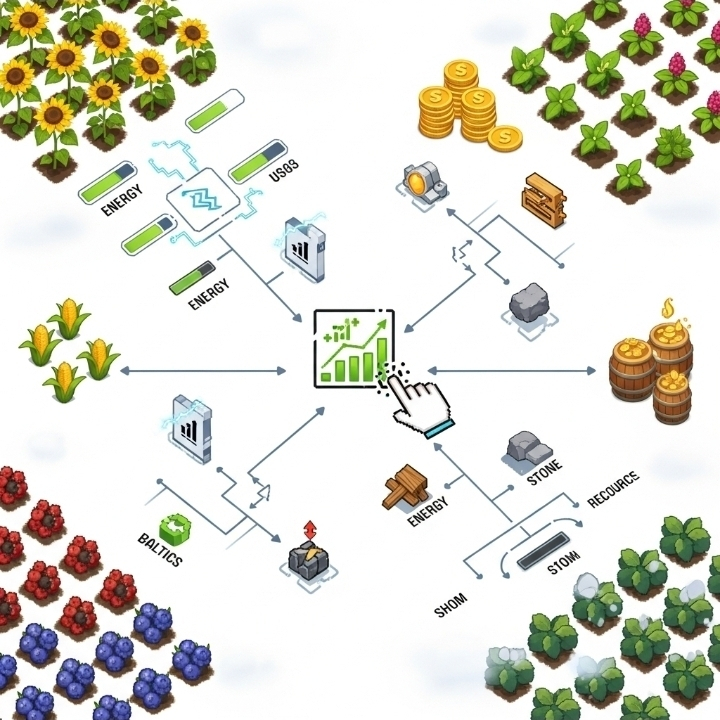
Two players plant the same crops. Same land. Same time online. But one of them quietly pulls out almost double.No extra grind. No better luck. Just better decisions.
I didn’t notice this at first. Pixels makes everything feel equal on the surface. You follow the farming loop, you harvest, you move on. It feels like progress is tied to effort. But the more I watched, the more it became clear that effort is only half the story.
The real difference starts with how players treat time inside the loop.
Some plant crops the moment they log in. Others wait a bit. They align planting with when they’ll actually return so nothing sits idle. It sounds small but over days it compounds. Idle crops are silent losses and most casual players don’t even register them.
Energy usage is another quiet divider. Casual players burn through it just to stay active. Optimizers spend it with intent. They avoid low value actions. They route their energy into steps that either unlock better crafting paths or produce items that actually move in the player economy.
That’s where resource handling becomes obvious. I’ve seen players dump materials instantly just to clear inventory. Others hold, combine, or redirect them into higher value outputs. Same inputs, completely different outcomes. Pixels doesn’t stop you from being inefficient. It just doesn’t reward it.
Land ownership amplifies this gap. More land should mean more earning but that’s not always what happens. Some players expand without a plan and end up spreading their effort thin. Others treat land like a system. Every tile has a purpose. Every action feeds into the next. That’s where the real scaling happens.
The PIXEL token sits right in the middle of all this. It’s easy to think of it as just earnings, but it behaves more like a tool. Spend it too early, and you slow your own progression. Use it at the right moment, and it unlocks loops that pay back over time. The difference isn’t how much PIXEL you earn. It’s whether your decisions multiply it or drain it.
Ronin makes everything feel seamless. That’s the dangerous part. Moving value in and out of the game is frictionless, so inefficiencies don’t feel like mistakes. But they add up. Small misplays in Pixels are not obvious but they are constant.
What really surprised me is how much social behavior affects this. The players who optimize rarely play in isolation. They compare notes. They adjust faster. They pick up on small changes in resource demand or quest flow. Casual players keep playing the same way, even when the environment shifts.
And this is where the gap becomes permanent.
Pixels does not loudly reward the hardest worker. It quietly rewards the player who understands the system. You can spend hours inside the game and still fall behind someone who is simply thinking a bit deeper about each step.
That raises a question I can’t ignore. If most of the value comes from optimization, what happens to the players who just want to play casually? Do they slowly realize they’re earning less, or do they leave before they even understand why?
And longer term, can an economy like this hold if efficiency keeps concentrating rewards into a smaller group of players?
That quiet gap isn’t going away. If anything, it widens over time.
In Pixels, you’re not really competing on effort. You’re competing on how clearly you see the system.