
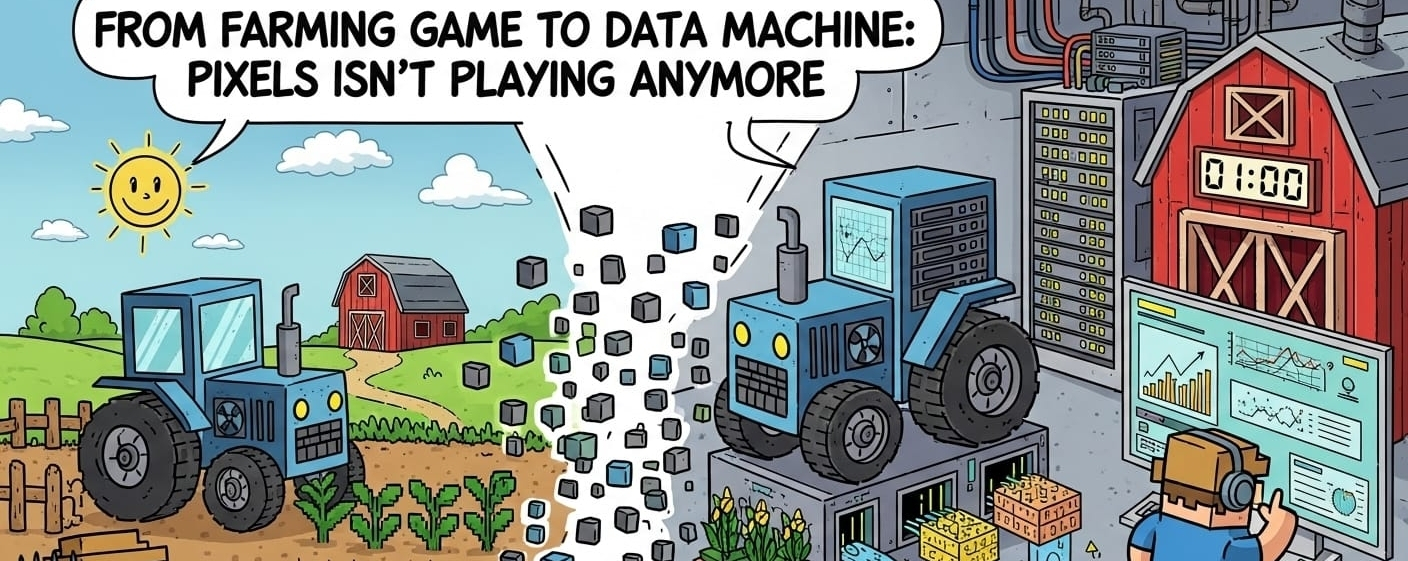
i been thinking about something for a few days and it won't leave my head. what if a game stops being just a game and slowly turns into a publishing ecosystem ? what are we even interacting with then ? players ? developers ? or just part of a big data-driven economic machine ?
pixels is making this question impossible to ignore. they're not just making games anymore. they're building a structured ecosystem where they make their own games and let others in, but the entry conditions are very specific.
start with first-party titles. pixels pals is a casual social mobile game where you raise virtual pets. sounds light and fun right ? but the real work is data capture. how users engage, what rewards they react to - that whole behavior layer gets recorded. then that data feeds back into their smart-reward system. meaning rewards aren't random anymore. they're behavior-driven. rewards become a calibration tool, not a giveaway.
then there's pixelsmobile. they say they're not simplifying the original game for mobile, but making it scalable. their r&d focus for 2026 is on latency, accessibility, mass concurrency. even if a million users play together, the system won't break. that's not game design anymore. that's infrastructure.
and vpixel integration is built into every first-party game from the start. monetization isn't added later. it's baked into the loop from day one. user experience and token flow are the same thing.
but the real shift is the partner game criteria. here, pixels stops being a game studio and becomes a selective publisher plus economic gatekeeper.
look at the conditions. rors 0.9 threshold means they're saying you get reward but you gotta generate economic return equal to or close to it. gaming becomes a capital efficiency problem, not pure entertainment.
then data sharing requirement. anonymized player data has to stream through their events api. this is where the game turns into a system feedback loop. developers aren't just making games, they're feeding input into a live economy.
monetization benchmark - at least 2% conversion of monthly active users. that's actually a casual audience filter. low engagement studios won't survive here.
agile development requirement sounds like software best practice but here it means more. the ecosystem itself iterates fast. slow developers are inherently incompatible.
this whole criteria set creates selection pressure. not all games can get in. those that do get forced to shape themselves to the system.
but for those that make it, benefits are real. free user acquisition through staking community distribution. attention becomes liquidity-backed. advanced analytics for fraud detection and ltv optimization. co-marketing with 300k+ users means distribution isn't centralized advertising anymore, it's ecosystem gravity.
so pixels is no longer publishing games. it's creating a curated economy layer where data flows continuously, reward systems tune behavior, and external studios have to follow those rules to be part of the ecosystem.
biggest question though. when an ecosystem decides who enters, how they play, and how value gets created - is that an open economy or a controlled system ? the more structured growth becomes, the less spontaneity. and gaming's real power was always unpredictability. how people would play couldn't be predicted completely.
pixels wants to manage that unpredictability with data and incentives. is that the future of scalability, or is the real soul of gameplay getting replaced bit by bit with structure ? i don't know man. but it's not just a farming game anymore. that's clear.
@Pixels #pixel $PIXEL
