A lot of games have farming. A lot of games have crafting, gathering, little quests, shared spaces. That part is familiar. The more interesting thing is the kind of mood it builds around those systems.
It feels like one of those games where the point is not to win a big moment. It is to settle in.
That sounds small, maybe even too small. But it matters. Especially in web3, where so many projects used to arrive with a lot of noise around them. Big promises. Big language. Big expectations. Pixels takes a different route. It gives you a world that looks simple on purpose and asks you to spend time there doing ordinary things. Planting. harvesting. moving from place to place. picking up what you need. meeting people without really making a big performance out of the social part.
You can usually tell when a game wants to be admired from a distance. Pixels feels more like it wants to be lived in a little.
That changes how you read everything else about it.
If someone only describes it as a social casual web3 game on Ronin, that is technically fine. Nothing wrong with that description. But it still misses the texture of it. Because the real shape of the game comes from repetition. The small routines. The way progress happens in pieces rather than in dramatic leaps. One of the first things you notice in a game like this is that the actions are not especially complicated. That is part of why they work. They leave room for habit. And habit is usually what turns a game from something you try into something you return to.
That return matters more than excitement in a game like this.
Some games are built around intensity. They need tension, speed, pressure, constant reward. Pixels does not really depend on that. It works more through accumulation. Time spent. paths learned. materials saved. crops planted at the right moment. areas that start to feel familiar after enough visits. There is something quiet in that design. It trusts that enough small actions, placed side by side, can create attachment. Not through spectacle. Just through presence.
That is where the social side becomes more interesting too.
A lot of people hear “social game” and imagine nonstop interaction. Chat windows flying. players clustering around events. constant cooperation or competition. Pixels feels social in a softer way. The world is shared, and that alone changes the feeling of even ordinary tasks. When other people are around, your routine stops feeling completely private. You are still doing your own work, but you are doing it near others. They are building their version of progress. You are building yours. The game does not always have to force connection for connection to exist. Sometimes it is enough that people are inhabiting the same rhythm.
That kind of design can be easy to overlook because it does not announce itself loudly. But after a while it becomes obvious. Shared worlds do not only create interaction. They create atmosphere. They make routine feel witnessed, even casually. That changes everything a little.
And I think that is one reason farming makes sense here.
Farming is one of those mechanics that sounds dull when reduced to a sentence. Plant crops. wait. collect. repeat. But in games, that loop has a strange staying power. Probably because it mirrors a very basic kind of satisfaction: putting something into motion, leaving it alone, and coming back to see that it changed. That rhythm fits naturally into casual play. It does not demand full concentration all the time. It allows people to enter and leave without losing the thread. In a social game, that matters. In a browser game, it matters even more.
Pixels seems built around that understanding.
It is not asking the player to constantly prove skill. It is asking for attention in smaller pieces. A few minutes here. a little planning there. maybe a longer session when someone feels like exploring or pushing their progress further. That flexibility makes the world feel easier to belong to. And honestly, “belong to” is probably the phrase that fits best here. Not own in the technical sense. Belong in the everyday sense. Know the routes. know the value of things. know what your routine looks like.
That is where the web3 layer starts to look different too.
Usually when people talk about web3 games, the conversation gets pulled toward ownership, tokens, assets, and economy. Those things are all relevant. They are part of the structure. Pixels has that layer too, and it is powered through the Ronin Network, which is closely tied to blockchain gaming. But what is interesting is not just that the infrastructure exists. It is whether the game can keep that infrastructure from swallowing the mood of the world.
That is the real challenge.
Because once a game ties itself to tokens and on-chain systems, it introduces another way of seeing every action. A crop is not just a crop anymore. An item is not just an item. Progress starts to carry economic meaning, even if only in the background. Sometimes that can make a game feel sharper and more alive. Sometimes it can flatten everything into calculation. The difference is hard to manage. And that is usually where web3 games either become spaces people care about, or systems people pass through.
Pixels seems aware of that tension.
It does not present itself like a trading dashboard pretending to be a game. At least not at the surface level. It still wants to feel like a place first. That matters. Not because it solves all the deeper issues, but because it shifts the emphasis. The question changes from “what can be extracted here?” to “what kind of daily life is this game trying to create?” That is a better question. Maybe the better one. Because long-term interest in a world usually depends less on the official economy and more on whether people develop ordinary reasons to return.
And ordinary reasons are underrated.
People come back because they want to finish a task they left halfway done. Because they know what they want to gather next. Because they want to see who is around. Because their little patch of progress means something to them now. These are not dramatic motivations, but they are durable. They create a kind of loyalty that looks quiet from the outside. It is not loud fandom. It is just continuity. The feeling that the world is still there, and your place in it is still there too.
The visual style supports that in a subtle way. Pixel art often creates a softer relationship between player and world. It simplifies things, but not in a cold or stripped-down way. More in a way that leaves room for imagination. Nothing feels too polished, too finished, too distant. The world stays readable. approachable. a little handmade. In a game about routine, that is useful. You do not want the environment fighting for attention every second. You want it to become familiar enough that you can move through it almost by feel.
That is probably why Pixels leaves a certain impression even when you are just describing it in plain terms. It is not really about innovation in the dramatic sense. It is about arrangement. Taking known mechanics and placing them in a structure where they support a calmer kind of online life. Farming gives the day shape. Exploration prevents the world from feeling flat. Crafting ties effort to result. The shared space gives all of that some social weight. The blockchain layer sits underneath, sometimes helpful, sometimes potentially distracting, but still part of the overall design.
None of that guarantees permanence, of course.
Web3 games still face the same questions they always do. What happens when the market mood changes. What keeps players around after the initial wave of attention fades. How strong is the world when incentives stop being the main reason someone showed up. Those questions still sit underneath Pixels too. They do not disappear because the game feels more grounded than others.
Still, there is something worth noticing in the way it approaches those questions. It does not try to overpower them with grand language. It just builds a slower environment and lets the answer come from daily use. From whether people keep returning. From whether the world starts to feel like a habit rather than a novelty.
And maybe that is the real angle here. Pixels is less interesting as a statement about the future of gaming, and more interesting as a small study in digital routine. A game where the mechanics matter, but the mood matters just as much. A place where people do simple things over and over, and somewhere in that repetition, a world begins to feel real enough to come back to, even if the larger questions stay open a little longer.
@Pixels #pixel $PIXEL

مقالة
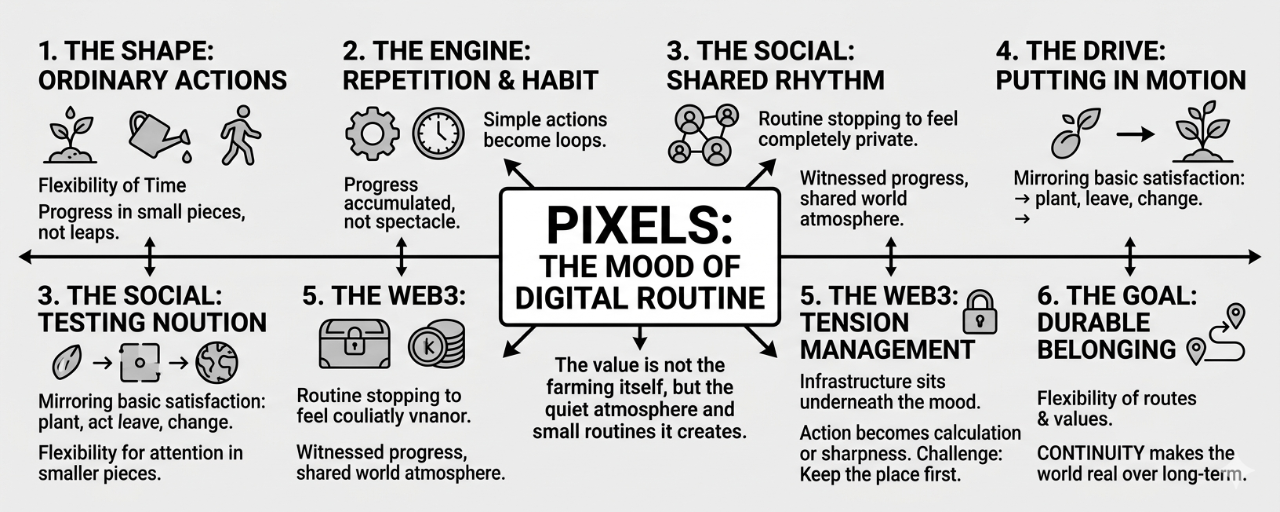
What stands out about Pixels is not really the farming by itself.
إخلاء المسؤولية: تتضمن آراء أطراف خارجية. ليست نصيحةً مالية. يُمكن أن تحتوي على مُحتوى مُمول. اطلع على الشروط والأحكام.