
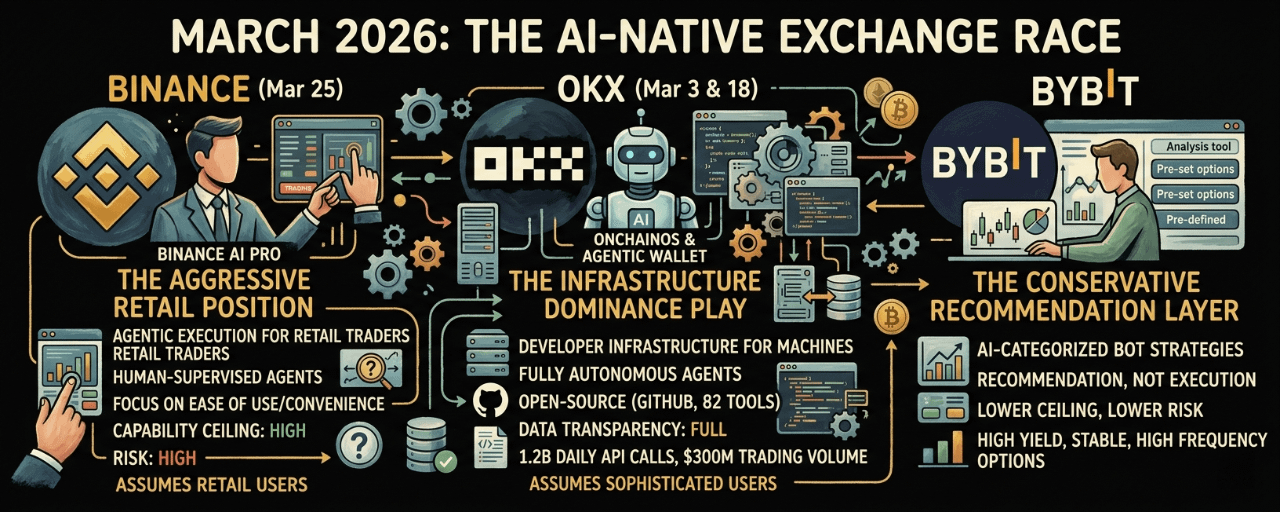
Binance AI Pro launched on March 25, 2026. That timing wasn't coincidental. OKX had launched its AI-focused OnchainOS upgrade on March 3, 2026, and followed it with the OKX Agentic Wallet on March 18. The race to become the AI-native exchange was already running when Binance stepped onto the track.
Understanding Binance AI Pro without understanding what its competitors launched in the same window is understanding a product in isolation from the competitive context that shaped it.
OKX's approach is architecturally different from Binance's and the difference is meaningful. OKX built OnchainOS as developer infrastructure. The AI layer unifies wallet infrastructure, liquidity routing, and on-chain data feeds so that AI agents, not just users, can operate across more than 60 blockchains and 500-plus decentralized exchanges. By March 18, OKX had added the Agentic Wallet, a product purpose-built for AI agents to hold assets and execute on-chain transactions autonomously, with private keys protected inside a Trusted Execution Environment so that LLMs cannot directly access the seed phrases even while signing transactions.
OKX's thesis is that the primary users of blockchain infrastructure in 2028 will be machines, not humans. OnchainOS is infrastructure for those machines. It already processed 1.2 billion daily API calls and roughly $300 million in trading volume as of the March launch, numbers that reflect developer adoption rather than retail user adoption.
Binance AI Pro's thesis is different. It's retail-first. The user is a human making decisions who wants AI assistance. The agentic infrastructure serves the human's configured intent. OKX's agentic infrastructure can serve human-configured agents or fully autonomous agents with minimal human supervision. These are different product philosophies with different risk profiles and different user models.
Bybit's AI offering, Aurora AI, operates on a more conservative model: AI-categorized bot strategy recommendations grouped by backtested behavior into high yield, stable, and high frequency categories. Bybit uses AI to help users choose from pre-built strategies rather than to create custom ones. The AI is a recommendation layer, not an execution agent. The capability ceiling is lower and so is the failure surface.
What does this competitive landscape tell you about where Binance AI Pro sits?
It tells you that Binance chose the most aggressive retail position in the exchange-native AI race. More capable than Bybit's recommendation layer, more human-supervised than OKX's developer-facing agentic infrastructure. Binance AI Pro is the product that most directly gives retail traders access to agentic execution without requiring them to understand agent architecture.
That position is the highest-reward and highest-risk spot in the competitive landscape. The users it serves are the largest population: retail traders who want AI assistance without technical complexity. The failure modes are the most visible: retail users misconfiguring AI-executed strategies in a live trading environment, at scale, on the world's largest exchange. If Binance AI Pro works well, it captures a market that OKX's developer-centric product and Bybit's conservative recommendation layer both miss. If it produces significant retail losses at scale, the reputational and regulatory consequences are more severe than they would be for either competitor's approach.
The OKX comparison is particularly instructive on one dimension: data transparency. OKX's Agent Trade Kit is fully open-source and available on GitHub. The 82 tools across seven modules are publicly auditable. The security model, local-first credential storage, permission-aware registration, is publicly documented. OKX's approach assumes sophisticated users who want full transparency and control. Binance AI Pro assumes retail users who want abstraction and convenience. Neither assumption is wrong. But the transparency gap is real.
As of April 2026, the AI exchange race is three to four weeks old in its most current form. The products launched in March are all in early stages. The competitive dynamics will shift as user adoption data accumulates, as features are added or abandoned, and as the regulatory environment for agentic trading clarifies. Which exchange's AI bet pays off depends on which user population grows fastest, which product architecture proves most resilient under real-world trading conditions, and whether the regulatory environment leans toward or against the more aggressive retail agentic approaches. Binance's bet is on retail scale. OKX's bet is on infrastructure dominance. Both bets are live simultaneously, and neither has produced a verdict yet.
@Binance Vietnam $XAU #BinanceAIPro
Trading always involves risk. AI-generated topics are not financial advice. Past performance does not reflect future performance. Please check product availability in your region.