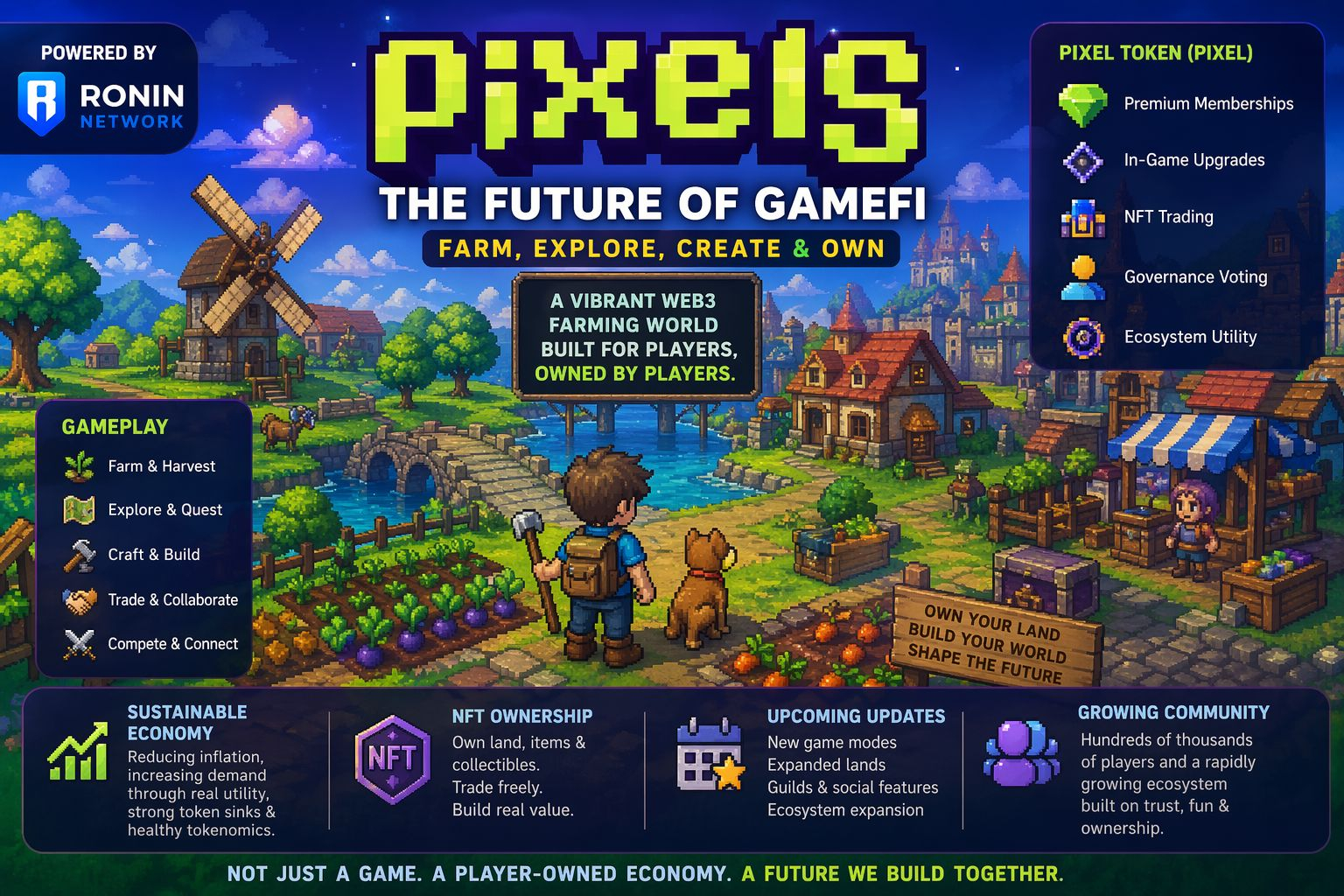
In Web3 gaming, it’s easy to get caught up in flashy promises. Every month, a new project claims it will “revolutionize GameFi,” but only a few are actually building something players want to return to every day. That’s what makes Pixels (PIXEL) stand out.
Pixels isn’t trying to sell players a dream built on speculation—it’s creating a living, growing world where gameplay, community, and digital ownership actually work together. It combines the familiar comfort of social farming games with the real ownership and economic freedom of Web3, offering a glimpse into what the future of GameFi could look like when the focus shifts from hype to sustainability.
At first glance, Pixels feels welcoming and simple: plant crops, gather resources, explore the world, complete quests, and build your digital farm. But beneath that relaxing gameplay loop is an ecosystem designed with much bigger ambitions. Every action in the game contributes to a broader player-driven economy where time, creativity, and strategy all carry real value.
That’s where Pixels begins to separate itself from traditional games. In most online games, players spend countless hours building assets they never truly own. In Pixels, your progress has meaning beyond the game itself. Through blockchain technology, players gain ownership over valuable in-game assets, from land and resources to unique collectibles. That ownership creates a stronger connection between the player and the world they help build.
This experience is powered by the Ronin Network, one of the most recognized gaming blockchains in Web3. Ronin gives Pixels the speed and affordability needed for a smooth gaming experience—fast transactions, low fees, and infrastructure built specifically for blockchain games. For players, this means the benefits of Web3 without the usual friction that often scares away mainstream users.
At the center of this ecosystem is the PIXEL token, and unlike many GameFi tokens that exist mainly for speculation, PIXEL has real utility woven directly into the game. It can be used for premium memberships, unlocking exclusive perks, upgrading assets, accessing special features, and eventually participating in governance decisions. This gives the token a real purpose inside the ecosystem, making demand naturally tied to player activity.
That kind of utility matters because sustainable economies are the foundation of any successful Web3 game. The biggest challenge in GameFi has never been attracting players—it has been keeping the economy alive after the hype fades. Too many projects rely on endless token emissions, rewarding users in ways that create inflation but no lasting demand. The result is predictable: token value drops, player motivation declines, and the ecosystem weakens.
Pixels is taking a smarter route.
Instead of depending solely on token rewards, the project is building strong utility sinks that encourage players to spend tokens within the ecosystem. Memberships, crafting upgrades, asset progression, and premium in-game mechanics all create organic demand for PIXEL. This helps reduce inflation while strengthening the in-game economy. It’s a model designed not just for growth, but for durability.
That long-term thinking extends to the project’s roadmap. Pixels is steadily expanding its ecosystem with new features, richer progression systems, and broader gameplay opportunities. Planned updates such as enhanced social mechanics, expanded land functionality, deeper guild systems, and new interactive experiences are all designed to make the world more engaging while increasing the utility of the PIXEL token.
These updates are important because the future of GameFi won’t be built on “play-to-earn” alone. It will be built on ecosystems where players stay because the game is fun, and where the economy works because the token has real value inside the world. Pixels appears to understand this balance better than many of its competitors.
Another reason Pixels has momentum is its community. Great ecosystems are not built by technology alone—they are built by the people who believe in them. Pixels has managed to attract a player base that is not only growing but actively engaged. Casual gamers are drawn in by the accessible gameplay, while Web3 users are attracted by the ownership model and economic potential. That mix creates a powerful network effect: the more active the community becomes, the stronger the ecosystem grows.
This is where the bigger vision becomes clear.
Pixels is not simply building a farming game on the blockchain—it is helping redefine what digital economies can become. It is proving that Web3 games can be social, enjoyable, economically meaningful, and sustainable at the same time. That combination is exactly what GameFi has been missing.
For years, the industry has talked about the future of player ownership, decentralized economies, and community-driven ecosystems. Pixels is turning those ideas into something practical—an ecosystem where entertainment and economic participation coexist naturally.
And that is why Pixels matters.
Because the future of GameFi will not belong to the loudest projects. It will belong to the projects that build real economies, real communities, and real reasons for players to stay. Pixels (PIXEL) is quietly doing exactly that.
If the next chapter of Web3 gaming belongs to projects that combine fun, ownership, and sustainable design, then Pixels is not just part of that future—it may be leading it.