For a long time, Web3 gaming has felt like an industry full of promises that never quite matched reality. The idea itself has always been exciting—games where players truly own their assets, participate in the economy, and benefit from the value they help create. On paper, it sounded like the future. But in practice, most projects struggled to deliver anything beyond short-term hype.
Too often, the focus was placed on tokens before gameplay. Communities formed around rewards instead of enjoyment, and once the incentives slowed down, so did the players. It created a cycle where games attracted attention quickly but failed to build the kind of long-term engagement that real gaming ecosystems need.
That is why Pixels (PIXEL) has started to stand out.
What makes Pixels interesting is that it does not feel like a project built around token speculation. It feels like a game first—one designed to keep players engaged through progression, interaction, and a world that feels active. The blockchain layer exists to strengthen the experience, not to define it. That difference may be exactly why Pixels has managed to capture so much attention in the GameFi space.
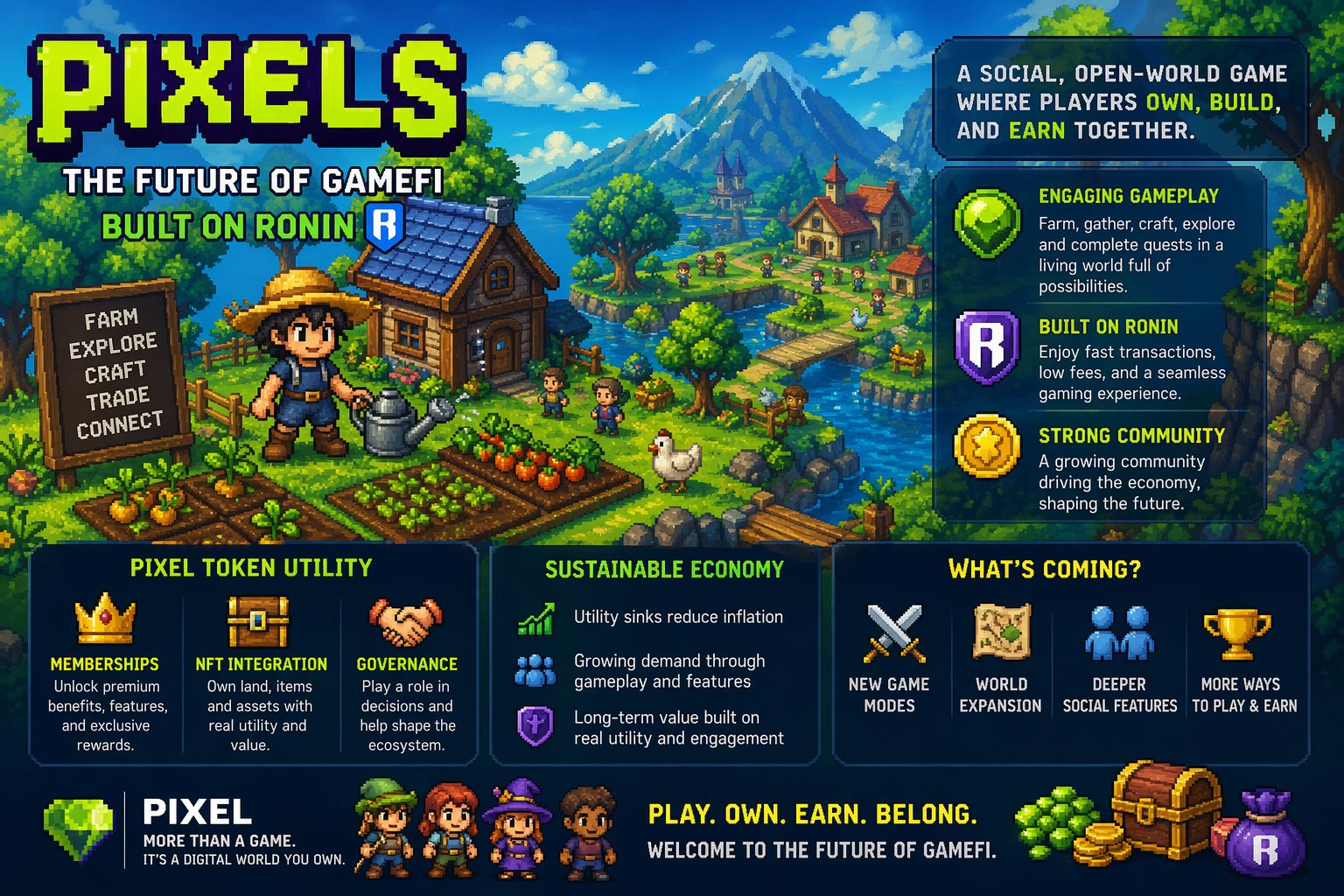
At the center of Pixels is a social open world where players can farm, gather resources, explore, craft, and interact with others. The gameplay is casual and easy to understand, but it creates a loop that keeps players involved. There is always something to work toward, whether that means upgrading resources, managing land, trading assets, or simply progressing through the world.
That sense of progression matters more than many people realize. The strongest games are the ones that make players feel connected to what they are building, and Pixels leans into that. Instead of making users feel like they are simply collecting rewards, it gives them a sense that their time in the ecosystem has meaning. That emotional connection is what creates retention, and retention is where real long-term value begins.
Another reason Pixels has gained momentum is the network it is built on. By launching on the Ronin Network, the project benefits from infrastructure that was designed specifically for blockchain gaming. Fast transactions and low fees may sound like technical details, but for players they make a huge difference. No one wants to deal with expensive fees or slow interactions while trying to enjoy a game.
Ronin removes much of that friction, making the experience feel smooth and accessible even for users who are not deeply familiar with crypto. That ease of use matters because the future of Web3 gaming depends on reaching players beyond the crypto-native crowd. A game can have great tokenomics and strong features, but if the experience feels complicated, mainstream adoption becomes difficult. Pixels seems to understand that, which is one reason its ecosystem feels more scalable than many others.
The PIXEL token also plays an important role, but not in the way many GameFi tokens have in the past. Instead of existing purely as a reward mechanism, PIXEL has real utility within the ecosystem. It can be used for premium memberships, in-game benefits, NFT interactions, and eventually governance features that allow the community to have a voice in the future of the platform.
That kind of utility is critical because sustainable ecosystems need consistent demand. In many earlier GameFi models, tokens were distributed faster than they were used, creating constant sell pressure and weakening the economy over time. Pixels appears to be taking a more balanced approach by giving players reasons to spend and use the token inside the game.
This creates a healthier economic loop. As players use PIXEL for memberships, upgrades, and other utilities, demand is generated through participation rather than speculation alone. That kind of demand is far more valuable because it is tied directly to player activity. The stronger the in-game utility becomes, the stronger the economy can become with it.
This is one of the most important reasons Pixels feels promising. It is trying to build an economy that works because players are engaged, not because rewards are temporarily high. That may sound simple, but it is one of the hardest problems in GameFi, and very few projects have managed to address it effectively.
The community surrounding Pixels is another sign that the project is moving in the right direction. Strong communities do not form just because of incentives—they form when players find value in the ecosystem itself. Pixels has managed to create an environment where interaction matters, where users feel part of something growing, and where participation adds to the overall momentum of the game.
This kind of engagement creates powerful network effects. As more players join, the social layer becomes stronger, the economy becomes more active, and the ecosystem becomes more valuable for everyone inside it. That is how successful gaming ecosystems scale. Growth feeds utility, utility feeds engagement, and engagement feeds further growth.
Looking ahead, Pixels appears to be building toward something much larger than a simple farming game. With plans for expanded gameplay systems, new features, and deeper economic mechanics, the project is gradually turning into a broader digital ecosystem. Each update adds new layers of utility and increases the ways players can interact with the world.
That long-term direction matters because the future of GameFi will likely belong to projects that create lasting digital economies rather than short-term reward systems. The projects that survive will be the ones that give players ownership, meaningful progression, and reasons to stay beyond token incentives.
Pixels seems to be moving toward that future.
It is still early, and no GameFi project is guaranteed success, but Pixels is showing signs of a model that could actually work at scale. It combines accessible gameplay, efficient infrastructure, real token utility, and a growing community—all the elements that GameFi has needed in order to mature.
For an industry that has often overpromised and underdelivered, that alone is significant.
Pixels may not just be another blockchain game trying to capture attention. It may be an example of what happens when a project focuses on building a world players genuinely want to be part of, while using Web3 technology to strengthen that experience.