
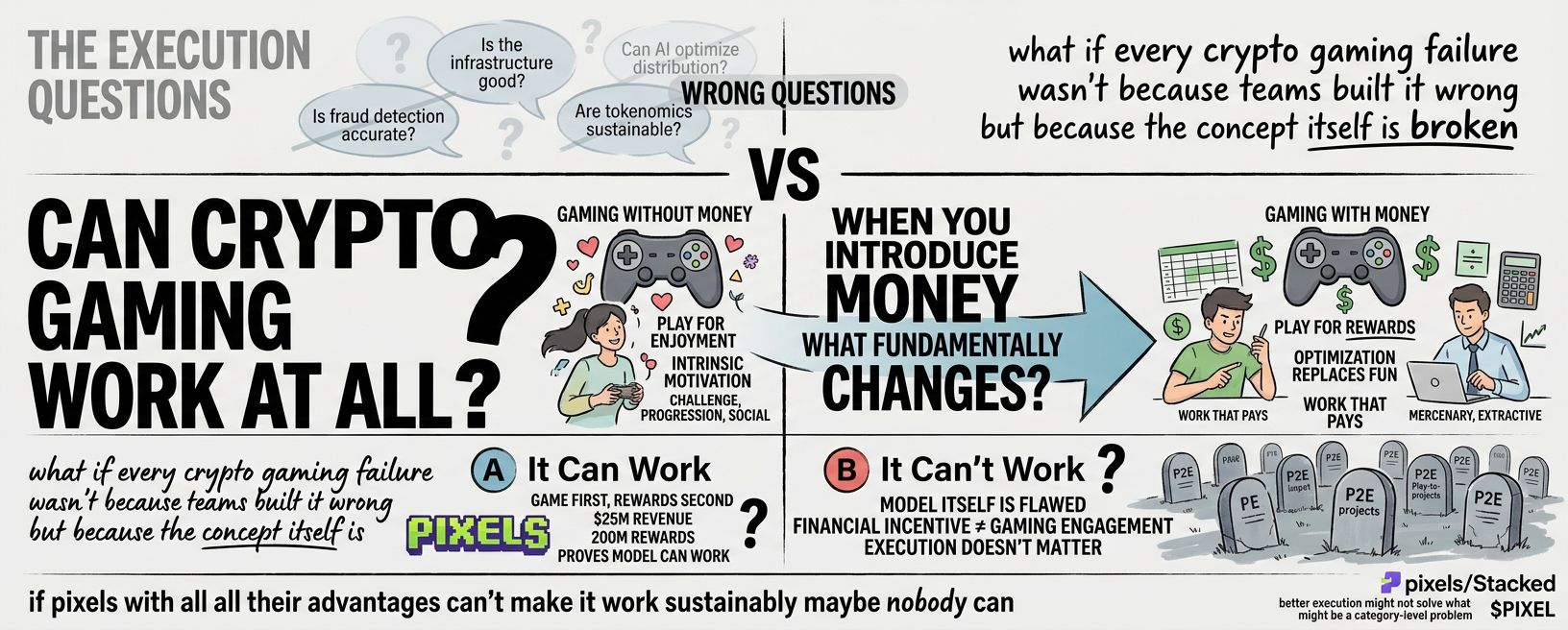
I keep watching @Pixels and trying to figure out if I'm asking the wrong question by focusing on whether Stacked's infrastructure is good enough when the real question might be whether crypto gaming can work at all regardless of infrastructure quality.
What I'm watching isn't whether Pixels built better systems than previous attempts. They did. What I'm watching is whether better execution solves a fundamentally flawed model or just delays recognizing that rewarding players to play games doesn't work.
The category viability question in crypto gaming.
Not the execution narrative. The possibility that every crypto gaming failure wasn't because teams built it wrong but because the concept itself is broken. That introducing financial rewards fundamentally changes gaming in ways that can't be fixed.
That's the uncomfortable question most crypto gaming projects don't ask.
Pixels says they solved play-to-earn by building real games first, then adding rewards. By having actual revenue. By using AI to optimize distribution.
All better execution than most attempts. What I can't tell is whether it's solving the right problem.
The challenge is that adding money to gaming changes player behavior. When people play for rewards instead of enjoyment, optimization replaces fun. They treat the game as work that pays rather than entertainment they'd pay for.
Most game designers understand this. That's why traditional games resist real-money rewards. Because they know what happens when you introduce financial incentive.
@Pixels processed 200 million rewards and generated $25 million in revenue. Better metrics than any previous play-to-earn.
What I don't know is whether it proves crypto gaming works or whether it proves Pixels built a good game that happens to have crypto rewards but would work without them.
The distinction matters. If Pixels works because it's fundamentally a good farming game, the crypto rewards are addition not foundation. Players would engage anyway.
If Pixels only works because of crypto rewards, then rewards are the foundation. That's riskier because engagement depends on sustained token value.
Most crypto gaming falls into the second category. Players come for rewards. When rewards diminish, they leave. The game doesn't stand alone.
Maybe Pixels is different. Maybe players genuinely enjoy the game. Maybe the farming mechanics work independent of financial rewards.
Maybe it's not and engagement correlates directly with reward value. Maybe players optimize rather than play.
I'm watching to see which one.
What I'm particularly watching is player behavior when reward rates change. If reduced distribution maintains engagement, that suggests the game works independently. If reduced rewards trigger churn, that suggests players are reward-motivated.
The stakes for crypto gaming as a category depend on this. If Pixels proves games can integrate financial rewards without destroying core engagement, the category has a future. If Pixels proves even best-in-class execution results in reward-dependent engagement, the category might be fundamentally flawed.
Most crypto gaming assumes execution is the problem. Better tokenomics. Better game design. Better anti-farming. All execution improvements.
What if execution isn't the problem. What if the model itself conflicts with what makes games engaging. What if financial motivation and intrinsic enjoyment are fundamentally opposed in ways infrastructure can't bridge.
Traditional games create engagement through challenge, progression, social interaction. Players engage because the activity is inherently rewarding.
Crypto games add external financial rewards. That changes motivation structure. Players optimize for financial return. That optimization can destroy intrinsic rewards.
Maybe Stacked's AI can balance this. Maybe sophisticated reward design maintains both intrinsic and extrinsic motivation.
Maybe you can't and every crypto game eventually faces the choice between rewarding players enough to maintain engagement or protecting token value by limiting rewards.
If Pixels with all their advantages can't make it work sustainably, that's significant evidence about category viability. If they hit fundamental limits, those limits probably exist for everyone.
I'd prefer crypto gaming works. I'd prefer Stacked proves you can integrate financial rewards without destroying engagement.
I'm just not convinced infrastructure improvements solve what might be a category-level problem about whether financial incentives and gaming engagement are compatible long-term.
The category question's fundamental. You can build perfect infrastructure. If the underlying model doesn't work, execution quality is irrelevant.
And honestly, I trust teams that question whether the category makes sense more than teams that assume better execution solves everything.
