
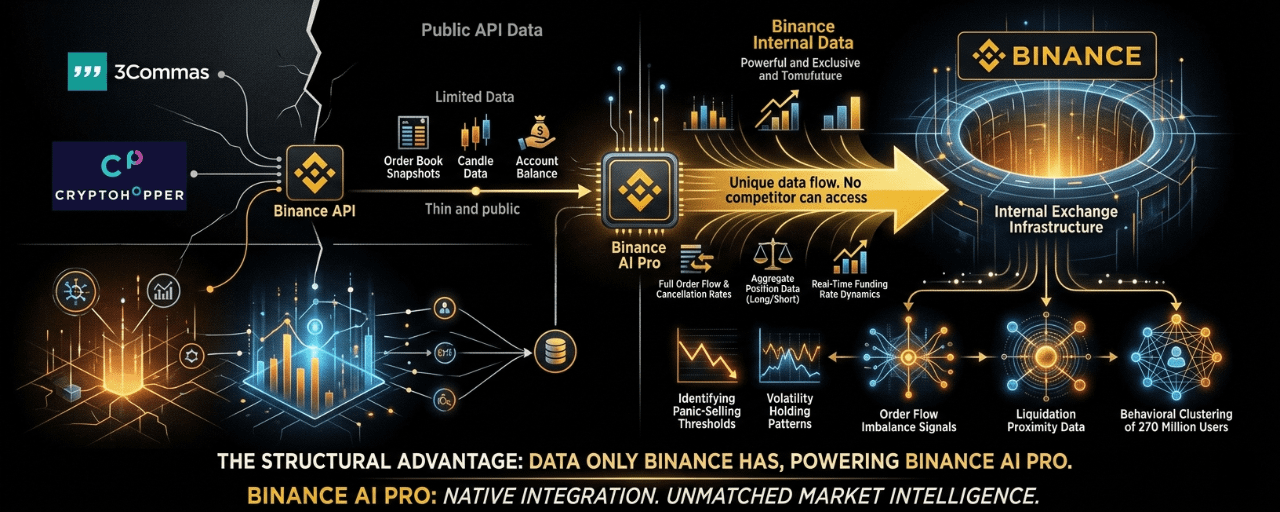
When 3Commas or Cryptohopper executes a strategy on Binance via API, it sees what the API exposes: order book snapshots, recent trade history, candle data, account balance, position status. That data is real, it's live, and it's the same data available to any connected application with API credentials.
It is not all the data Binance has.
Binance's exchange infrastructure generates and retains data that is never published through any API and not available to any external tool. The full internal order flow, including distribution of order sizes, timing patterns, and cancellation rates across Binance's full user population. The aggregate position data showing what fraction of Binance's users are long or short on any given asset at any given moment. The funding rate dynamics as they develop in real time across perpetual markets. The relationship between retail order flow and price movement, built from years of transaction-level history across hundreds of millions of accounts.
Binance AI Pro, as a native product of the exchange itself, is the only AI trading tool that could, in principle, access this data. That is its structural advantage over every competitor.
The specific forms this advantage takes are worth tracing concretely.
Order flow imbalance signals. Professional traders pay significant fees for order flow data. Quantitative funds analyze whether the aggregate orders in a market weight toward buying or selling pressure, at what price levels, and with what urgency. Binance sees this natively across its full user base in real time. If Binance AI Pro's market analysis draws on this data, its signal landscape is fundamentally different from any external model working from public candle closes and volume bars. 3Commas, Cryptohopper, and OKX's Agent Trade Kit cannot replicate this regardless of how sophisticated their models become.
Liquidation proximity data. When leveraged positions inside Binance approach margin call thresholds, Binance knows before the liquidation hits the public feed, because the breach has already occurred internally. The distribution of approaching liquidations across user accounts is internal Binance data. An analysis model with access to aggregate liquidation-proximity signals could anticipate cascade dynamics that external models can only infer from price behavior after the cascade begins. Binance AI Pro, running inside the exchange that holds this data, is the only retail product where this capability is architecturally possible.
Behavioral clustering across the user base. Binance can observe how its 270 million registered users cluster into behavioral archetypes. Which user populations hold through volatility. Which panic-sell at specific drawdown thresholds. Which strategy types accumulate most heavily before a major move. Combined with Binance AI Pro's real-time execution data from its own AI Account user base, this behavioral intelligence creates a feedback loop that no external tool — regardless of the quality of its AI models — can replicate.
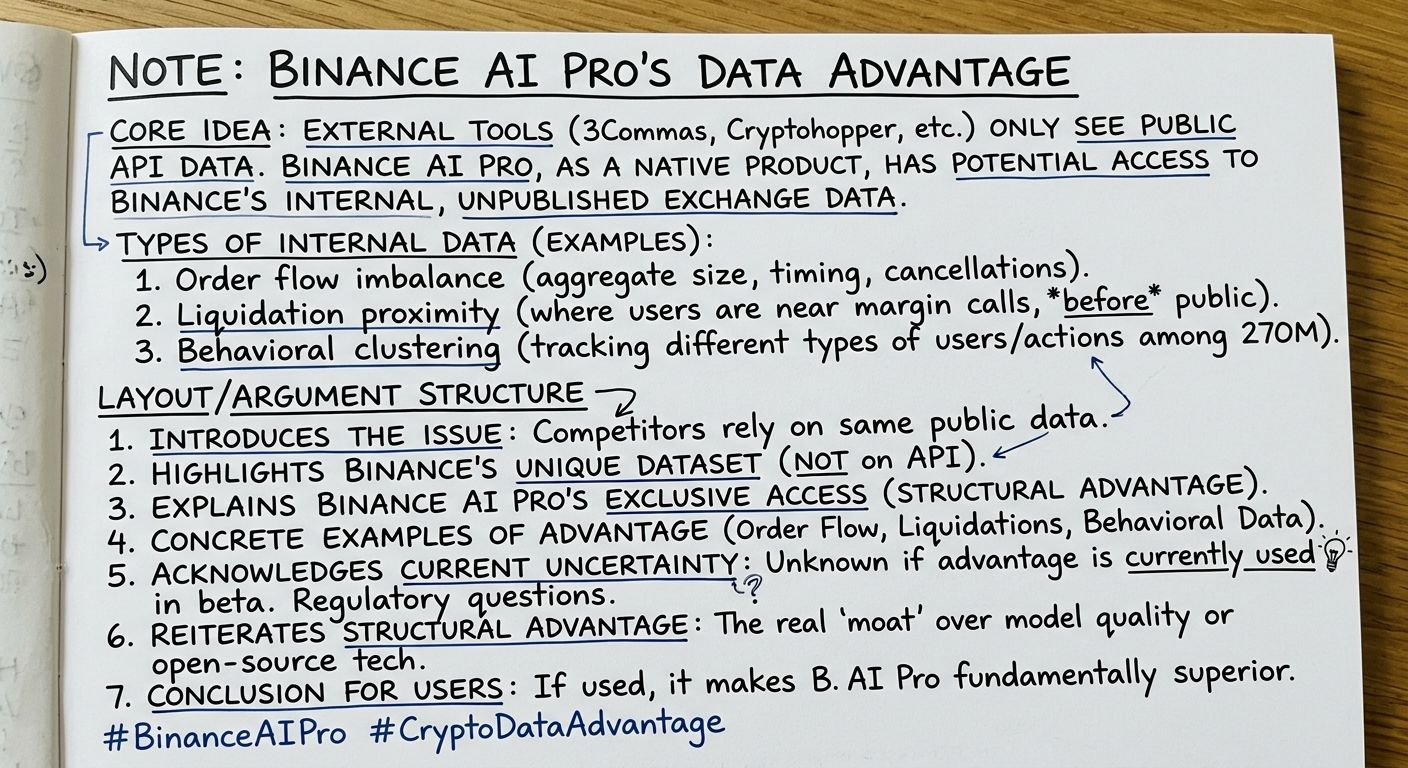
To be clear, I do not know which of these data advantages Binance AI Pro currently accesses. The product documentation does not specify what data sources feed Binance AI Pro's analysis beyond "market analysis" and Binance AI Skills using the platform's native data connections. It is possible that in the current beta, Binance AI Pro is operating on a relatively standard market data feed augmented by the on-chain queries available through the Skills Hub — the same basic data any external tool can reach. It is also possible that some form of Binance's internal data advantage is already flowing through Binance AI Pro's analysis and users have no way to know.
What is structural, regardless of current implementation, is that Binance can choose to incorporate that advantage into Binance AI Pro at any point. The data exists. The infrastructure is native. The question is whether Binance's product team decides to use it, and whether doing so raises regulatory concerns about information asymmetry between Binance AI Pro users and the broader market.
For users evaluating whether Binance AI Pro is genuinely better than a third-party tool, the data advantage question is the most important unresolved issue. If Binance AI Pro's analysis derives from the same data any external API subscriber can access, the case for native integration rests primarily on convenience and credit economy. If Binance AI Pro draws on Binance's proprietary order flow intelligence, it is structurally superior to any external competitor in ways that cannot be closed regardless of model quality.
That structural advantage, if it materializes, is the real moat — not OpenClaw, which is open source and available to anyone, and not the five AI engines, which competitors can also integrate. The moat is data that only exists because Binance is the world's largest exchange by volume, and that data becomes more valuable as the exchange grows. The fact that this advantage is currently implicit rather than explicit in Binance AI Pro's positioning is itself a notable signal about how Binance is choosing to frame the product in beta.
@Binance Vietnam $XAU #BinanceAIPro
Trading always involves risk. AI-generated topics are not financial advice. Past performance does not reflect future performance. Please check product availability in your region.