
A lot of projects can say that. What stands out is that it seems to have forced its team to deal with a harder question than most games want to face early on.
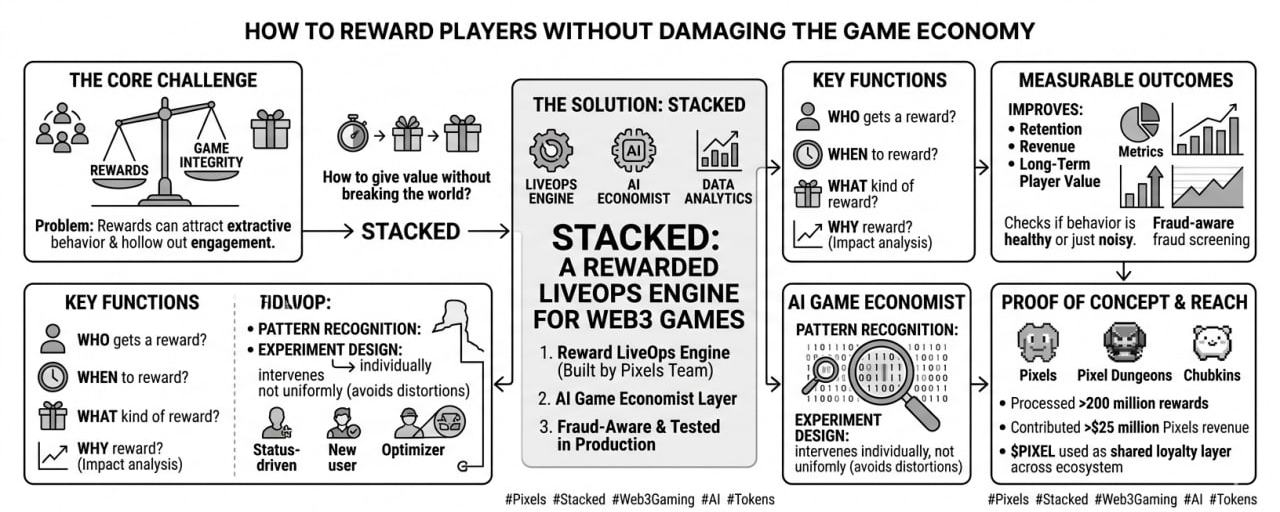
How do you reward players without slowly damaging the thing they came for?
That sounds obvious, but it usually is not. At first, rewards feel simple. Give people a reason to come back. Give them something to earn. Let them feel progress. But after a while, the shape of the problem changes. You start noticing that rewards do not just attract players. They also attract behavior. Some of that behavior is healthy. Some of it is empty. Some of it is outright extractive.
That is usually where game economies start to get blurry.
@Pixels , because it is built around farming, exploration, creation, and social play, depends a lot on rhythm. People need reasons to return, but those reasons cannot feel mechanical for too long. If every loop becomes about extraction, the world starts to lose its texture. The game may still look alive from the outside, but something underneath it starts thinning out.
And that seems to be the context in which Stacked makes sense.
Stacked is basically the system that grew out of trying to manage those tensions in a live environment. Not in theory. Not as a side experiment. Just as a response to what operating a game like Pixels actually teaches you over time.
The cleanest way to describe it is probably this: Stacked is a rewarded LiveOps engine, built by the Pixels team, with an AI game economist layered into it. It helps game studios run reward campaigns in a more deliberate way. Who should get a reward. When should they get it. What kind of reward actually helps. And then, importantly, whether any of it improved retention, revenue, or long-term player value.
That last part matters more than people sometimes admit.
A lot of reward systems stop at distribution. They can send value into a game, but they cannot really tell you what that value did afterward. So teams end up looking at surface metrics, hoping they mean something deeper. More activity. More claims. More short bursts of participation. But that does not always tell you whether the game became healthier or just noisier.
Stacked seems built around that distinction. It is not only about handing out rewards. It is about measuring whether those rewards changed player behavior in a useful way.
You can usually tell when a system was built by people who have already been burned by the easy version of the idea. There is a certain restraint in it. It stops chasing the appearance of growth and starts asking whether the incentives are creating the wrong habits underneath.
That feels relevant here because web3 gaming has already gone through a long phase of overpromising on rewards. Most people have seen how that story goes. A game offers too much too fast. The wrong users arrive. Bots move in. Genuine players get crowded out. The economy becomes something to farm instead of something to participate in. Then the reward layer, which was supposed to deepen engagement, starts hollowing it out.
So the fact that Stacked comes from the Pixels team is probably not a branding detail. It is the main reason it exists at all. They went through the messy part. They had to deal with economies under pressure. They had to learn what kinds of incentives survive contact with real players and what kinds collapse into abuse.
That is why it makes more sense to think of Stacked less as a feature and more as infrastructure.
It already powers Pixels, #pixel Dungeons, and Chubkins. So this is not a case where the product story is ahead of the product itself. The system is already live. It has processed more than 200 million rewards across the ecosystem. And the broader Stacked-powered systems have contributed to over $25 million in Pixels revenue.
That revenue figure does something useful. It grounds the conversation. It becomes less about whether the idea sounds smart and more about whether it has already produced outcomes inside a real business. That shifts the tone. It makes the whole thing easier to look at without hype.
The AI game economist part is also easier to understand if you avoid imagining something overly dramatic. This does not need to mean some all-knowing machine running the economy by itself. It is more practical than that. The role seems to be pattern recognition and experiment design. Looking across player behavior, finding moments where intervention might matter, and suggesting tests worth running.
And honestly, that is where AI probably becomes useful in games anyway. Not as a replacement for judgment, but as a tool for seeing patterns at a scale humans struggle to track cleanly. Especially in economies where players move differently, spend differently, churn for different reasons, and respond to rewards in ways that are rarely uniform.
One player may need a reward to stay engaged in the first week. Another may only respond when the reward has status attached to it. Another may already be too optimized, too close to the edge of exploitative behavior. If you treat all those players the same, the reward system starts creating distortions. If you treat them differently, the game has a better chance of holding its shape.
That is where $PIXEL becomes more interesting too.
Inside this setup, PIXEL is not just sitting there as the token of one single game. It is being used more like a shared rewards and loyalty layer across an ecosystem. That changes the frame. Instead of being confined to one title, it becomes part of a broader relationship between player, game, and network. A kind of connective asset moving across different experiences.
Of course, that only works if the system around it is stable enough. Otherwise you just spread the same weaknesses across more games. But if the reward engine is already fraud-aware, tested in production, and tied to measurable outcomes, then the token starts to feel less ornamental and more functional.
Maybe that is the quieter point in all this.
Pixels is easy to describe as a game. Stacked is harder to describe because it is really the byproduct of operating that game long enough to see where the cracks form. It is what shows up when the team stops asking how to reward players more, and starts asking how to reward them without breaking the world they are in.
That is a different angle. A more patient one. And it probably explains more than the usual pitch does.